. 2000 Jul 1;14(13):1578-83.

Transgene-mediated cosuppression in the C. elegans germ line

Affiliations

Transgene-mediated cosuppression in the C. elegans germ line

A F Dernburg et al. Genes Dev. .

Abstract

Functional silencing of chromosomal loci can be induced by transgenes (cosuppression) or by introduction of double-stranded RNA (RNAi). Here, we demonstrate the generality of and define rules for a transgene-mediated cosuppression phenomenon in the Caenorhabditis elegans germ line. Functional repression is not a consequence of persistent physical association between transgenes and endogenous genes or of mutations in affected genes. The cosuppression mechanism likely involves an RNA mediator that defines its target specificity, reminiscent of RNAi. Cosuppression is strongly abrogated in rde-2 and mut-7 mutants, but is not blocked in an rde-1 mutant, indicating that cosuppression and RNAi have overlapping but distinct genetic requirements.


Figures
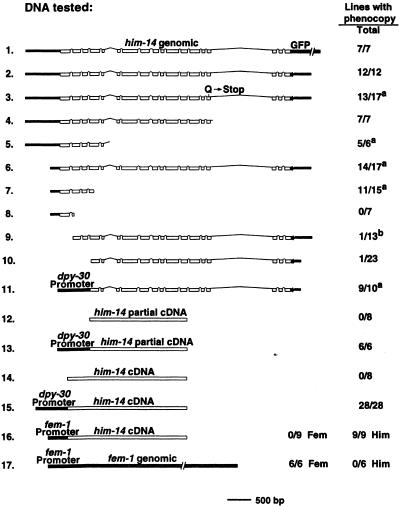
Figure 1
Figure 1
Induction of him-14 phenocopy by transgene arrays. DNAs tested for their ability to elicit a Him (1–17) or Fem (16–17) phenocopy are shown (see Materials and Methods for details). For each DNA, we indicate the number of transgenic lines that exhibited phenocopy/total number of lines obtained. Except where noteda, phenocopy was assessed both in the germ lines of the founding transgenic F1 hermaphrodites and in the germ lines of their progeny. For DNAs that efficiently induced Him phenocopy, most lines (72%–100%) exhibited phenocopy immediately in the germ lines of the F1; where tested, the remainder showed Him phenocopy in the F2 generation. a Phenocopy was not assessed subsequent to the F1 generation for these lines. b A partial Him phenocopy was observed in this line.
Figure 2
Figure 2
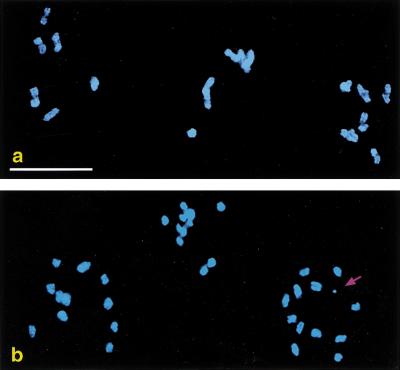
spo-11 phenocopy induced by a transgene array. (a) Three wild-type oocyte nuclei at the end of meiotic prophase. Each contains six bivalents, representing the six pairs of homologous chromosomes linked by chiasmata. (b) Same stage from an animal carrying a transgene array with many copies of the spo-11(+) gene. Loss of function of this gene has resulted in the absence of chiasmata. In some nuclei, one or more extrachromosomal arrays (arrow) are observed in addition to the 12 univalent chromosomes. Bar, 10 μm.
Figure 3
Figure 3
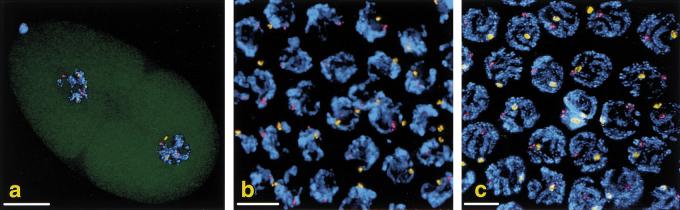
Absence of pairing between a transgene array and the affected chromosomal locus. The subnuclear location of extrachromosomal arrays and the affected chromosomal loci were examined using FISH. (Yellow) Hybridization to the array; (magenta) chromosome region containing the spo-11 locus. (a) A two-cell embryo; a projection through the nuclei is superimposed on an image of green autofluorescence to show the embryo's outline. The condensed nucleus at the anterior pole is the polar body. The posterior P1 cell (lower right) gives rise to the adult germ line. In each of the two interphase nuclei, both chromosomal loci are detected, as well as either two or three arrays. (b, c) Nuclei in early meiotic prophase and mid-prophase (pachytene), respectively. In each nucleus, the two homologous chromosomal loci are paired with each other (resulting in a single focus of hybridization) but are not associated with the extrachromosomal arrays. Due to mitotic instability, some nuclei do not contain arrays (b), yet the loss of gene function affects all nuclei. Bar in a, 10 μm; in b and c, 5 μm.

References

    1. Cogoni C, Macino G. Conservation of transgene-induced post-transcriptional gene silencing in plants and fungi. Trends Plant Sci. 1997;2:438–443.
    1. ————— Gene silencing in Neurospora crassa requires a protein homologous to RNA-dependent RNA polymerase. Nature. 1999;399:166–169. - PubMed
    1. Cogoni C, Irelan JT, Schumacher M, Schmidhauser TJ, Selker EU, Macino G. Transgene silencing of the al-1 gene in vegetative cells of Neurospora is mediated by a cytoplasmic effector and does not depend on DNA–DNA interactions or DNA methylation. EMBO J. 1996;15:3153–3163. - PMC - PubMed
    1. Dernburg AF, Sedat JW. Mapping three-dimensional chromosome architecture in situ. In: Berrios M, editor. Nuclear Structure and Function. San Diego: Academic Press; 1998. pp. 187–233. - PubMed
    1. Dernburg AF, Broman KW, Fung JC, Marshall WF, Philips J, Agard DA, Sedat JW. Perturbation of nuclear architecture by long-distance chromosome interactions. Cell. 1996;85:745–759. - PubMed

Publication types

LinkOut - more resources