


Early adult outcomes of adolescent binge drinking: person- and variable-centered analyses of binge drinking trajectories
- PMID: 10888080
- PMCID: PMC1847635
Early adult outcomes of adolescent binge drinking: person- and variable-centered analyses of binge drinking trajectories
Abstract
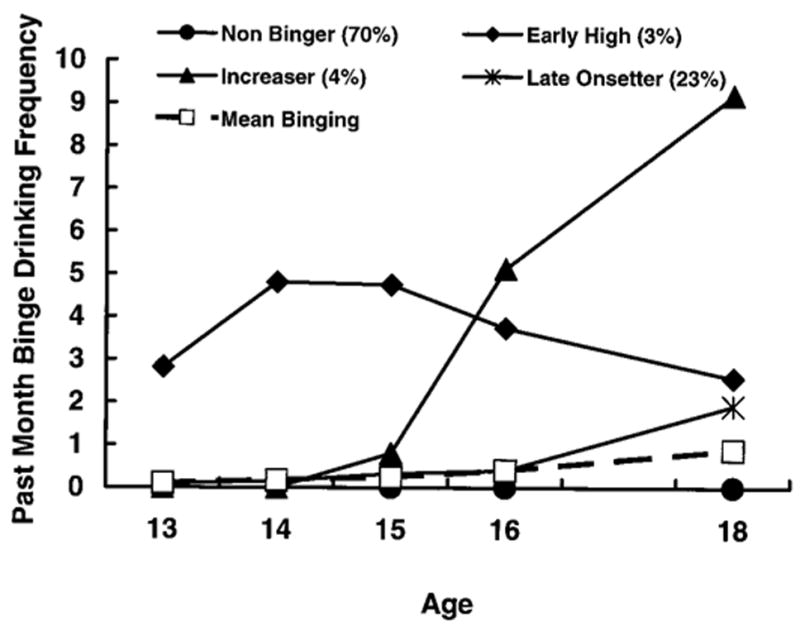
Background: Many studies of the consequences of binge drinking take a variable-centered approach that may mask developmentally different trajectories. Recent studies have reported qualitatively different binge drinking trajectories in young adulthood. However, analyses of developmental trajectories of binge drinking have not been examined for an important period of drinking development: adolescence. The purpose of this study was to examine young adult outcomes of adolescent binge drinking using an approach that combines person-centered and variable-centered methods.
Methods: Data were from the Seattle Social Development Project, an ethnically diverse, gender balanced sample (n = 808) followed prospectively from age 10 to age 21. Semiparametric group-based modeling was used to determine groups of binge drinking trajectories in adolescence. Logistic regression was used to examine how well the trajectory groups predicted young adult outcomes after demographics, childhood measures, and adolescent drug use were considered.
Results: Four distinct trajectories of binge drinking during adolescence were identified: Early Highs, Increasers, Late Onsetters, and Nonbingers. These trajectories significantly predicted positive and negative outcomes in adulthood after controlling for demographic characteristics, early proxy measures of the outcome, and adolescent drug use.
Conclusions: This integrated person- and variable-centered approach provides more information about the effects of specific patterns of binge drinking than studies that employ variable-centered methods alone.
Figures
References
-
- Achenbach TM. Integrative Guide for the 1991 CBCL/4–18:YSR, and TRF Profiles. University of Vermont, Department of Psychiatry; Burlington, VT: 1991.
-
- American Psychiatric Association. Diagnostic and Statistical Manual of Mental Disorders. 4. American Psychiatric Association; Washington, DC: 1994.
-
- Anthony JC, Warner LA, Kessler RC. Comparative epidemiology of dependence on tobacco, alcohol, controlled substances, and inhalants: Basic findings from the National Comorbidity Survey. In: Marlatt GA, VandenBos GR, editors. Addictive Behaviors: Readings on Etiology, Prevention, and Treatment. American Psychological Association; Washington, DC: 1997. pp. 3–39.
-
- Bartusch DRJ, Lynam DR, Moffitt TE, Silva PA. Is age important? Testing a general versus developmental theory of antisocial behavior. Criminology. 1997;35:13–48.
-
- Bates ME. Integrating person-centered and variable-centered approaches to the study of developmental courses and transitions in alcohol use: Introduction to the Special Section. Alcohol Clin Exp Res. 2000;24:878–881. - PubMed
Publication types
MeSH terms
Grants and funding
LinkOut - more resources
Full Text Sources
Medical
