. 2000 Aug;74(15):7171-8.
doi: 10.1128/jvi.74.15.7171-7178.2000.

Structural determinants of murine leukemia virus reverse transcriptase that affect the frequency of template switching

Affiliations

Structural determinants of murine leukemia virus reverse transcriptase that affect the frequency of template switching

E S Svarovskaia et al. J Virol. 2000 Aug.

Abstract

Retroviral reverse transcriptases (RTs) frequently switch templates within the same RNA or between copackaged viral RNAs to generate mutations and recombination. To identify structural elements of murine leukemia virus RT important for template switching, we developed an in vivo assay in which RT template switching within direct repeats functionally reconstituted the green fluorescent protein gene. We quantified the effect of mutations in the YXDD motif, the deoxynucleoside triphosphate binding site, the thumb domain, and the RNase H domain of RT and hydroxyurea treatment on the frequencies of template switching. Hydroxyurea treatment and some mutations in RT increased the frequency of RT template switching up to fivefold, while all of the mutations tested in the RNase H domain decreased the frequency of template switching by twofold. Based on these results, we propose a dynamic copy choice model in which both the rate of DNA polymerization and the rate of RNA degradation influence the frequency of RT template switching.


Figures
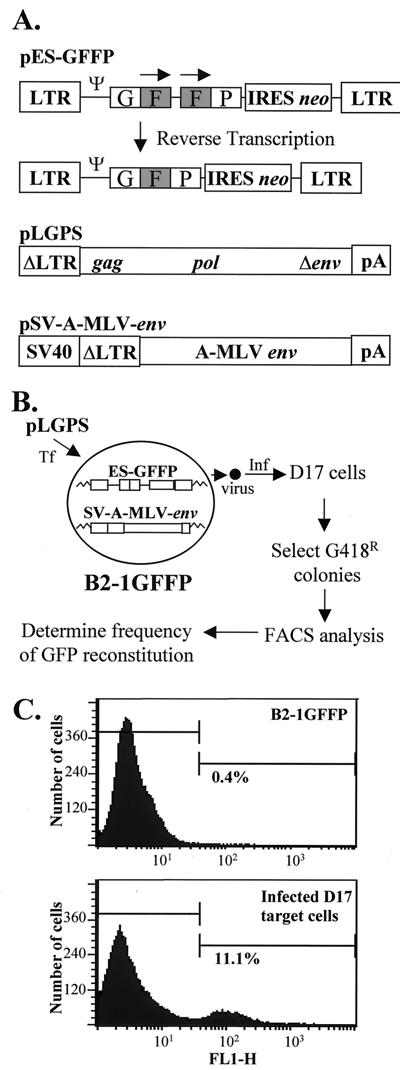
FIG. 1
FIG. 1
Structures of MLV-based constructs and direct repeat deletion assay to identify structural determinants of MLV RT important for template switching. (A) Structures of MLV-based vector pES-GFFP, pLGPS, and pSV-A-MLV-env. The pES-GFFP vector contains LTRs and all of the cis-acting elements of MLV. GFFP and neo are transcribed from the LTR promoter. The IRES of encephalomyocarditis virus is used to express neo. The directly repeated F portion of GFP is shaded and indicated by overhead arrows. During reverse transcription, the repeated F portion may be deleted to reconstitute a functional GFP. The pLGPS construct expresses MLV gag and pol from a truncated viral LTR. The pSV-A-MLV-env construct expresses the amphotropic MLV envelope from a truncated MLV LTR and the simian virus 40 (SV40) promoter enhancer. Ψ, MLV packaging signal. (B) Experimental protocol. B2-1GFFP, a D17-based cell line expressing pES-GFFP and pSV-A-MLV-env, was constructed. The wild-type and mutated pLGPS constructs were separately cotransfected (Tf) with pSVα3.6 into B2-1GFFP cells, and the virus produced was used to infect (Inf) D17 cells. The infected cell clones resistant to G418 were analyzed by FACS, and frequencies of direct repeat deletion were determined. (C) The top graph shows FACS analysis of B2-1GFFP cells. The bottom graph shows FACS analysis of D17 target cells infected with virus collected from B2-1GFFP cells transfected with wild-type pLGPS and selected for G418 resistance.
FIG. 2
FIG. 2
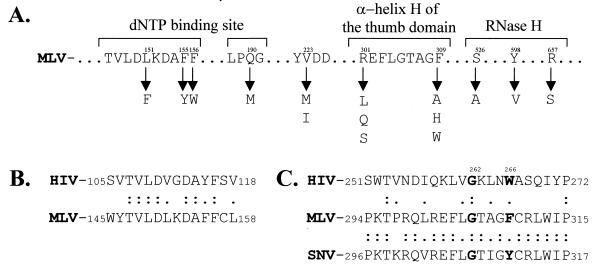
Mutant forms of MLV RT. (A) Selected regions of the MLV RT primary sequence containing the dNTP-binding site, the YXDD motif, the α-helix H of the thumb domain, and RNase H. The numbers above the primary sequence indicate the amino acid positions in the primary sequence. The substitution mutations analyzed at each amino acid position are indicated below the primary sequence with downward arrows. (B) Primary sequence alignment of the MLV and HIV-1 RT dNTP-binding sites. Double dots represent identical amino acids, whereas single dots represent conserved amino acids. The numbers indicate amino acid positions in the primary sequence. (C) Primary sequence alignment of the α-helix H of the HIV-1 RT thumb domain and corresponding sequences in the MLV and SNV RTs.
FIG. 3
FIG. 3
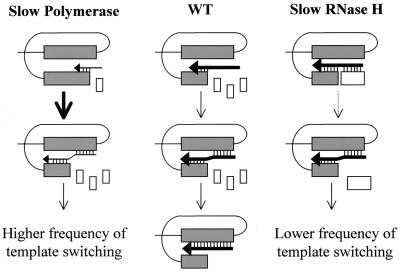
Dynamic copy choice model for RT template switching. Shaded boxes represent direct repeats in an RNA template. Horizontal arrows represent nascent DNA. The thickness of these arrows indicates the relative polymerization rate; the thicker the arrow, the higher the rate of polymerization. Small open boxes represent RNA degraded by the RNase H domain. In the case of slow RNase H activity, the degraded RNA fragments are shown as larger open boxes. Hydrogen bonds between the RNA template and nascent DNA are designated by vertical marks. Vertical arrows of various thicknesses indicate the relative efficiency of template switching. WT, wild type.

References

    1. Bavand M R, Wagner R, Richmond T J. HIV-1 reverse transcriptase: polymerization properties of the p51 homodimer compared to the p66/p51 heterodimer. Biochemistry. 1993;32:10543–10552. - PubMed
    1. Beard W A, Bebenek K, Darden T A, Li L, Prasad R, Kunkel T A, Wilson S H. Vertical-scanning mutagenesis of a critical tryptophan in the minor groove binding track of HIV-1 reverse transcriptase. Molecular nature of polymerase-nucleic acid interactions. J Biol Chem. 1998;273:30435–30442. - PubMed
    1. Beard W A, Minnick D T, Wade C L, Prasad R, Won R L, Kumar A, Kunkel T A, Wilson S H. Role of the “helix clamp” in HIV-1 reverse transcriptase catalytic cycling as revealed by alanine-scanning mutagenesis. J Biol Chem. 1996;271:12213–12220. - PubMed
    1. Beard W A, Stahl S J, Kim H R, Bebenek K, Kumar A, Strub M P, Becerra S P, Kunkel T A, Wilson S H. Structure/function studies of human immunodeficiency virus type 1 reverse transcriptase. Alanine scanning mutagenesis of an alpha-helix in the thumb subdomain. J Biol Chem. 1994;269:28091–28097. - PubMed
    1. Bebenek K, Beard W A, Casas-Finet J R, Kim H R, Darden T A, Wilson S H, Kunkel T A. Reduced frameshift fidelity and processivity of HIV-1 reverse transcriptase mutants containing alanine substitutions in helix H of the thumb subdomain. J Biol Chem. 1995;270:19516–19523. - PubMed

Publication types

LinkOut - more resources