Review
. 1999;23(2):151-60.

Relapse prevention. An overview of Marlatt's cognitive-behavioral model

Affiliations
Review

Relapse prevention. An overview of Marlatt's cognitive-behavioral model

M E Larimer et al. Alcohol Res Health. 1999.

Abstract

Relapse prevention (RP) is an important component of alcoholism treatment. The RP model proposed by Marlatt and Gordon suggests that both immediate determinants (e.g., high-risk situations, coping skills, outcome expectancies, and the abstinence violation effect) and covert antecedents (e.g., lifestyle factors and urges and cravings) can contribute to relapse. The RP model also incorporates numerous specific and global intervention strategies that allow therapist and client to address each step of the relapse process. Specific interventions include identifying specific high-risk situations for each client and enhancing the client's skills for coping with those situations, increasing the client's self-efficacy, eliminating myths regarding alcohol's effects, managing lapses, and restructuring the client's perceptions of the relapse process. Global strategies comprise balancing the client's lifestyle and helping him or her develop positive addictions, employing stimulus control techniques and urge-management techniques, and developing relapse road maps. Several studies have provided theoretical and practical support for the RP model.


Figures
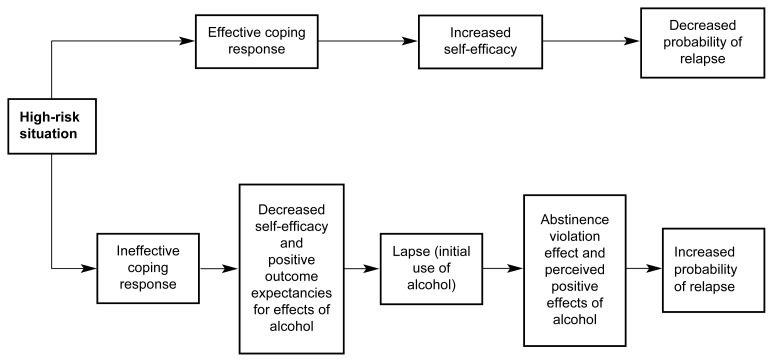
Figure 1
Figure 1
The cognitive-behavioral model of the relapse process posits a central role for high-risk situations and for the drinker’s response to those situations. People with effective coping responses have confidence that they can cope with the situation (i.e., increased self-efficacy), thereby reducing the probability of a relapse. Conversely, people with ineffective coping responses will experience decreased self-efficacy, which, together with the expectation that alcohol use will have a positive effect (i.e., positive outcome expectancies), can result in an initial lapse. This lapse, in turn, can result in feelings of guilt and failure (i.e., an abstinence violation effect). The abstinence violation effect, along with positive outcome expectancies, can increase the probability of a relapse. NOTE: This model also applies to users of drugs other than alcohol.
Figure 2
Figure 2
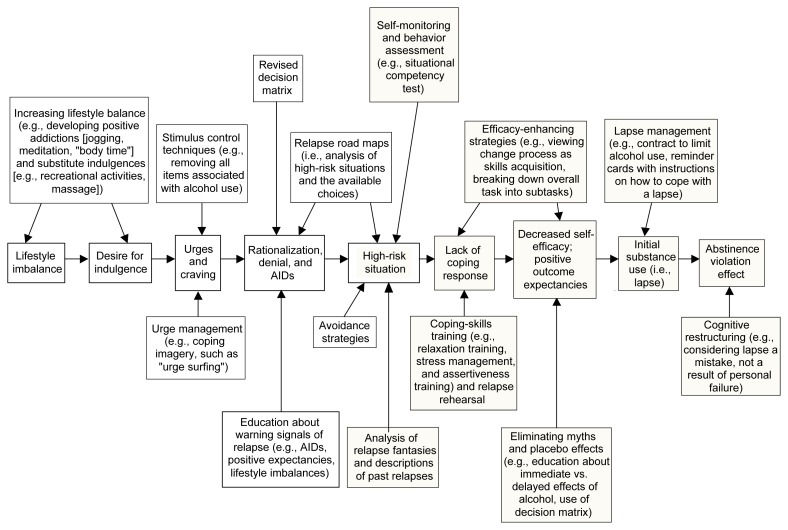
Covert antecedents and immediate determinants of relapse and intervention strategies for identifying and preventing or avoiding those determinants. Lifestyle balance is an important aspect of preventing relapse. If stressors are not balanced by sufficient stress management strategies, the client is more likely to use alcohol in an attempt to gain some relief or escape from stress. This reaction typically leads to a desire for indulgence that often develops into cravings and urges. Two cognitive mechanisms that contribute to the covert planning of a relapse episode—rationalization and denial—as well as apparently irrelevant decisions (AIDs) can help precipitate high-risk situations, which are the central determinants of a relapse. People who lack adequate coping skills for handling these situations experience reduced confidence in their ability to cope (i.e., decreased self-efficacy). Moreover, these people often have positive expectations regarding the effects of alcohol (i.e., outcome expectancies). These factors can lead to initial alcohol use (i.e., a lapse), which can induce an abstinence violation effect that, in turn, influences the risk of progressing to a full relapse. Self-monitoring, behavior assessment, analyses of relapse fantasies, and descriptions of past relapses can help identify a person’s high-risk situations. Specific intervention strategies (e.g., skills training, relapse rehearsal, education, and cognitive restructuring) and general strategies (e.g., relaxation training, stress management, efficacy-enhancing imagery, contracts to limit the extent of alcohol use, and reminder cards) can help reduce the impact of relapse determinants. Shaded boxes indicate steps in the relapse process and intervention measures that are specific to each client and his or her ability to cope with alcohol-related situations. White boxes indicate steps in the relapse process and intervention strategies that are related to the client’s general lifestyle and coping skills. High-risk situations are related to both the client’s general and specific coping abilities.

References

    1. Annis HM. Inventory of Drinking Situations. Toronto, Canada: Addiction Research Foundation; 1982a.
    1. Annis HM. Situational Confidence Questionnaire. Toronto, Canada: Addiction Research Foundation; 1982b.
    1. Annis HM. A relapse prevention model for treatment of alcoholics. In: Miller WR, Heather N, editors. Treating Addictive Behaviors: Processes of Change. New York: Plenum Press; 1986. pp. 407–433.
    1. Annis HM, Davis CS. Assessment of expectancies. In: Donovan DM, Marlatt GA, editors. Assessment of Addictive Behaviors: Behavioral, Cognitive, and Physiological Procedures. New York: Guilford Press; 1988. pp. 198–213.
    1. Bandura A. Self-efficacy: Toward a unifying theory of behavioral change. Psychological Review. 1977;84(2):191–215. - PubMed

Publication types

LinkOut - more resources