


doi: 10.1073/pnas.120176397.
Temperature and length scale dependence of hydrophobic effects and their possible implications for protein folding
Affiliations
- PMID: 10890881
- PMCID: PMC26946
- DOI: 10.1073/pnas.120176397
Item in Clipboard
Temperature and length scale dependence of hydrophobic effects and their possible implications for protein folding
Proc Natl Acad Sci U S A.
.
Abstract
The Lum-Chandler-Weeks theory of hydrophobicity [Lum, K., Chandler, D. & Weeks, J. D. (1999) J. Phys. Chem. 103, 4570-4577] is applied to treat the temperature dependence of hydrophobic solvation in water. The application illustrates how the temperature dependence for hydrophobic surfaces extending less than 1 nm differs significantly from that for surfaces extending more than 1 nm. The latter is the result of water depletion, a collective effect, that appears at length scales of 1 nm and larger. Because of the contrasting behaviors at small and large length scales, hydrophobicity by itself can explain the variable behavior of entropies of protein folding.
Figures
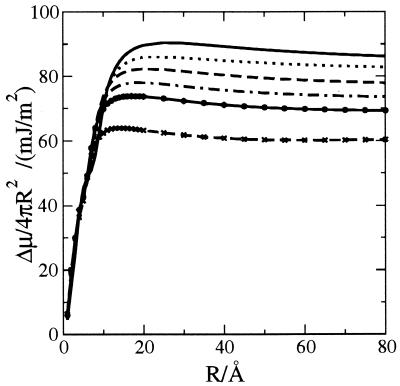
Excess chemical potential, Δμ, per exposed surface area for hard spheres of radius R, calculated by using the LCW theory (11), for temperatures of 277, 298, 323, 348, 373, and 423 K (the plateau decreases with increasing temperature).
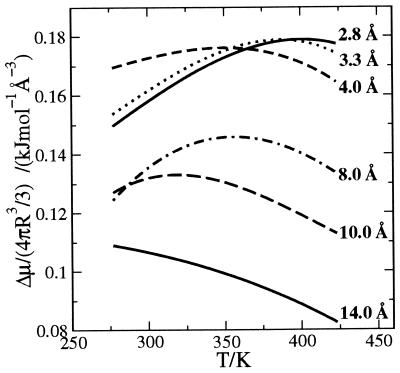
Excess chemical potential per solute volume as a function of temperature (T in Kelvin) for spherical bubbles of different radii (R) as indicated.
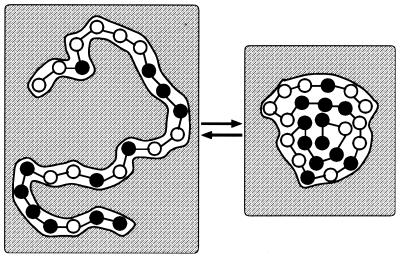
Schematic of protein-folding equilibrium. The black and white circles represent hydrophobic and hydrophilic residues, respectively. The shaded region depicts aqueous solution.
References
-
- Kauzmann W. Adv Protein Chem. 1959;14:1–63. - PubMed
-
- Tanford C. The Hydrophobic Effect—Formation of Micelles and Biological Membranes. New York: Wiley Interscience; 1973.
-
- Murphy K P, Privalov P L, Gill S J. Science. 1990;247:559–561. - PubMed
-
- Privalov P L, Gill S J. Adv Protein Chem. 1988;39:191–234. - PubMed
Publication types
MeSH terms
Substances
LinkOut - more resources
Full Text Sources
Miscellaneous
