


CD40 induces apoptosis in carcinoma cells through activation of cytotoxic ligands of the tumor necrosis factor superfamily
- PMID: 10891490
- PMCID: PMC86001
- DOI: 10.1128/MCB.20.15.5503-5515.2000
CD40 induces apoptosis in carcinoma cells through activation of cytotoxic ligands of the tumor necrosis factor superfamily
Abstract
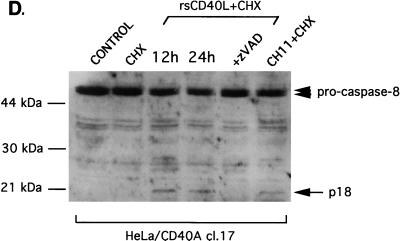
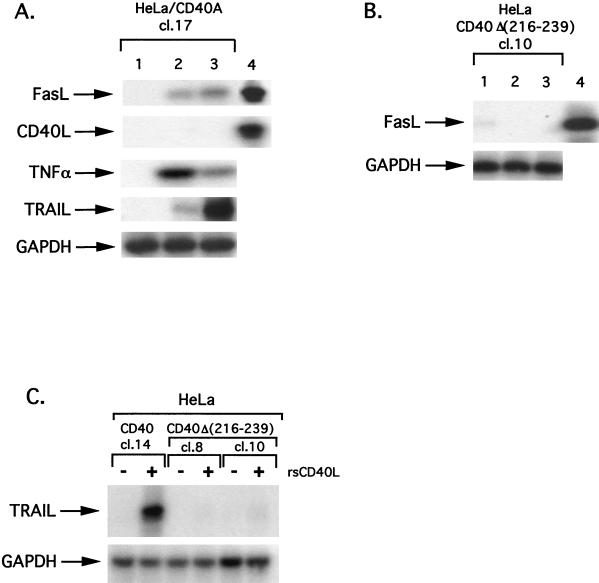
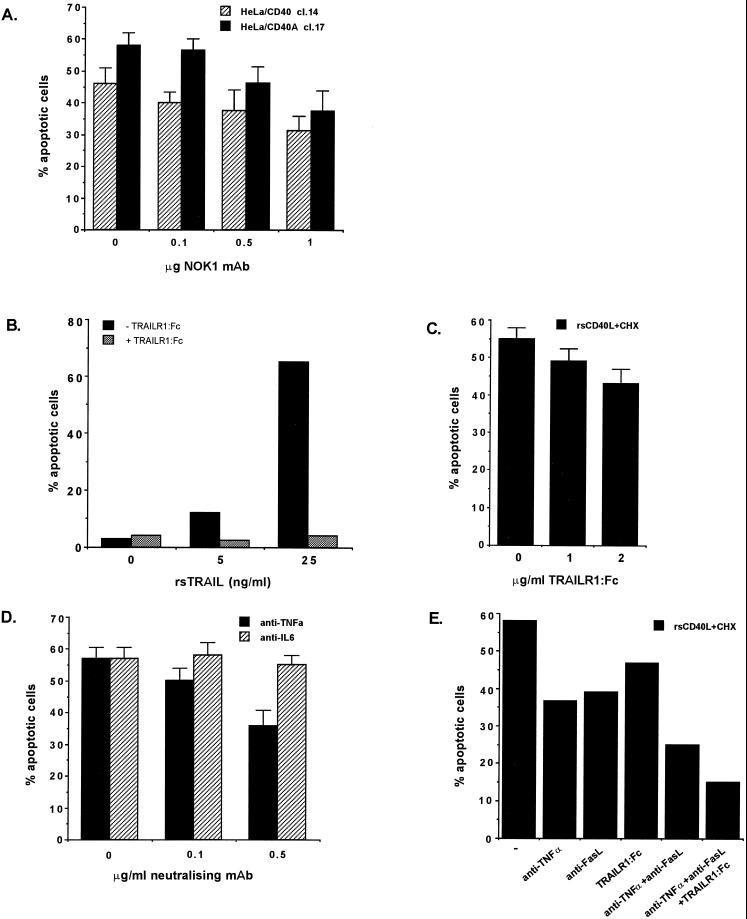
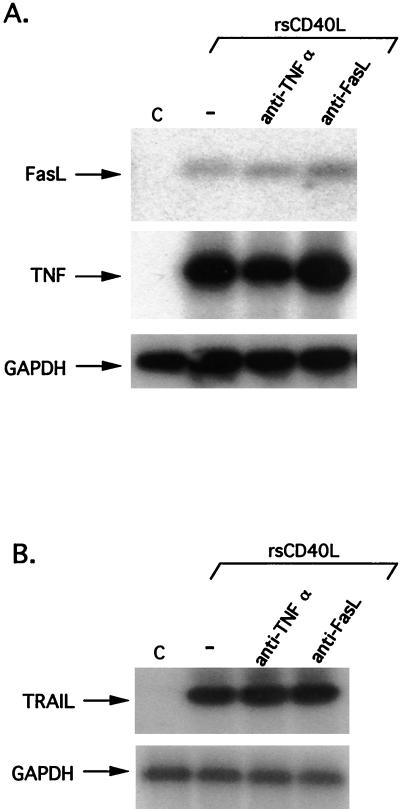
CD40, a tumor necrosis factor (TNF) receptor (TNFR) family member, conveys signals regulating diverse cellular responses, ranging from proliferation and differentiation to growth suppression and cell death. The ability of CD40 to mediate apoptosis in carcinoma cells is intriguing given the fact that the CD40 cytoplasmic C terminus lacks a death domain homology with the cytotoxic members of the TNFR superfamily, such as Fas, TNFR1, and TNF-related apoptosis-inducing ligand (TRAIL) receptors. In this study, we have probed the mechanism by which CD40 transduces death signals. Using a trimeric recombinant soluble CD40 ligand to activate CD40, we have found that this phenomenon critically depends on the membrane proximal domain (amino acids 216 to 239) but not the TNFR-associated factor-interacting PXQXT motif in the CD40 cytoplasmic tail. CD40-mediated cytotoxicity is blocked by caspase inhibitors, such as zVAD-fmk and crmA, and involves activation of caspase 8 and caspase 3. Interestingly, CD40 ligation was found to induce functional Fas ligand, TRAIL (Apo-2L) and TNF in apoptosis-susceptible carcinoma cells and to up-regulate expression of Fas. These findings identify a novel proapoptotic mechanism which is induced by CD40 in carcinoma cells and depends on the endogenous production of cytotoxic cytokines and autocrine or paracrine induction of cell death.
Figures
References
-
- Afford S C, Randhawa S, Eliopoulos A G, Hubscher S G, Young L S, Adams D H. CD40 activation induces apoptosis in cultured human hepatocytes via induction of cell surface Fas ligand expression and amplifies Fas-mediated hepatocyte death during allograft rejection. J Exp Med. 1999;189:441–446. - PMC - PubMed
-
- Baker M P, Eliopoulos A G, Young L S, Armitage R J, Gregory C D, Gordon J. Prolonged phenotypic, functional and molecular changes in group I Burkitt lymphoma cells on short term exposure to CD40 ligand. Blood. 1998;92:2830–2843. - PubMed
-
- Barkett M, Gilmore T D. Control of apoptosis by Rel/NF-κB transcription factors. Oncogene. 1999;18:6910–6924. - PubMed
-
- Blake N, Lee S, Redchenko I, Thomas W, Steven N, Leese A, Steigerwald-Mullen P, Kurilla M G, Frappier L, Rickinson A B. Human CD8(+) T cell responses to EBV EBNA1: HLA class I presentation of the (Gly-Ala)-containing protein requires exogenous processing. Immunity. 1997;7:791–802. - PubMed
-
- Brunet A, Bonni A, Zigmond M J, Lin M Z, Juo P, Hu L S, Anderson M J, Arden K C, Blenis J, Greenberg M E. Akt promotes cell survival by phosphorylating and inhibiting a forkead transcription factor. Cell. 1999;96:857–868. - PubMed
Publication types
MeSH terms
Substances
LinkOut - more resources
Full Text Sources
Other Literature Sources
Research Materials
Miscellaneous
