. 2000 Jul 17;19(14):3739-49.
doi: 10.1093/emboj/19.14.3739.

Cyclophilin A and Ess1 interact with and regulate silencing by the Sin3-Rpd3 histone deacetylase

Affiliations

Cyclophilin A and Ess1 interact with and regulate silencing by the Sin3-Rpd3 histone deacetylase

M Arévalo-Rodríguez et al. EMBO J. .

Abstract

Three families of prolyl isomerases have been identified: cyclophilins, FK506-binding proteins (FKBPs) and parvulins. All 12 cyclophilins and FKBPs are dispensable for growth in yeast, whereas the one parvulin homolog, Ess1, is essential. We report here that cyclophilin A becomes essential when Ess1 function is compromised. We also show that overexpression of cyclophilin A suppresses ess1 conditional and null mutations, and that cyclophilin A enzymatic activity is required for suppression. These results indicate that cyclophilin A and Ess1 function in parallel pathways and act on common targets by a mechanism that requires prolyl isomerization. Using genetic and biochemical approaches, we found that one of these targets is the Sin3-Rpd3 histone deacetylase complex, and that cyclophilin A increases and Ess1 decreases disruption of gene silencing by this complex. We show that conditions that favor acetylation over deacetylation suppress ess1 mutations. Our findings support a model in which Ess1 and cyclophilin A modulate the activity of the Sin3-Rpd3 complex, and excess histone deacetylation causes mitotic arrest in ess1 mutants.


Figures
None
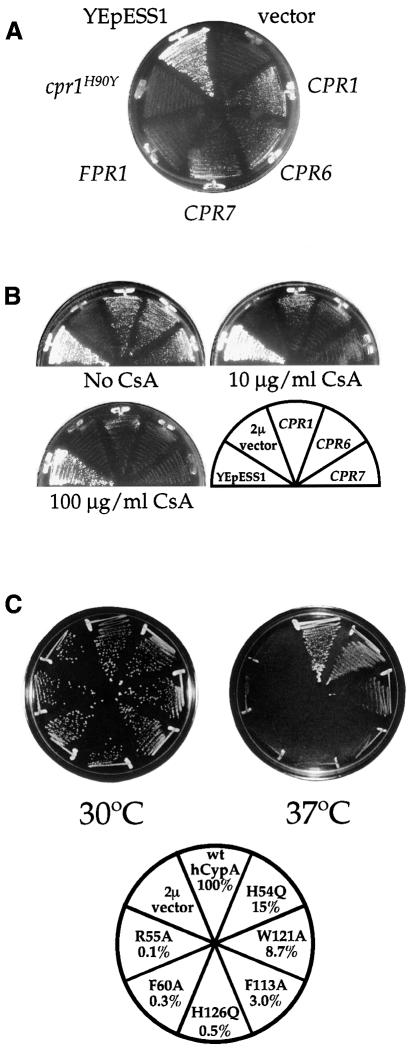
Fig. 1. Cyclophilins suppress ess1ts mutants. (A) The ess1ts mutant strain H164RW303 was transformed with 2µ plasmids expressing no protein (pRS426 vector), the cyclophilins Cpr1 (pTB3), Cpr6 (pKDw10) or Cpr7 (pKS24), FKBP12 (FPR1; plasmid pYJH23), the cyclophilin A active site mutant cpr1H90Y [pCPR1(H90Y)] or Ess1 as a control (YEpESS1). Growth was for 72 h at 37°C. (B) Suppression of ess1ts mutants by cyclophilin A (CPR1) and cyclophilin 40 homologs is CsA sensitive. ess1ts strain H164RW303 transformed with 2µ plasmids expressing CPR1, CPR6 or CPR7 was grown on synthetic dextrose medium–uracil and then transferred to SD–Ura medium with 0, 10 or 100 µg/ml CsA and incubated for 72 h at 35°C. (C) Suppression of ess1 conditional mutants by cyclophilin A requires prolyl isomerase activity. ess1ts mutant H164RW303 was transformed with multicopy plasmids expressing wild-type or active site mutants of human cyclophilin A and growth was tested at 30 and 37°C. The wild-type cyclophilin A gene is indicated as wt hCypA, and the active site mutations and relative level of in vitro prolyl isomerase activity are indicated.
None
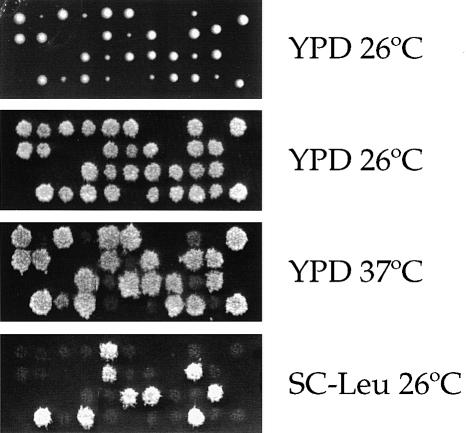
Fig. 2. Cyclophilin A and ess1 mutations are synthetically lethal. The ess1ts/ESS1 cpr1Δ::LEU2/CPR1 diploid strain MAY3 × MH250-2c was sporulated, and tetrads were dissected and incubated on YPD medium at 26°C for 4 days. Viable meiotic segregants were replica-plated to YPD medium at 26 and 37°C to score the ess1ts mutation, and to synthetic medium lacking leucine to score the cpr1Δ::LEU2 cyclophilin A mutation.
None
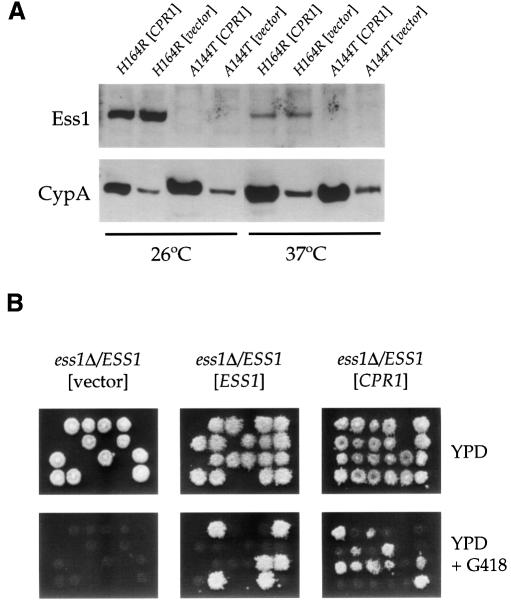
Fig. 3. Cyclophilin A does not stabilize A144T or H164R Ess1 thermolabile mutant proteins, and suppresses an ess1 null mutation. (A) Cells expressing the H164R or A144T Ess1 mutant proteins (strains A144TW303 or H164RW303), and which contained a control plasmid (YEplac195 vector) or a 2µ plasmid (pTB3) overexpressing cyclophilin A (CPR1), were grown at 26°C until log phase, diluted and grown at 26 or 37°C for 12 h. Total protein extracts were analyzed by western blotting with antisera against Ess1 or cyclophilin A (CypA). (B) An ess1Δ::G418/ESS1 diploid strain was transformed with a control 2µ plasmid (vector pRS426), or with 2µ plasmids expressing Ess1 (ESS1) or the cyclophilin A gene CPR1. Strains were sporulated, tetrads dissected and spores germinated on YPD medium at 26°C. Viable segregants were replica-plated to YPD medium containing G418 to score the ess1Δ::G418 mutation, and also to synthetic medium lacking uracil compared with 5-FOA medium (not shown) to detect the plasmid-borne URA3 gene.
None
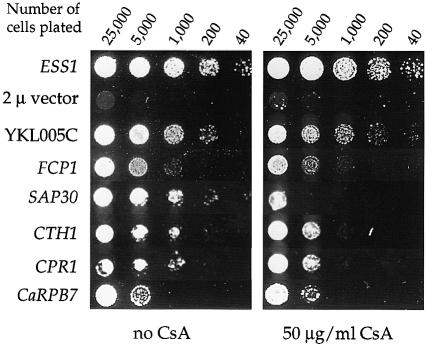
Fig. 4. Cyclosporin A blocks suppression of ess1ts mutations by Sap30 and Cth1. An ess1ts mutant strain (H164RW303) containing a control plasmid (vector pRS426) or plasmids expressing ESS1 or the multicopy suppressors YKL005C, FCP1, SAP30, CTH1, CPR1 or CaRPB7 were 5-fold serially diluted, spotted on SD–Ura medium lacking (no CsA) or containing 50 µg/ml CsA, and incubated at 37°C for 3 days.
None
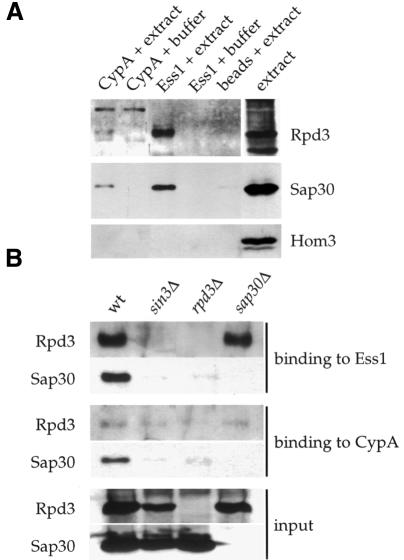
Fig. 5. Cyclophilin A and Ess1 physically interact with protein complexes containing Rpd3 and Sap30. (A) Yeast extracts from strain W303-1A transformed with a plasmid expressing a V5 epitope-tagged form of Sap30 (pYMR263W) were incubated with Affigel alone (beads) or coupled to cyclophilin A (CypA) or Ess1. Bound proteins were eluted and analyzed by western blotting with antisera against Rpd3 or the V5 epitope (Sap30). (B) Yeast extracts from wild-type (W303-1A), sin3Δ (MAY6) or rpd3Δ (MAY7) strains transformed with pYMR263W, or from an untransformed sap30Δ strain (MAY8), were incubated with Affigel-coupled cyclophilin A or Ess1, and the bound proteins analyzed as in (A). The lower panel shows western blot analysis of the protein extracts used in these experiments; proteins were resolved and analyzed as in (A) and (B).
None
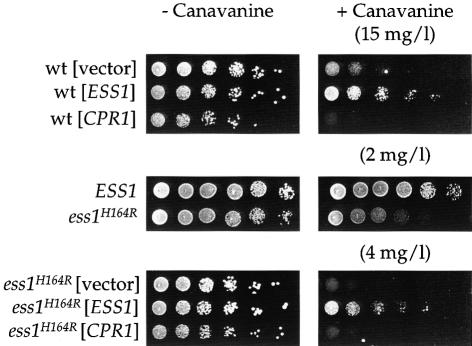
Fig. 6. Ess1 and cyclophilin A modulate silencing at the rDNA array. A wild-type (wt) yeast strain (CFY559) containing the ADE2-CAN1 double marker integrated in the rDNA array, or isogenic ESS1 (MAY23) and ess1H164R (MAY22) strains, were transformed with 2µ plasmids encoding ESS1 (YEpESS1) or CPR1 (pTB3), or with an empty vector (YEplac195) as a control. Cells were 5-fold serially diluted, spotted on SD–Ade medium containing l-canavanine, and incubated for 48 h at 30°C.
None
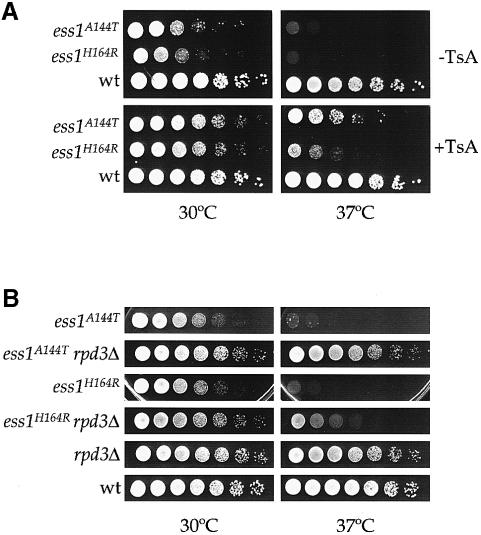
Fig. 7. Rpd3 mediates the mitotic phenotype of ess1 conditional mutants. (A) Isogenic ess1A144T (MAY1), ess1H164R (MAY3) and ESS1 wt (JK9-3dα) strains were 5-fold serially diluted and spotted on YPD with or without 13 µM trichostatin A (TsA) and incubated for 48 h at 30 or 37°C. (B) Yeast strains ess1A144T (MAY12-7d), ess1A144T rpd3Δ (MAY12-7b), ess1H164R (MAY16-5c), ess1H164R rpd3Δ (MAY16-2c), rpd3Δ (MAY12–5b) and wt (JK9-3dα) were 5-fold serially diluted, spotted on YPD and incubated for 48 h at 30 or 37°C.
None
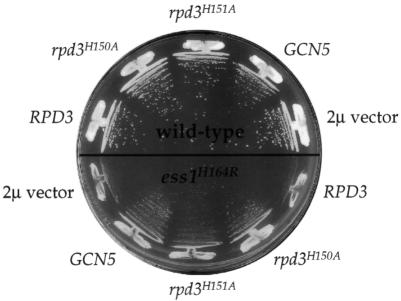
Fig. 8. Overexpression of Gcn5 or dominant-negative alleles of RPD3 suppresses an ess1 conditional mutation. Temperature-sensitive ess1 strain H164RW303 (ess1H164R) or wild-type strain W303-1A was transformed with 2µ plasmids expressing RPD3 (YEplac112-RPD3), rpd3H150A (YEplac112-RPD3-H150A), rpd3H151A (YEplac112-RPD3-H151A) or GCN5 (Yep10PGK-exp-ScGCN5), or with an empty plasmid, and tested for growth at 35°C.
None
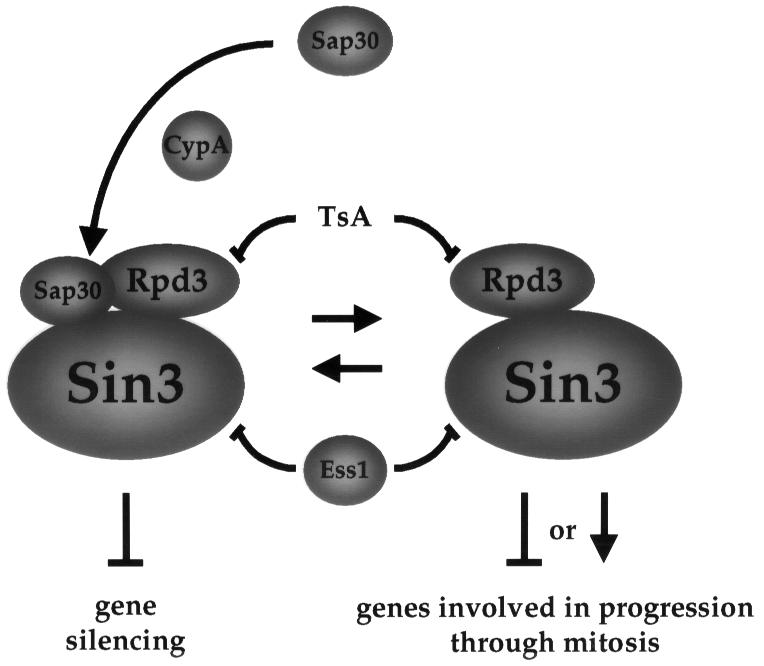
Fig. 9. Model for the mechanism of suppression of ess1 mutations by CypA and Sap30. In this model, Ess1 is a negative modulator of the Sin3–Rpd3 complex, which in turn functions as a global transcriptional regulator. In ess1 mutants, hyperactive Sin3–Rpd3 complexes deregulate expression of genes involved in cell cycle control, causing mitotic arrest. Cyclophilin A (CypA) recruits Sap30 to the complex, reduces activity with mitotic targets and suppresses cell cycle arrest of ess1 mutants.

References

    1. Albert A., Lavoie,S. and Vincent,M. (1999) A hyperphosphorylated form of RNA polymerase II is the major interphase antigen of the phosphoprotein antibody MPM-2 and interacts with the peptidyl-prolyl isomerase Pin1. J. Cell Sci., 112, 2493–2500. - PubMed
    1. Anfinsen C.B. (1973) Principles that govern the folding of protein chains. Science, 181, 223–230. - PubMed
    1. Baker E.K., Colley,N.J. and Zuker,C.S. (1994) The cyclophilin homolog NinaA functions as a chaperone, forming a stable complex in vivo with its protein target rhodopsin. EMBO J., 13, 4886–4895. - PMC - PubMed
    1. Brillantes A.-M.B. et al. (1994) Stabilization of calcium release channel (ryanodine receptor) function by FK506-binding protein. Cell, 77, 513–523. - PubMed
    1. Bryk M., Banerjee,M., Murphy,M., Knudsen,K.E., Garfinkel,D.J. and Curcio,M.J. (1997) Transcriptional silencing of Ty1 elements in the RDN1 locus of yeast. Genes Dev., 11, 255–269. - PubMed

Publication types

MeSH terms