


Calcium imaging demonstrates colocalization of calcium influx and extrusion in fly photoreceptors
- PMID: 10900015
- PMCID: PMC26990
- DOI: 10.1073/pnas.97.15.8578
Calcium imaging demonstrates colocalization of calcium influx and extrusion in fly photoreceptors
Abstract
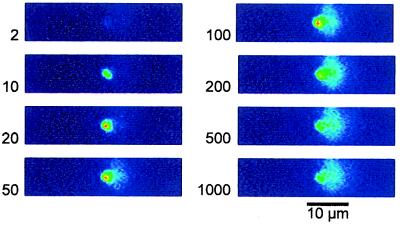
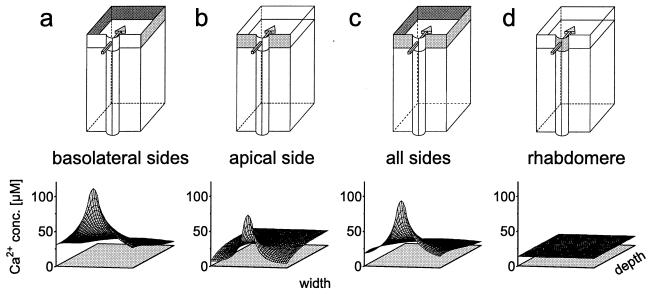
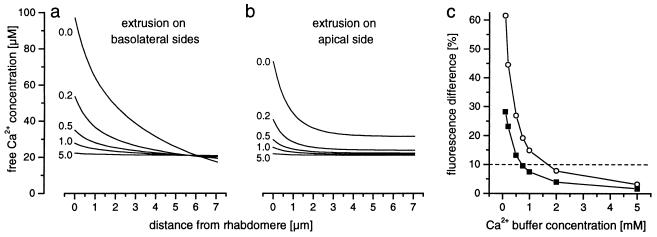
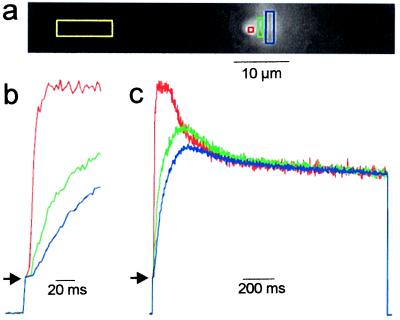
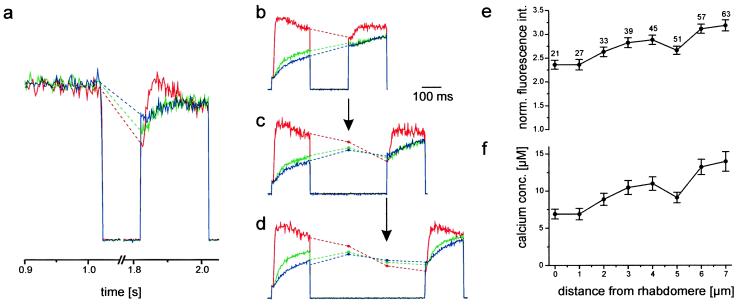
During illumination, Ca(2+) enters fly photoreceptor cells through light-activated channels that are located in the rhabdomere, the compartment specialized for phototransduction. From the rhabdomere, Ca(2+) diffuses into the cell body. We visualize this process by rapidly imaging the fluorescence in a cross section of a photoreceptor cell injected with a fluorescent Ca(2+) indicator in vivo. The free Ca(2+) concentration in the rhabdomere shows a very fast and large transient shortly after light onset. The free Ca(2+) concentration in the cell body rises more slowly and displays a much smaller transient. After approximately 400 ms of light stimulation, the Ca(2+) concentration in both compartments reaches a steady state, indicating that thereafter an amount of Ca(2+), equivalent to the amount of Ca(2+) flowing into the cell, is extruded. Quantitative analysis demonstrates that during the steady state, the free Ca(2+) concentration in the rhabdomere and throughout the cell body is the same. This shows that Ca(2+) extrusion takes place very close to the location of Ca(2+) influx, the rhabdomere, because otherwise gradients in the steady-state distribution of Ca(2+) should be measured. The close colocalization of Ca(2+) influx and Ca(2+) extrusion ensures that, after turning off the light, Ca(2+) removal from the rhabdomere is faster than from the cell body. This is functionally significant because it ensures rapid dark adaptation.
Figures
References
MeSH terms
Substances
LinkOut - more resources
Full Text Sources
Miscellaneous
