


Review
doi: 10.1172/JCI10583.
Cellular mechanisms of insulin resistance
Affiliations
- PMID: 10903330
- PMCID: PMC314317
- DOI: 10.1172/JCI10583
Item in Clipboard
Review
Cellular mechanisms of insulin resistance
J Clin Invest.
2000 Jul.
No abstract available
Figures
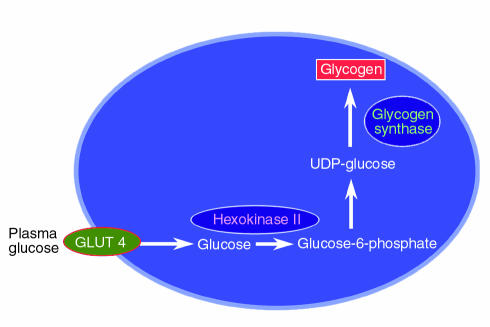
Potential rate-controlling steps responsible for reduced insulin-stimulated muscle glycogen synthesis in patients with type 2 diabetes mellitus. UDP, uridine diphosphate.
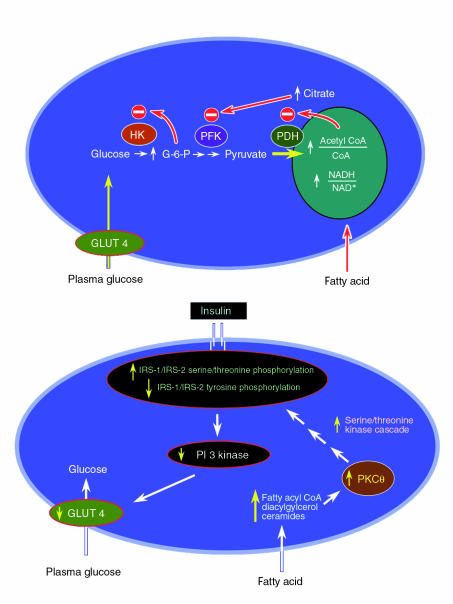
Top: Mechanism of fatty acid–induced insulin resistance in skeletal muscle as proposed by Randle et al. An increase in fatty acid concentration results in an elevation of the intramitochondrial acetyl CoA/CoA and NADH/NAD+ ratios, with subsequent inactivation of pyruvate dehydrogenase. This in turn causes citrate concentrations to increase, leading to inhibition of phosphofructokinase. Subsequent increases in intracellular glucose-6-phosphate concentration would inhibit hexokinase II activity, which would result in an increase in intracellular glucose concentration and a decrease in muscle glucose uptake. Bottom: Proposed alternative mechanism for fatty acid–induced insulin resistance in human skeletal muscle. An increase in delivery of fatty acids to muscle or a decrease in intracellular metabolism of fatty acids leads to an increase in intracellular fatty acid metabolites such as diacylglycerol, fatty acyl CoA, and ceramides. These metabolites activate a serine/threonine kinase cascade (possibly initiated by protein kinase Cθ) leading to phosphorylation of serine/threonine sites on insulin receptor substrates (IRS-1 and IRS-2), which in turn reduces the ability of the insulin receptor substrates to activate PI 3-kinase. As a consequence, glucose transport activity and other events downstream of insulin receptor signaling are diminished. HK, hexokinase II; PFK, phosphofructokinase; PDH, pyruvate dehydrogenase; PKCθ, protein kinase Cθ.
References
-
- Warram JH, Martin BC, Krolewski AS, Soeldner JS, Kahn CR. Slow glucose removal rate and hyperinsulinemia precede the development of type II diabetes in the offspring of diabetic patients. Ann Intern Med. 1990;113:909–915. - PubMed
-
- Lillioja S, et al. Impaired glucose tolerance as a disorder of insulin action. Longitudinal and cross-sectional studies in Pima Indians. N Engl J Med. 1988;318:1217–1225. - PubMed
-
- Haffner SM, et al. Diminished insulin sensitivity and increased insulin response in nonobese, nondiabetic Mexican Americans. Metabolism. 1990;39:842–847. - PubMed
-
- Reaven GM, Bernstein R, Davis B, Olefsky JM. Nonketotic diabetes mellitus: insulin deficiency or insulin resistance? Am J Med. 1976;60:80–88. - PubMed
Publication types
MeSH terms
Substances
Grants and funding
LinkOut - more resources
Full Text Sources
Other Literature Sources
Medical
