. 2000 Jul;106(2):289-98.
doi: 10.1172/JCI8761.

Adenosine formed by 5'-nucleotidase mediates tubuloglomerular feedback

Affiliations

Adenosine formed by 5'-nucleotidase mediates tubuloglomerular feedback

S Thomson et al. J Clin Invest. 2000 Jul.

Abstract

Nephron function is stabilized by tubuloglomerular feedback (TGF). TGF operates within the juxtaglomerular apparatus, sensing changes in tubular flow and eliciting compensatory changes in single nephron GFR (SNGFR). The mediator(s) of TGF remains unconfirmed. One theory is that ATP consumed in active transport by the macula densa leads to formation of adenosine, which causes glomerular vasoconstriction. We performed micropuncture in rats to test this hypothesis. Adenosine activity was manipulated by microperfusing nephrons with adenosine A1 receptor blocker, A1-agonist, or 5'-nucleotidase inhibitor. Effects on TGF were characterized by changes in TGF efficiency (the compensation for small perturbations in tubular flow) and by changes in the maximum range over which TGF can cause SNGFR to change. These data were further applied to generate TGF profiles [SNGFR versus late proximal flow (V(LP))]. TGF efficiency was significantly reduced by blocking A1-receptors. TGF efficiency, TGF range, and the slope of the TGF profile (DeltaSNGFR/DeltaV(LP)) were all significantly reduced by blocking 5'-nucleotidase. When adenosine activity was clamped by combining 5'-nucleotidase inhibitor with A1-agonist to determine whether TGF requires adenosine to be present or to fluctuate, the TGF slope was reduced by 83%, indicating that adenosine activity must fluctuate for normal TGF to occur and that adenosine is a mediator of TGF.


Figures
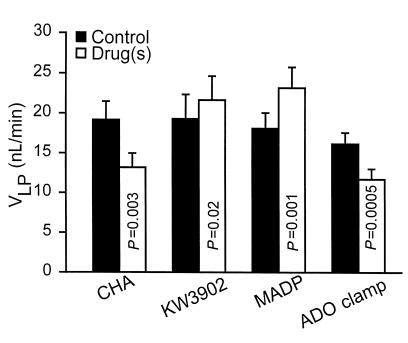
Figure 1
Figure 1
Ambient tubular flow before and during addition of various drugs to the free-flowing late proximal nephrons (mean ± SEM). Fluid was drawn from the tubule directly upstream from the pump delivering the drug(s) to correct for the volume required to deliver the drug(s). P values refer to the effect of each drug by repeated measures ANOVA. CHA, adenosine A1 receptor agonist (cyclohexyladenosine); KW3902, adenosine A1 receptor blocker; MADP, inhibitor of 5′-nucleotidase (α, β methylene adenosine diphosphate); ADO clamp, MADP + CHA.
Figure 2
Figure 2
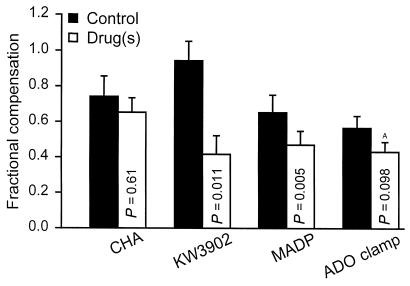
Fractional compensation for ± 5 nL/min perturbations in VLP applied before and during addition of various drugs to the free-flowing late proximal nephrons (mean ± SEM). P values refer to the effect of each drug by repeated measures ANOVA. The adenosine A1 agonist, CHA, had no effect. The blocking adenosine A1 receptors with KW3902 or inhibiting 5′-nucleotidase with MADP clearly reduced fractional compensation. The effect of the ADO clamp was equivocal by repeated measures, although fractional compensation during the ADO clamp was significantly less than a control value pooled from all groups. AP = 0.02 by unpaired Student’s t test versus homogeneous pooled controls.
Figure 3
Figure 3
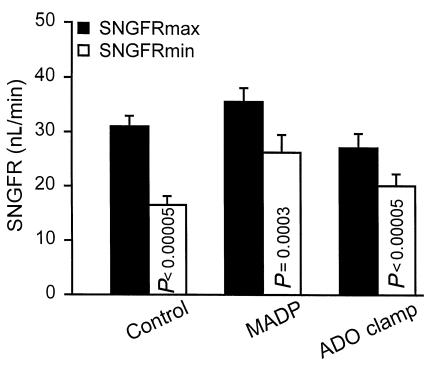
SNGFR during loop of Henle perfusion at 4 nL/min (SNGFRmax) versus flow during loop perfusion at 38 nL/min (SNGFRmin); mean ± SEM. Stimulation of TGF through loop of Henle perfusion caused SNGFR to decline in all cases.
Figure 4
Figure 4
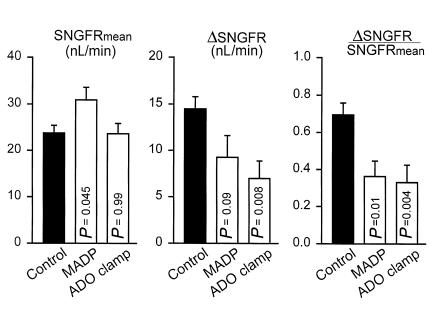
Effects of MADP and ADO clamp on SNGFR at the TGF inflection point (SNGFRmean), the maximum amount by which SNGFR can be made to change via activation of TGF (ΔSNGFR), and ΔSNGFR normalized to SNGFRmean (mean ± SEM). P values shown are comparisons to control by ANOVA with Tukey adjustment for post hoc intergroup comparisons.
Figure 5
Figure 5
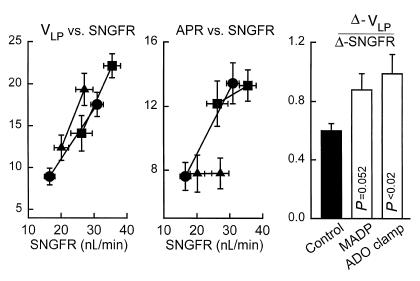
Glomerular tubular balance. The TGF system was used as a tool to manipulate SNGFR. Values are shown corresponding to paired determinations of SNGFR and VLP or absolute proximal reabsorption (APR) during minimal and maximal stimulation of TGF. Controls are indicated by circles; MADP, by squares; ADO clamp, by triangles. The right-hand panel depicts the slopes of the lines in the left-hand panel that correspond to f2′ in Eq. 2 (see text). P values shown refer to comparisons with control by Student’s t test with Bonferroni correction for multiple group comparisons.
Figure 6
Figure 6
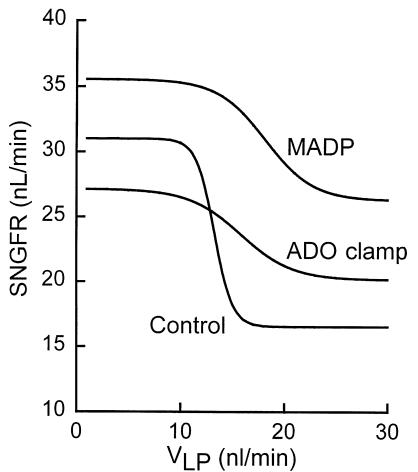
TGF curves generated from the present data. Four parameters are required to generate each curve. These include SNGFRmean, ΔSNGFR, VLP at the inflection point, and f1′ at the inflection point. To generate these curves, it was assumed that f1′ is a symmetric sigmoid and that nephrons in the perturbation experiments were operating near the inflection points of their respective TGF curves. All other features of the curves are obtained directly from the present data.
Figure 7
Figure 7
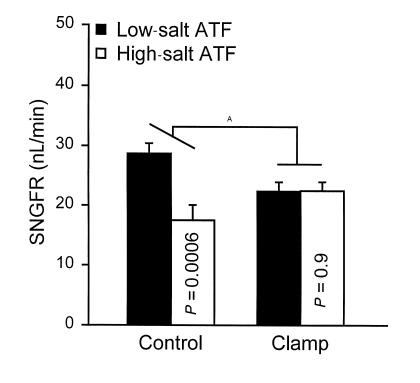
SNGFR by paired proximal collections during retrograde perfusion of Henle’s loop from the early distal tubule. Perfusion was at 12.5 nL/min with artificial tubular fluid (ATF) containing either 10 or 50 mM NaCl to effect minimum or maximum stimulation of TGF. To clamp adenosine activity, 5′-nucleotidase blocker and cyclohexyladenosine were added to tubular ATF. P values refer to effect of changing salt concentration. ABy two-way ANOVA, the adenosine clamp reduced the TGF response (P = 0.0006) but had no effect on SNGFR independent of TGF (P = 0.75).

References

    1. Osswald H, Muhlbauer B, Schenk F. Adenosine mediates tubuloglomerular feedback response: an element of metabolic control of kidney function. Kidney Int. 1991;39:S128–S131. - PubMed
    1. Schnermann J, Weihprecht H, Briggs J. Inhibition of tubuloglomerular feedback during adenosine-1 receptor blockade. Am J Physiol. 1990;258:F553–F561. - PubMed
    1. Weihprecht H, Lorenz JN, Briggs JP, Schnermann J. Synergistic effects of angiotensin and adenosine in the renal microvasculature. Am J Physiol. 1994;266:F227–F239. - PubMed
    1. Pflueger AC, Schenk F, Osswald H. Increased sensitivity of the renal vasculature to adenosine in streptozotocin-induced diabetes mellitus rats. Am J Physiol. 1995;269:F529–F535. - PubMed
    1. Thomson S, Vallon V, Blantz RC. Asymmetry of tubuloglomerular feedback effector mechanism with respect to ambient tubular flow. Am J Physiol. 1996;271:F1123–F1130. - PubMed

Publication types