


Improvement in the results of surgical treatment of advanced squamous esophageal carcinoma during 15 consecutive years
- PMID: 10903602
- PMCID: PMC1421135
- DOI: 10.1097/00000658-200008000-00013
Improvement in the results of surgical treatment of advanced squamous esophageal carcinoma during 15 consecutive years
Abstract
Objective: To document the clinicopathologic characteristics and survival of patients undergoing esophagectomy for squamous carcinoma of the thoracic esophagus, and to examine the factors contributing to improvements in outcome noted in patients with advanced carcinoma.
Summary background data: Japanese and some Western surgeons recently have reported that radical esophagectomy with extensive lymphadenectomy conferred a survival advantage to patients with esophageal carcinoma. The factors contributing to this improvement in results have not been well defined.
Methods: From 1981 to 1995, 419 patients with carcinoma of the thoracic esophagus underwent esophagectomy at the Keio University Hospital. The clinicopathologic characteristics and survival of patients treated between 1981 and 1987 were compared with those of patients treated between 1988 and 1995. Multivariate analysis using the Cox regression model was carried out to evaluate the impact of 15 variables on survival of patients with p stage IIa to IV disease. Several variables related to prognosis were examined to identify differences between the two time periods.
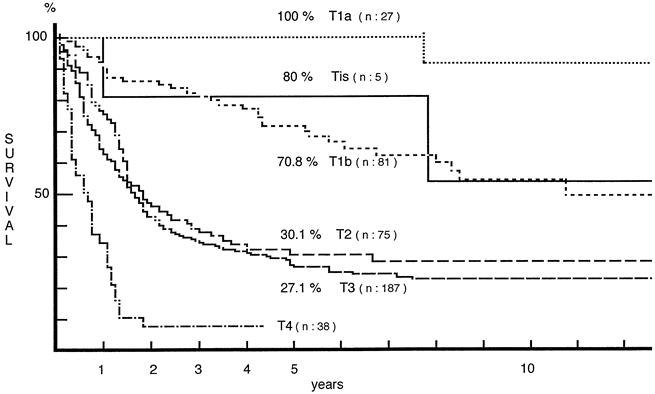
Results: The 5-year survival rate for all patients was 40.0%. The 5-year survival rate was 17.7% for p stage IIa to IV patients treated during the earlier period and 37.6% for those treated during the latter period. The Cox regression model revealed seven variables to be important prognostic factors. Of these seven, three (severity of postoperative complications, degree of residual tumor, and number of dissected mediastinal nodes) were found to be significantly different between the earlier and latter periods.
Conclusions: The survival of patients undergoing surgery for advanced carcinoma (p stage IIa to IV) of the thoracic esophagus has improved during the past 15 years. The authors' data suggest that this improvement is due mainly to advances in surgical technique and perioperative management.
Figures




References
-
- International Union Against Cancer. TNM Supplement 1993. New York: Springer-Verlag; 1993.
-
- Ando N, Shinozawa Y, Ikehata Y, et al. Postoperative nutritional status in patients with esophageal carcinoma. In: Ferguson MK, Little AG, Skinner DB, ed. Diseases of the Esophagus. New York: Futra Publishing; 1990: 261–269.
-
- Goseki N, Koike M, Yoshida M. Histopathologic characteristics of early-stage esophageal carcinoma. A comparative study with gastric carcinoma. Cancer 1992; 69: 1088–1093. - PubMed
-
- Iizuka T, Ide H, Kakegawa T, et al. Preoperative radioactive therapy for esophageal carcinoma. Randomized evaluation trial in eight institutions. Chest 1988; 93: 1054–1058. - PubMed
MeSH terms
LinkOut - more resources
Full Text Sources
Medical
Miscellaneous
