


Cytoplasmic binding and disposition kinetics of diclofenac in the isolated perfused rat liver
- PMID: 10903973
- PMCID: PMC1572206
- DOI: 10.1038/sj.bjp.0703448
Cytoplasmic binding and disposition kinetics of diclofenac in the isolated perfused rat liver
Abstract
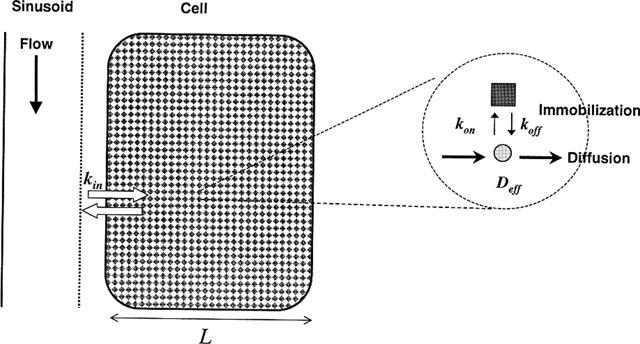
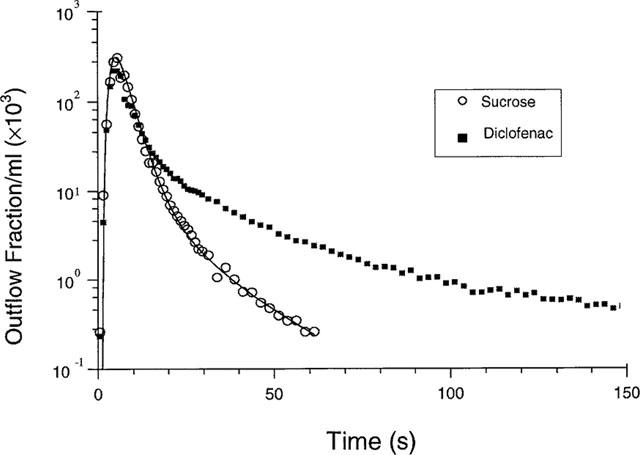
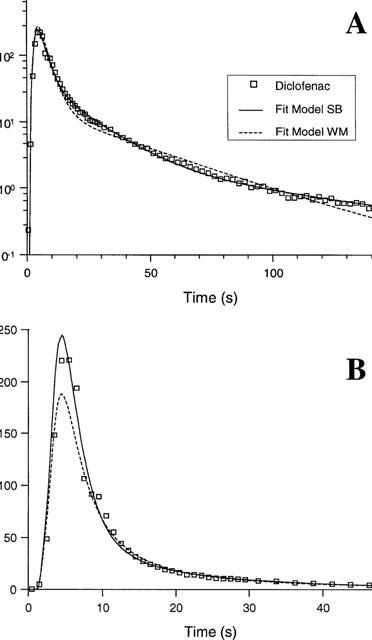
1. The binding kinetics of diclofenac to hepatocellular structures were evaluated in the perfused rat liver using the multiple indicator dilution technique and a stochastic model of organ transit time density. 2. The single-pass, in situ rat liver preparation was perfused with buffer solution (containing 2% albumin) at 30 ml min(-1). Diclofenac and [(14)C]-sucrose (extracellular reference) were injected simultaneously as a bolus dose into the portal vein (six experiments in three rats). An analogous series of experiments was performed with [(14)C]-diclofenac and [(3)H]-sucrose. 3. The diclofenac outflow data were analysed using three models of intracellular distribution kinetics, assuming (1) instantaneous distribution and binding (well-mixed model), (2) 'slow' binding at specific intracellular sites after instantaneous distribution throughout the cytosol (slow binding model), and (3) 'slowing' of cytoplasmic diffusion due to instantaneous binding (slow diffusion model). 4. The slow binding model provided the best description of the data. The rate constants for cellular influx and sequestration were 0.126+/-0. 026 and 0.013+/-0.009 s(-1), respectively. The estimated ratio of cellular initial distribution volume to extracellular volume of 2.82 indicates an almost instantaneous distribution in the cellular water space, while the corresponding ratio of 5.54 estimated for the apparent tissue distribution volume suggests a relatively high hepatocellular binding. The non-instantaneous intracellular equilibration process was characterized by time constants of the binding and unbinding process of 53.8 and 49.5 s, respectively. The single-pass availability of diclofenac was 86%. The results obtained with [(14)C]-diclofenac and [(3)H]-sucrose were not statistically different.
Figures
References
-
- BARLOW J.W., CURTIS A.J., RAGGATT L.E., LOIDL N.M., TOPLISS D.J., STOCKIGT J.R. Drug competition for intracellular triiodothyronine-binding sites. Eur. J. Endocrinol. 1994;130:417–421. - PubMed
-
- CHEUNG K., HICKMAN P.E., POTTER J.M., WALKER N., JERICHO M., HASLAM R., ROBERTS M.S. An optimised model for rat liver perfusion studies. J. Surg. Res. 1996;66:81–89. - PubMed
-
- CRANK J. The Mathematics of Diffusion, 2nd ed. Oxford University Press; 1975.
-
- DIAZ-GARCIA J.M., EVANS A.M., ROWLAND M. Application of the axial dispersion model of hepatic drug elimination to the kinetics of diazepam in the isolated perfused rat liver. J. Pharmacokin. Biopharm. 1992;20:171–193. - PubMed
-
- EVANS A.M., HUSSEIN Z., ROWLAND M. A two-compartment dispersion model describes the hepatic outflow profile of diclofenac in the presence of its binding protein. J. Pharm. Pharmacol. 1991;43:709–714. - PubMed
Publication types
MeSH terms
Substances
LinkOut - more resources
Full Text Sources
Miscellaneous
