


Simian immunodeficiency virus (SIV) gag DNA-vaccinated rhesus monkeys develop secondary cytotoxic T-lymphocyte responses and control viral replication after pathogenic SIV infection
- PMID: 10906202
- PMCID: PMC112269
- DOI: 10.1128/jvi.74.16.7485-7495.2000
Simian immunodeficiency virus (SIV) gag DNA-vaccinated rhesus monkeys develop secondary cytotoxic T-lymphocyte responses and control viral replication after pathogenic SIV infection
Abstract
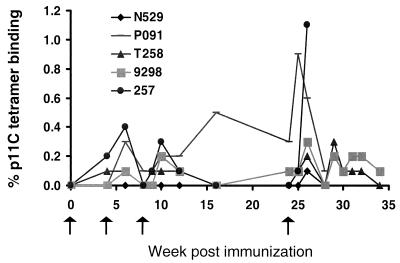
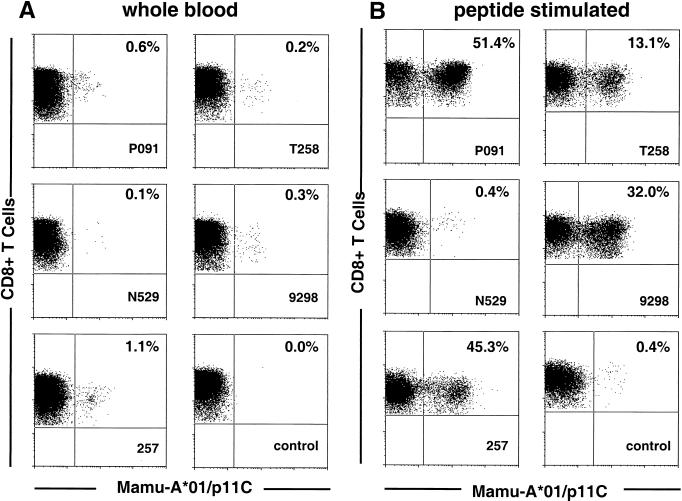
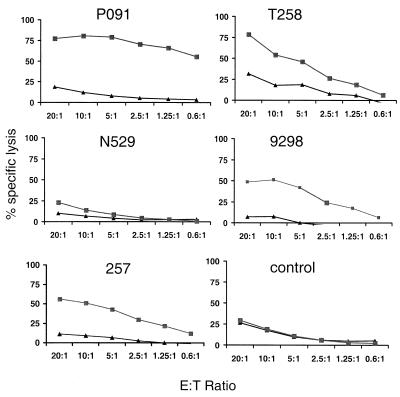
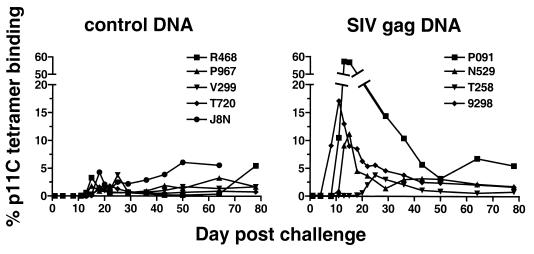
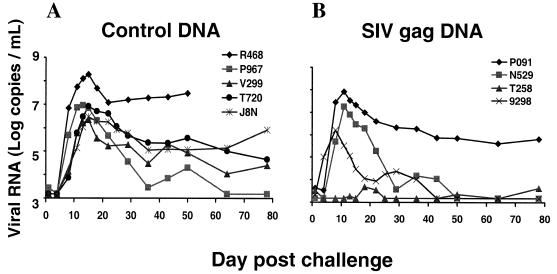
The potential contribution of a plasmid DNA construct to vaccine-elicited protective immunity was explored in the simian immunodeficiency virus (SIV)/macaque model of AIDS. Making use of soluble major histocompatibility class I/peptide tetramers and peptide-specific killing assays to monitor CD8(+) T-lymphocyte responses to a dominant SIV Gag epitope in genetically selected rhesus monkeys, a codon-optimized SIV gag DNA vaccine construct was shown to elicit a high-frequency SIV-specific cytotoxic T-lymphocyte (CTL) response. This CTL response was demonstrable in both peripheral blood and lymph node lymphocytes. Following an intravenous challenge with the highly pathogenic viral isolate SIVsm E660, these vaccinated monkeys developed a secondary CTL response that arose with more rapid kinetics and reached a higher frequency than did the postchallenge CTL response in control plasmid-vaccinated monkeys. While peak plasma SIV RNA levels were comparable in the experimentally and control-vaccinated monkeys during the period of primary infection, the gag plasmid DNA-vaccinated monkeys demonstrated better containment of viral replication by 50 days following SIV challenge. These findings indicate that a plasmid DNA vaccine can elicit SIV-specific CTL responses in rhesus monkeys, and this vaccine-elicited immunity can facilitate the generation of secondary CTL responses and control of viral replication following a pathogenic SIV challenge. These observations suggest that plasmid DNA may prove a useful component of a human immunodeficiency virus type 1 vaccine.
Figures
References
-
- Allen T M, Sidney J, del Guercio M F, Glickman R L, Lensmeyer G L, Wiebe D A, DeMars R, Pauza C D, Johnson R P, Sette A, Watkins D I. Characterization of the peptide binding motif of a rhesus MHC class I molecule (Mamu-A*01) that binds an immunodominant CTL epitope from simian immunodeficiency virus. J Immunol. 1998;160:6062–6071. - PubMed
-
- Barouch D H, Santra S, Steenbeke T D, Zheng X X, Perry H C, Davies M E, Freed D C, Craiu A, Strom T B, Shiver J W, Letvin N L. Augmentation and suppression of immune responses to an HIV-1 DNA vaccine by plasmid cytokine/Ig administration. J Immunol. 1998;161:1875–1882. - PubMed
-
- Belyakov I M, Derby M A, Ahlers J D, Kelsall B L, Earl P, Moss B, Strober W, Berzofsky J A. Mucosal immunization with HIV-1 peptide vaccine induces mucosal and systemic cytotoxic T lymphocytes and protective immunity in mice against intrarectal recombinant HIV-vaccinia challenge. Proc Natl Acad Sci USA. 1998;95:1709–1714. - PMC - PubMed
-
- Boyer J D, Chattergoon M, Shah A, Ginsberg R, MacGregor R R, Weiner D B. HIV-1 DNA based vaccine induces a CD8 mediated cross-clade CTL response. Dev Biol Stand. 1998;95:147–153. - PubMed
-
- Boyer J D, Ugen K E, Wang B, Agadjanyan M, Gilbert L, Bagarazzi M L, Chattergoon M, Frost P, Javadian A, Williams W V, Refaeli Y, Ciccarelli R B, McCallus D, Coney L, Weiner D B. Protection of chimpanzees from high-dose heterologous HIV-1 challenge by DNA vaccination. Nat Med. 1997;3:526–532. - PubMed
Publication types
MeSH terms
Substances
Grants and funding
LinkOut - more resources
Full Text Sources
Other Literature Sources
Research Materials
