. 2000 Aug;182(16):4512-20.
doi: 10.1128/JB.182.16.4512-4520.2000.

Inactivation of the stress- and starvation-inducible gls24 operon has a pleiotrophic effect on cell morphology, stress sensitivity, and gene expression in Enterococcus faecalis

Affiliations

Inactivation of the stress- and starvation-inducible gls24 operon has a pleiotrophic effect on cell morphology, stress sensitivity, and gene expression in Enterococcus faecalis

J C Giard et al. J Bacteriol. 2000 Aug.

Abstract

Enterococcus faecalis induces the synthesis of at least 42 proteins during 24 h of glucose starvation. Because of its induction during carbohydrate and complete starvation (incubation in tap water) and CdCl(2) and bile salts stresses, one of these proteins (Gls24) was qualified as a "general stress protein" and was analyzed at the molecular level. Its corresponding gene, gls24, seems to be the penultimate gene of an operon composed, altogether, of six open reading frames (ORFs). The ORF preceding gls24 (orf4) showed very strong identity with gls24. The deduced polypeptides of these two genes showed similarity with a 20-kDa hypothetical protein from Lactococcus lactis and an alkaline stress protein from Staphylococcus aureus with no previously known biological significance. Data from the operon sequence and Northern analysis led to the conclusions that (i) gls24 possesses its own promoter which is especially induced at the onset of starvation and (ii) the operon promoter is stress inducible in exponential-phase cells. A mutation in the gls24 gene led to a severe reduction of growth rate and reduction of survival against 0.3% bile salts in the 24-h-starved cells compared to the wild-type strain. Moreover, the chain length of the mutant is significantly reduced during growth. These results argue strongly for a role of the protein Gls24 and/or GlsB in morphological changes and in stress tolerance in E. faecalis. Comparison of two-dimensional protein gels from wild-type cells with those from gls24 mutant cells revealed a pleiotropic effect of the mutation on gene expression. At least nine proteins were present in larger amounts in the mutant. For six of them, the corresponding N-terminal microsequence has been obtained. Three of these sequences map in genes coding for L-lactate dehydrogenase, lipoamide dehydrogenase, and pyruvate decarboxylase, all involved in pyruvate metabolism.


Figures
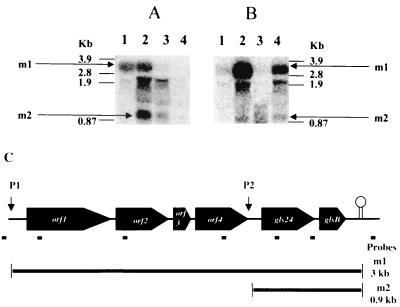
FIG. 1
FIG. 1
Northern analyses of E. faecalis RNA. (A) Samples of total RNA were prepared from cells in exponential growth phase (lane 1), at the onset of starvation (lane 2), and after 3 and 12 h of glucose starvation (lanes 3 and 4, respectively). (B) Samples of total RNA were prepared from cells in exponential growth phase (lanes 1 and 3) and after 30 min in the presence of 50 μg of CdCl2 per ml (lane 2) or 0.08% bile salts (lane 4). The hybridizations were achieved with the 32P-labelled probe deduced from the sequence between gls24 and glsB (5′-CCATGATTGTTTCCTCCC-3′). The numbers on both sides show the RNA markers (3.9 to 0.87 kb). Positions of the entire operon mRNA (transcripts m1) and the gls24-glsB mRNA (transcripts m2) are indicated by arrows. (C) Schematic representation of the E. faecalis operon containing gls24 encoding the general stress protein Gls24. Promoter regions P1 and P2 are indicated by arrows. The transcripts m1 and m2 derived from this operon observed in the Northern analyses are presented, and their deduced sizes are indicated. Small black bars under the operon indicate positions of the different oligonucleotides used as probes for the Northern analyses.
FIG. 2
FIG. 2
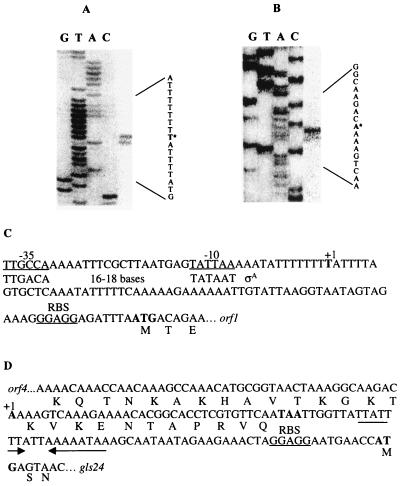
(A and B) Mapping of the 5′ ends of the entire operon mRNA (A) and gls24-glsB mRNA (B) by primer extension analysis. RNA was isolated from E. faecalis JH2-2 after 30 min of CdCl2 stress exposure (A) and at the onset of starvation (B). The potential transcription start sites are marked with asterisks. Lanes G, T, A, and C show the sequencing ladder obtained by using the same primer as was used for the primer extension. (C and D) Sequences of the P1 (C) and P2 (D) promoter regions. Potential −35 and −10 regions and the RBS sequences are underlined. The transcriptional start sites (+1) and translational start and stop codons are indicated in boldface letters. The consensus sequence for ςA-dependent promoter with its appropriate spacer is shown (C). The AT-rich inverted repeat sequence observed between the P2 promoter region is marked by arrows (D).
FIG. 3
FIG. 3
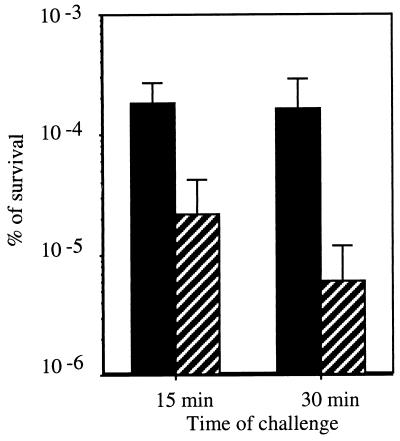
Percentage of survival for 24-h-starved cells of E. faecalis JH2-2 (black bars) and gls24 mutant (hatched bars) cells after 15 and 30 min of challenge with 0.3% bile salts. These data are the average of four separate experiments, and standard deviations are indicated at the top of each bar.
FIG. 4
FIG. 4
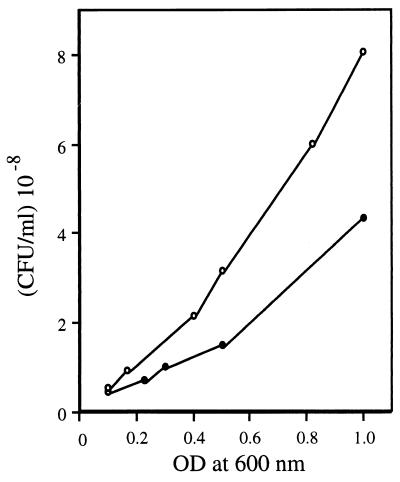
Correlation between OD600 and plate count of E. faecalis JH2-2 (closed circle) and gls24 mutant strain (open circle).
FIG. 5
FIG. 5
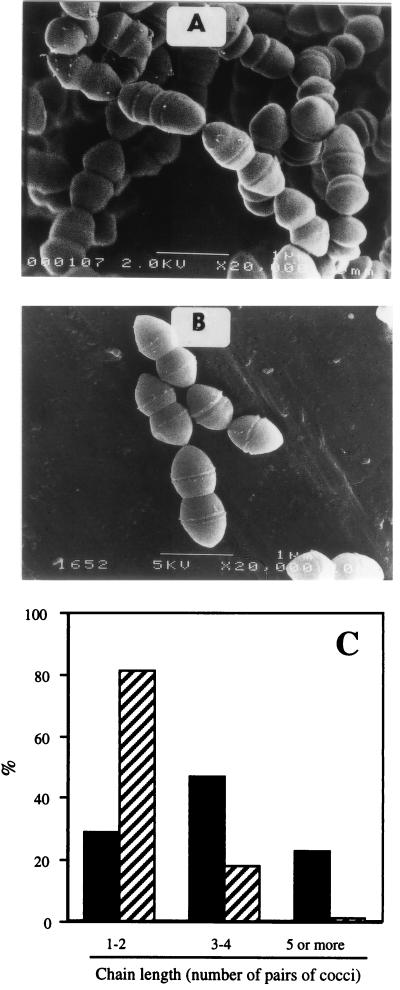
Morphology of E. faecalis cells. Strains JH2-2 (A) and gls24 mutant (B) were grown at 37°C in semisynthetic medium. Electron micrographs of rapidly growing cells are shown. (C) Ratio of different chain lengths of cells observed in E. faecalis JH2-2 (black bars) and gls24 mutant strain (hatched bars). 100% corresponds to at least 200 chains.
FIG. 6
FIG. 6
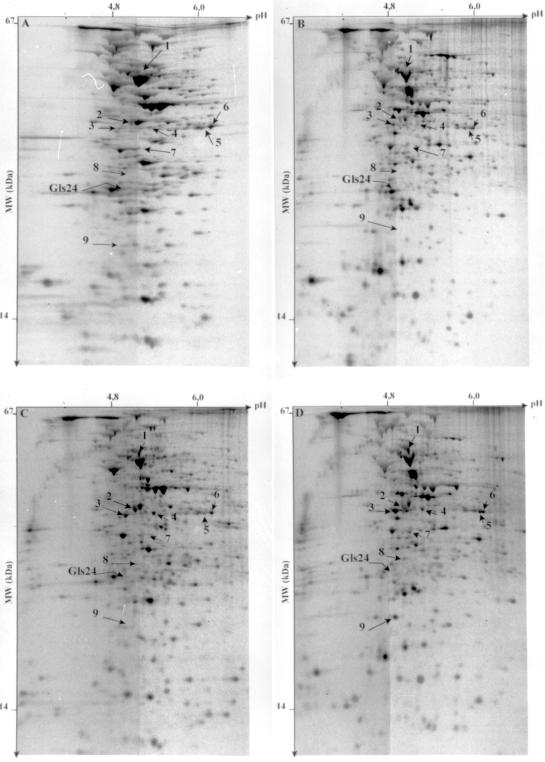
2D separation of 35S-labelled proteins from growing (A and C) and 24-h starved cells (B and D) of E. faecalis JH2-2 (A and B) and gls24 mutant (C and D) strains. Arrows indicate the positions of polypeptides that are synthesized in higher amounts in the gls24 mutant than in the wild-type cells. The position of the protein Gls24 is also indicated.
FIG. 7
FIG. 7
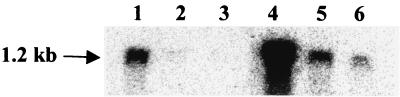
Northern blot analysis of total cellular RNA isolated from strain JH2-2 (lanes 1 to 3) and gls24 mutant (lanes 4 to 6). Samples were prepared from cells in exponential growth phase (lanes 1 and 4), at the onset of starvation (lanes 2 and 5), and after 3 h of glucose starvation (lanes 3 and 6). A 32P-labelled 20-bp oligonucleotide deduced from the sequence of the gene encoding l-lactate dehydrogenase (5′-CGTCAGGATTATTTTTCACC-3′) was used as a hybridization probe. Position of the 1.2-kb mRNA is indicated.

References

    1. Aldea M, Garrido T, Hernandez-Chico C, Vicente M, Kushner S R. Induction of a growth-phase-dependent promoter trigger transcription of bolA, an Escherichia coli morphogene. EMBO J. 1989;8:3923–3931. - PMC - PubMed
    1. Almiron M, Link A J, Furlong D, Kolter R. A novel DNA-binding protein with regulatory and protective roles in starved Escherichia coli. Genes Dev. 1992;6:2646–2654. - PubMed
    1. Altshul S F, Gish W, Miller W, Myers E W, Lipman D J. Basic local alignment search tool. J Mol Biol. 1990;215:403–410. - PubMed
    1. Anderson T F. Techniques for the preservation of three-dimensional structure in preparing specimens for the electron microscope. Trans N Y Acad Sci. 1951;13:130–134.
    1. Antelmann H, Engelmann S, Schmid R, Hecker M. General and oxidative stress responses in Bacillus subtilis: cloning, expression, and mutation of the alkyl hydroperoxide reductase operon. J Bacteriol. 1996;178:6571–6578. - PMC - PubMed

MeSH terms

LinkOut - more resources