


doi: 10.1128/MCB.20.16.5840-5846.2000.
Aldose reductase-deficient mice develop nephrogenic diabetes insipidus
Affiliations
- PMID: 10913167
- PMCID: PMC86061
- DOI: 10.1128/MCB.20.16.5840-5846.2000
Item in Clipboard
Aldose reductase-deficient mice develop nephrogenic diabetes insipidus
Mol Cell Biol.
2000 Aug.
Abstract
Aldose reductase (ALR2) is thought to be involved in the pathogenesis of various diseases associated with diabetes mellitus, such as cataract, retinopathy, neuropathy, and nephropathy. However, its physiological functions are not well understood. We developed mice deficient in this enzyme and found that they had no apparent developmental or reproductive abnormality except that they drank and urinated significantly more than their wild-type littermates. These ALR2-deficient mice exhibited a partially defective urine-concentrating ability, having a phenotype resembling that of nephrogenic diabetes insipidus.
Figures
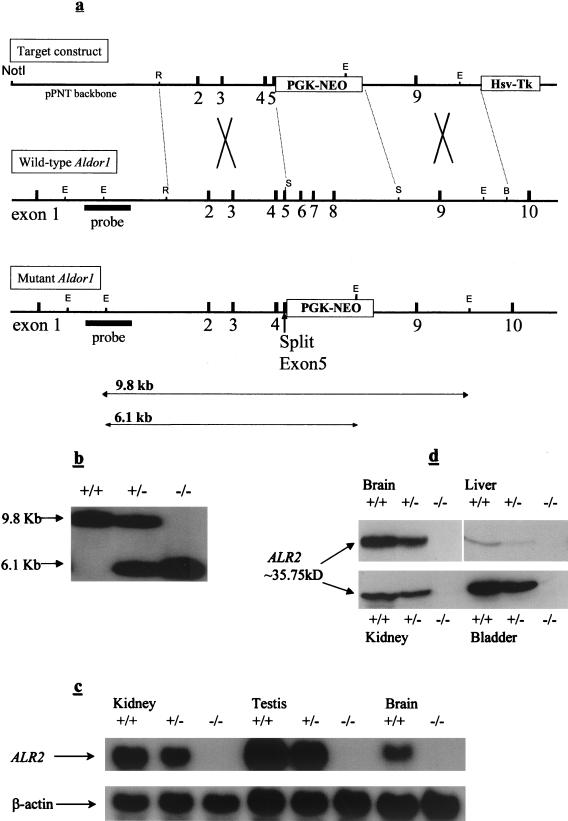
Generation of ALR2-deficient mice. (a) The gene targeting construct, containing the herpes simplex virus tk gene (tk) and the neomycin resistance gene (neo). The restriction map of the wild-type and mutant ALR2 genes are shown. Relative positions of all exons are shown in filled boxes. The NotI site used to linearize the construct and the outside probe (filled bar) and the expected sizes of EcoRV fragments used for analysis of genomic DNA are indicated. E, EcoRV; R, EcoRI; S, SpeI; B, BglII. (b) Genotyping the ALR2 allele by Southern blot analysis. The expected bands of ∼9.8 kb for the wild-type ALR2 allele and ∼6.1 kb for the mutant ALR2 allele were observed. (c) Northern analysis of total RNA (10 μg/lane) from kidney, testis, and brain tissue of F2 mice. The blot was analyzed with an ALR2 cDNA probe containing exons 5 to 8 and normalized with β-actin. An ∼1.3-kb band was detected representing the ALR2 transcript. (d) Western analysis of total protein isolated from brain, liver, bladder, and kidney extracts of F2 mice. ALR2 was detected using a polyclonal rabbit antibody specific for it.
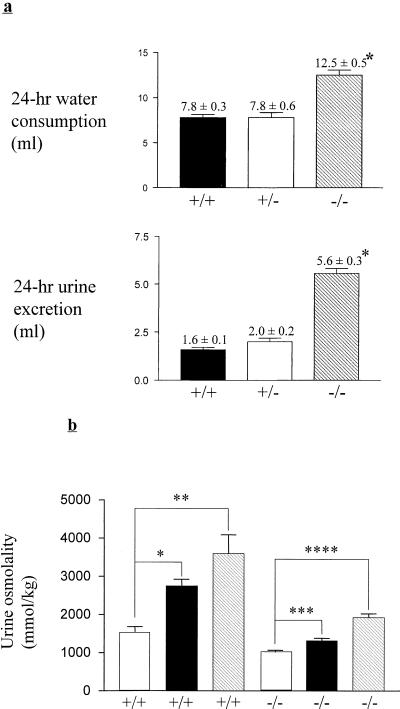
(a) Water intake and urine output in Aldor1+/+, Aldor1+/−, and Aldor1−/− mice. Water consumption and urine excretion by wild-type (n = 20), heterozygous (n = 15), and knockout (n = 20) male mice during a 24-h period were determined. Mice were housed individually in metabolic cages, and values were determined over a 2-day period. Data are means ± standard errors of the means. ∗, P < 0.0001 compared with Aldor1+/+ and Aldor1+/− mice. Statistical significance was determined by the unpaired Student t test. (b) Urine-concentrating ability before and after a 24-h water deprivation period or AVP injection in Aldor1+/+ and Aldor1−/− mice, measured as urine osmolality. White bars, before deprivation or AVP injection; dark bars, after AVP injection; striped bars, after deprivation. Data are means ± standard errors of the means (n = 4). ∗, P = 0.0005; ∗∗, P = 0.0024; ∗∗∗, P = 0.0014; ∗∗∗∗, P < 0.0001. Statistical significance was determined by the unpaired Student t test.
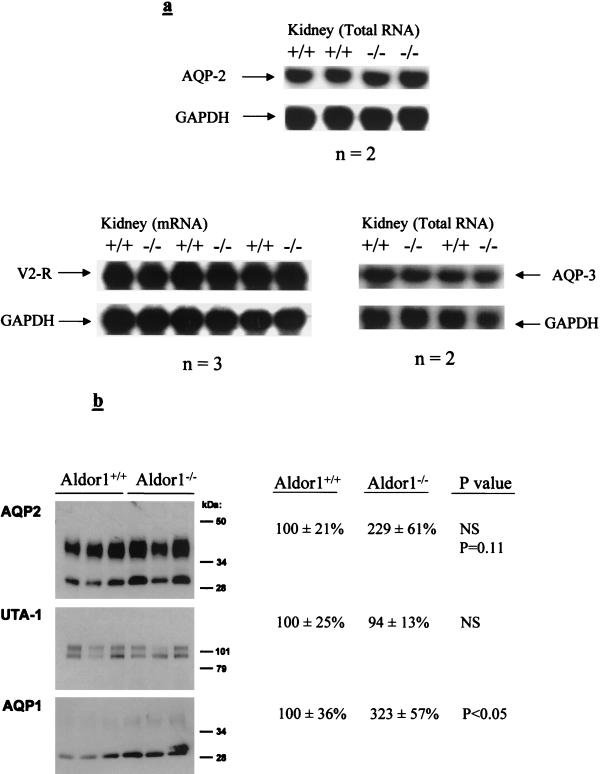
(a) Detection of aquaporin 2 (AQP-2), aquaporin 3 (AQP-3), and V2R mRNA levels. Results of Northern blot analysis of total RNA (10 μg/lane) and mRNA (3 μg/lane) from kidney extracts of Aldor1+/+ and Aldor1−/− mice are shown. The blots were analyzed with probes designed from the cDNA sequences of the three genes published in GenBank (discussed in Methods and Materials). The blots were normalized with glyceraldehyde-3-phosphate dehydrogenase (GAPDH). (b) Immunoblots comparing AQP2, AQP1, and UTA-1 expression in kidney inner medullae from Aldor1+/+ and Aldor1−/− mice. Loading was 2 μg/lane for AQP1 and AQP2 and 10 μg/lane for UTA-1. Densitometry data are shown on the right. Statistical significance was determined by the unpaired Student t test.
References
-
- Bichet D G, Oksche A, Rosenthal W. Congenital nephrogenic diabetes insipidus. J Am Soc Nephrol. 1997;8:1951–1958. - PubMed
-
- Bradford M M. A rapid and sensitive method for the quantitation of microgram quantities of protein utilizing the principle of protein-dye binding. Anal Biochem. 1976;72:248–254. - PubMed
-
- Brown D, Shields G I, Valtin H, Morris J F, Orci L. Lack of intramembranous particle clusters in collecting ducts of mice with nephrogenic diabetes insipidus. Am J Physiol. 1985;249:F582–F589. - PubMed
-
- Costantino L, Rastelli G, Vianello P, Cignarella G, Barlocco D. Diabetes complications and their potential prevention: aldose reductase inhibition and other approaches. Med Res Rev. 1999;19:3–23. - PubMed
Publication types
MeSH terms
Substances
LinkOut - more resources
Full Text Sources
Molecular Biology Databases
Research Materials
