


Colonization of corn, Zea mays, by the entomopathogenic fungus Beauveria bassiana
- PMID: 10919808
- PMCID: PMC92172
- DOI: 10.1128/AEM.66.8.3468-3473.2000
Colonization of corn, Zea mays, by the entomopathogenic fungus Beauveria bassiana
Abstract
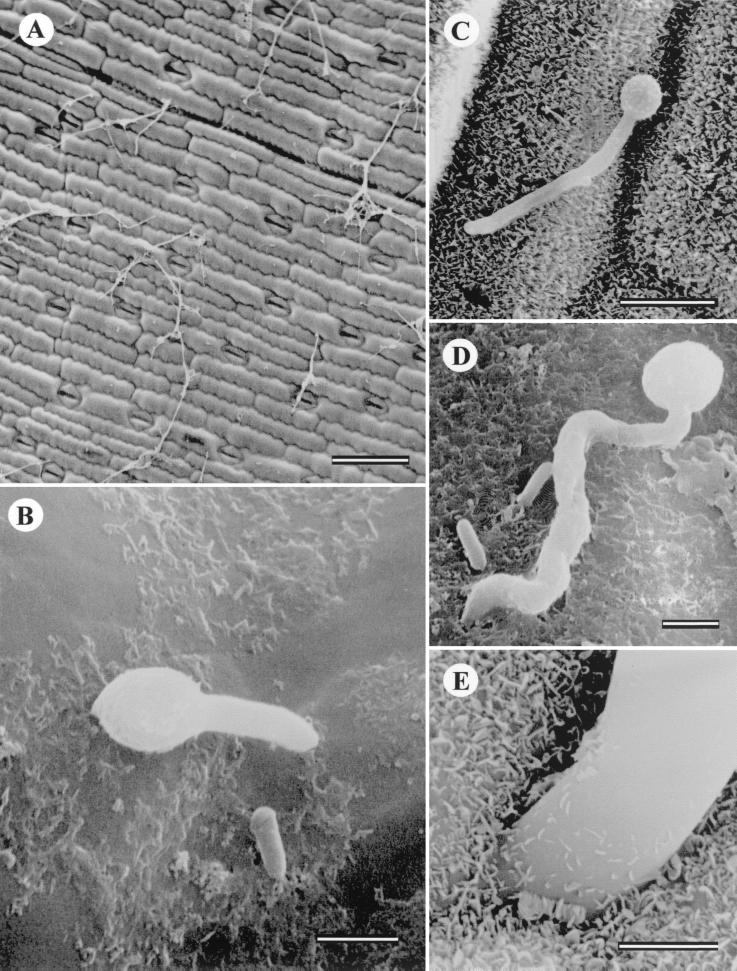
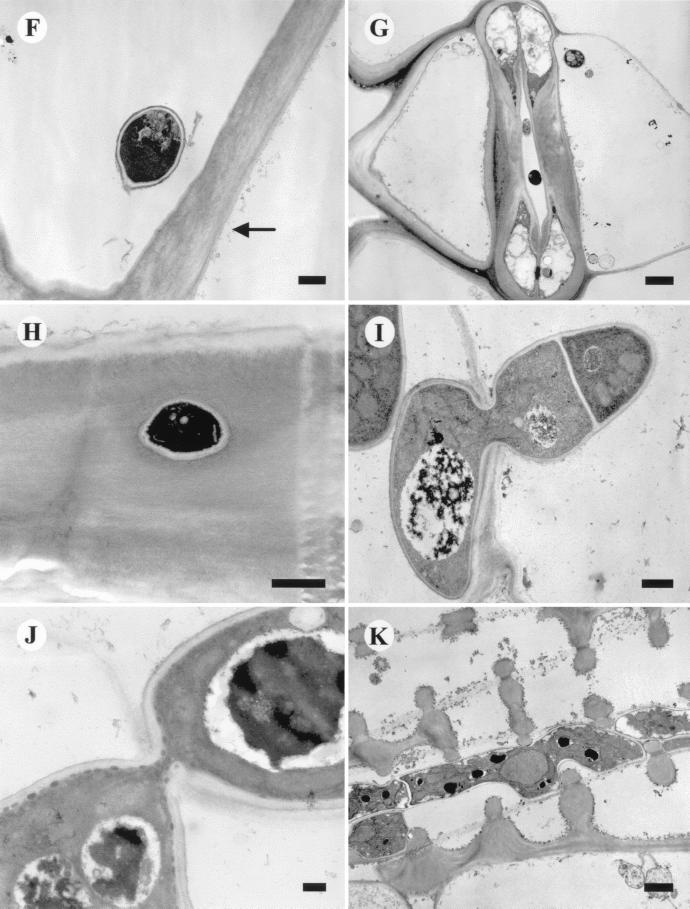
Light and electron microscopy were used to describe the mode of penetration by the entomopathogenic fungus Beauveria bassiana (Balsamo) Vuillemin into corn, Zea mays L. After inoculation with a foliar spray of conidia, germinating hyphae grew randomly across the leaf surface. Often a germ tube formed from a conidium and elongated only a short distance before terminating its growth. Not all developing hyphae on the leaf surface penetrated the cuticle. However, when penetration did occur, the penetration site(s) was randomly located, indicating that B. bassiana does not require specific topographic signals at an appropriate entry site as do some phytopathogenic fungi. Long hyphal structures were observed to follow the leaf apoplast in any direction from the point of penetration. A few hyphae were observed within xylem elements. Because vascular bundles are interconnected throughout the corn plant, this may explain how B. bassiana travels within the plant and ultimately provides overall insecticidal protection. Virulency bioassays demonstrate that B. bassiana does not lose virulence toward the European corn borer, Ostrinia nubilalis (Hübner), once it colonizes corn. This endophytic relationship between an entomopathogenic fungus and a plant suggests possibilities for biological control, including the use of indigenous fungal inocula as insecticides.
Figures
References
-
- Baird R B. The artificial control of insects by means of entomogenous fungi, a compilation of references with abstracts. Nova Scotia, Canada: Canadian Agricultural Research Station, Kentrille; 1958.
-
- Bartlett K A, Lefebvre C L. Field experiments with Beauveria bassiana (Bals.) Vuill., a fungus attacking the European corn borer. J Econ Entomol. 1934;27:1147–1157.
-
- Bidochka M J, Khachatourians C G. The implication of metabolic acids produced by Beauveria bassiana in pathogenesis of the migratory grasshopper, Melanoplus sanguinipes. J Invertebr Pathol. 1991;58:106–117.
-
- Bing L A, Lewis L C. Suppression of Ostrinia nubilalis (Hübner) (Lepidoptera: Pyralidae) by endophytic Beauveria bassiana (Balsamo) Vuillemin. Environ Entomol. 1991;20:1207–1211.
-
- Bing L A, Lewis L C. Endophytic Beauveria bassiana (Balsamo) Vuillemin in corn: the influence of the plant growth stage and Ostrinia nubilalis (Hübner) Biocontrol Sci Technol. 1992;2:39–47.
MeSH terms
LinkOut - more resources
Full Text Sources
Other Literature Sources
