


Long-chain aldehyde dehydrogenase that participates in n-alkane utilization and wax ester synthesis in Acinetobacter sp. strain M-1
- PMID: 10919810
- PMCID: PMC92174
- DOI: 10.1128/AEM.66.8.3481-3486.2000
Long-chain aldehyde dehydrogenase that participates in n-alkane utilization and wax ester synthesis in Acinetobacter sp. strain M-1
Abstract
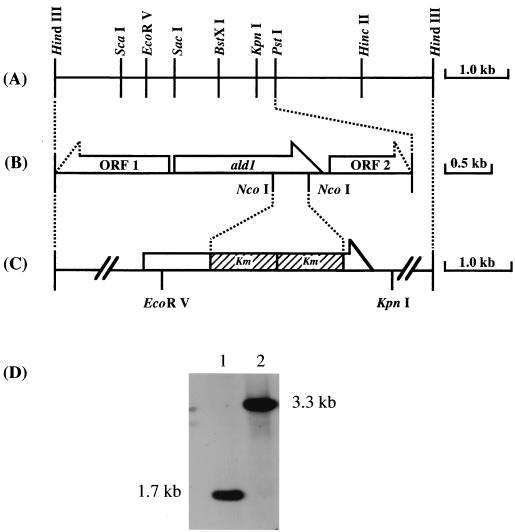
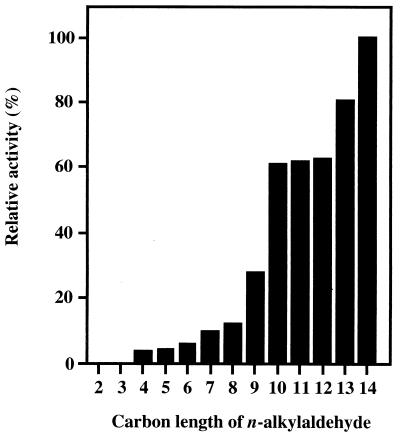
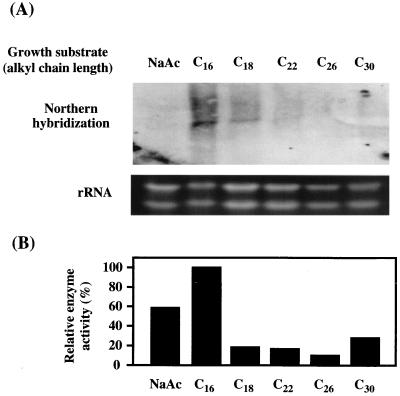
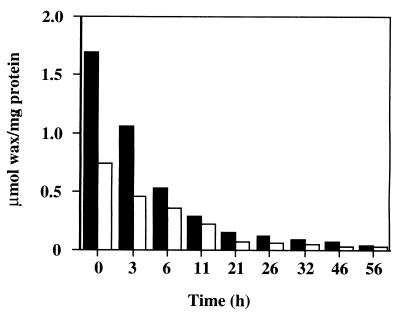
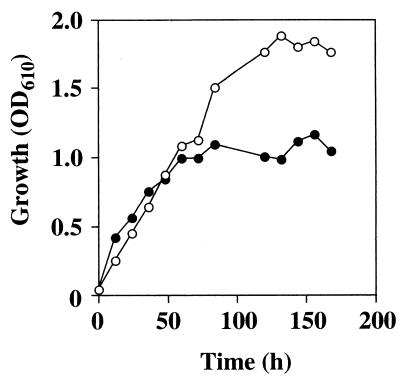
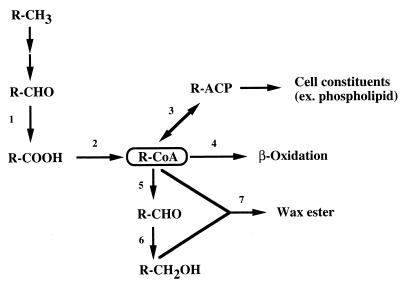
A long-chain aldehyde dehydrogenase, Ald1, was found in a soluble fraction of Acinetobacter sp. strain M-1 cells grown on n-hexadecane as a sole carbon source. The gene (ald1) was cloned from the chromosomal DNA of the bacterium. The open reading frame of ald1 was 1,512 bp long, corresponding to a protein of 503 amino acid residues (molecular mass, 55,496 Da), and the deduced amino acid sequence showed high similarity to those of various aldehyde dehydrogenases. The ald1 gene was stably expressed in Escherichia coli, and the gene product (recombinant Ald1 [rAld1]) was purified to apparent homogeneity by gel electrophoresis. rAld1 showed enzyme activity toward n-alkanals (C(4) to C(14)), with a preference for longer carbon chains within the tested range; the highest activity was obtained with tetradecanal. The ald1 gene was disrupted by homologous recombination on the Acinetobacter genome. Although the ald1 disruptant (ald1Delta) strain still had the ability to grow on n-hexadecane to some extent, its aldehyde dehydrogenase activity toward n-tetradecanal was reduced to half the level of the wild-type strain. Under nitrogen-limiting conditions, the accumulation of intracellular wax esters in the ald1Delta strain became much lower than that in the wild-type strain. These and other results imply that a soluble long-chain aldehyde dehydrogenase indeed plays important roles both in growth on n-alkane and in wax ester formation in Acinetobacter sp. strain M-1.
Figures
References
-
- Asperger O, Kleber H. The biology of Acinetobacter. New York, N.Y: Plenum Press; 1991. pp. 323–350.
-
- Aurich H, Eitner G. Induktion der NADP+-abhängigen Aldehyddehydrogenase durch Kohlenwasserstoffe bei Acinetobacter calcoaceticus. Z Allg Mikrobiol. 1977;17:263–266. - PubMed
-
- Bagdasarian M, Lurz R, Rückert B, Franklin F C H, Bagdasarian M M, Frey J, Timmis K N. Specific-purpose plasmid cloning vectors. II. Broad-host-range, high-copy-number, RSF1010-derived vectors, and a host-vector system for gene cloning in Pseudomonas. Gene. 1981;16:237–247. - PubMed
-
- De Mot R, Nagy I, Schoofs G, Vanderleyden J. Sequence of a Rhodococcus gene cluster encoding the subunits of ethanolamine ammonia-lyase and an APC-like permease. Can J Microbiol. 1994;40:403–407. - PubMed
-
- Dewitt S, Erbin J L, Howes-Orchison D, Dalietos D, Neidleman S L. Saturated and unsaturated wax esters produced by Acinetobacter sp. HO1-N grown on C16–C20n-alkanes. J Am Oil Chem Soc. 1982;59:69–74.
MeSH terms
Substances
Associated data
- Actions
LinkOut - more resources
Full Text Sources
Other Literature Sources
Molecular Biology Databases
Miscellaneous
