


Marathon running transiently increases c-Jun NH2-terminal kinase and p38 activities in human skeletal muscle
- PMID: 10922016
- PMCID: PMC2270029
- DOI: 10.1111/j.1469-7793.2000.00663.x
Marathon running transiently increases c-Jun NH2-terminal kinase and p38 activities in human skeletal muscle
Abstract
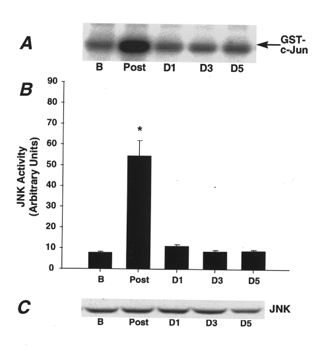
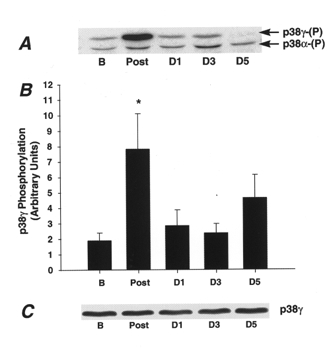
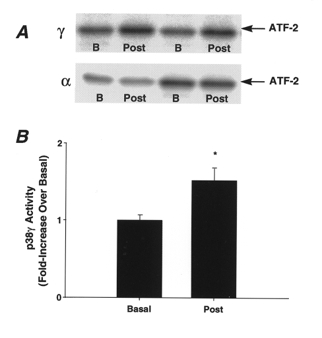
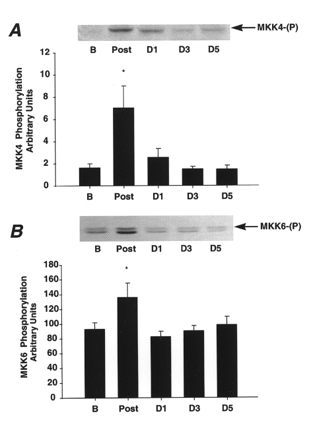
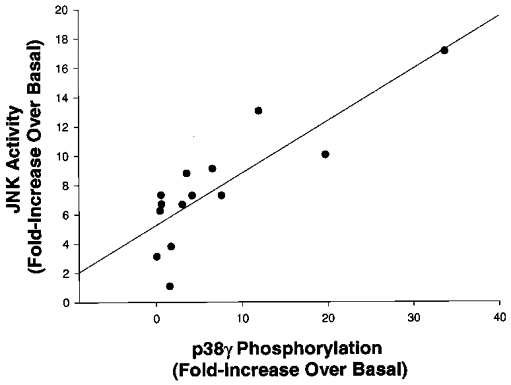
We examined the pattern of activation and deactivation of the stress-activated protein kinase signalling molecules c-Jun NH2-terminal kinase (JNK) and p38 kinase in skeletal muscle in response to prolonged strenuous running exercise in human subjects. Male subjects (n = 14; age 32 +/- 2 years; VO2,max 60 +/- 2 ml kg-1 min-1) completed a 42.2 km marathon (mean race time 3 h 35 min). Muscle biopsies were obtained 10 days prior to the marathon, immediately following the race, and 1, 3 and 5 days after the race. The activation of JNK and p38, including both p38alpha and p38gamma, was measured with immune complex assays. The phosphorylation state of p38 (alpha and gamma) and the upstream regulators of JNK and p38, mitogen-activated protein kinase kinase 4 (MKK4) and mitogen-activated protein kinase kinase 6 (MKK6), were assessed using phosphospecific antibodies. JNK activity increased 7-fold over basal level immediately post-exercise, but decreased back to basal levels 1, 3 and 5 days after the exercise. p38gamma phosphorylation (4-fold) and activity (1.5-fold) increased immediately post-exercise and returned to basal levels at 1, 3 and 5 days following exercise. In contrast, p38alpha phosphorylation and activity did not change over the time course studied. MKK4 and MKK6 phosphorylation increased and decreased in a trend similar to that observed with JNK activity and p38gamma phosphorylation. Prolonged running exercise did not affect JNK, p38alpha, or p38gamma protein expression in the days following the race. This study demonstrates that both JNK and p38 intracellular signalling cascades are robustly, yet transiently increased following prolonged running exercise. The differential activation of the p38 isoforms with exercise in human skeletal muscle indicates that these proteins may have distinct functions in vivo.
Figures
References
-
- Aronson D, Boppart MD, Dufresne SD, Fielding RA, Goodyear LJ. Exercise stimulates c-jun NH2 kinase activity in human skeletal muscle. Biochemical and Biophysical Research Communications. 1998;251:106–110. - PubMed
-
- Aronson D, Dufresne SD, Goodyear LJ. Contractile activity stimulates the c-Jun NH2-terminal kinase pathway in rat skeletal muscle. Journal of Biological Chemistry. 1997;272:25636–25640. - PubMed
-
- Asp S, Rohde T, Richter EA. Impaired muscle glycogen resynthesis after a marathon is not caused by decreased muscle GLUT-4 content. Journal of Applied Physiology. 1997;83:1482–1485. - PubMed
-
- Boppart MD, Aronson D, Gibson L, Roubenoff R, Abad LW, Bean J, Goodyear LJ, Fielding RA. Eccentric exercise markedly increases c-Jun NH2 terminal kinase activity in human skeletal muscle. Journal of Applied Physiology. 1999;87:1668–1673. - PubMed
-
- Bradford MM. A rapid and sensitive method for the quantitation of microgram quantities of protein, utilizing the principal of protein-dye binding. Analytical Biochemistry. 1976;72:248–254. - PubMed
Publication types
MeSH terms
Substances
Grants and funding
LinkOut - more resources
Full Text Sources
Medical
Research Materials
Miscellaneous
