Review
. 2000 Aug 1;97(16):8836-40.
doi: 10.1073/pnas.97.16.8836.

AvrPto-dependent Pto-interacting proteins and AvrPto-interacting proteins in tomato

Affiliations
Review

AvrPto-dependent Pto-interacting proteins and AvrPto-interacting proteins in tomato

A J Bogdanove et al. Proc Natl Acad Sci U S A. .

Abstract

The plant-intracellular interaction of the avirulence protein AvrPto of Pseudomonas syringae pathovar tomato, the agent of bacterial speck disease, and the corresponding tomato resistance protein Pto triggers responses leading to disease resistance. Pto, a serine/threonine protein kinase, also interacts with a putative downstream kinase, Pto-interactor 1, as well as with members of a family of transcription factors Pto-interactors 4, 5, and 6. These proteins are likely involved, respectively, in a phosphorylation cascade resulting in hypersensitive cell death, and in defense gene activation. The mechanism by which the interaction of AvrPto and Pto initiates defense response signaling is not known. To pursue the hypothesis that tertiary interactions are involved, we modified the yeast two-hybrid protein interaction trap and conducted a search for tomato proteins that interact with Pto only in the presence of AvrPto. Five classes of AvrPto-dependent Pto interactors were isolated, and their interaction specificity confirmed. Also, to shed light on a recently demonstrated virulence activity of AvrPto, we conducted a standard two-hybrid screen for tomato proteins in addition to Pto that interact with AvrPto: i.e., potential virulence targets or modifiers of AvrPto. By constructing an N-terminal rather than a C-terminal fusion of AvrPto to the LexA DNA binding domain, we were able to overcome autoactivation by AvrPto and identify four classes of specific AvrPto-interacting proteins.


Figures
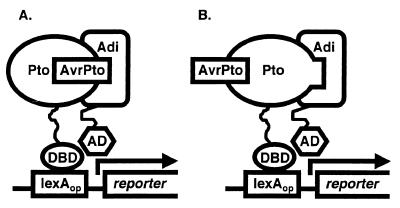
Figure 1
Figure 1
Yeast three-hybrid hunt for AvrPto-dependent Pto-interacting (Adi) proteins. Coexpression of AvrPto fused to a nuclear localization signal and of Pto fused to the DNA-binding domain (DBD) of the LexA transcriptional activator (bait fusion) made it possible to screen a library of tomato cDNA clones fused to the activation domain (AD) of LexA (prey fusion) for proteins that interact with an AvrPto-Pto complex (A) or with Pto that had assumed an AvrPto-dependent conformation (B). Association of the bait and prey reconstitutes the LexA transcriptional activator and drives expression of reporter genes (lacZ and leu2) under the control of the LexA operator (LexAop). Pto interaction with candidate Adi clones is later tested for AvrPto-dependence.
Figure 2
Figure 2
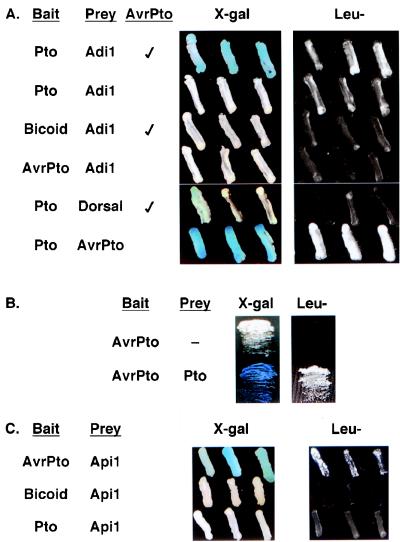
Test for AvrPto-dependence and specificity of Adi protein interactions with Pto, and for specificity of Api protein interactions with AvrPto. Individual yeast transformants expressing each of the indicated three- or two-hybrid protein combinations were streaked to minimal medium agar plates containing 40 μg/ml X-gal to assay expression of the lacZ reporter gene, indicated by a developing blue color, and to minimal medium lacking leucine to assay expression of the leu2 reporter gene, indicated by growth. The Drosophila proteins Bicoid and Dorsal were used as arbitrary bait and prey fusions (kindly provided by R. Brent, Massachusetts General Hospital) for testing the specificity of the interactions observed. (A) Adi clones were tested in yeast containing the indicated constructs. Shown are results for Adi1. Results for all of the Adi proteins are summarized in Table 1. The interaction of Pto and AvrPto is shown for reference. (B) Lack of autoactivation and confirmed interaction with Pto by the AvrPto-LexA fusion used in the hunt for AvrPto interactors. Pto prey fusion was constructed previously by X. Tang in our laboratory. (C) Api clones were tested in yeast containing the indicated constructs. Shown are results for Api1. Results for all of the Adi proteins are summarized in Table 2.
Figure 3
Figure 3
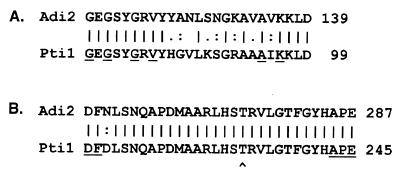
Alignments of the predicted ATP-binding sites (A) and the predicted activation domains of Adi2 and Pti1 (B). Residues that are highly conserved in similar protein kinases and that constitute the two motifs are underlined (34). T233, the major site of Pti1 autophosphorylation and phosphorylation by Pto (25), is marked with a caret.
Figure 4
Figure 4
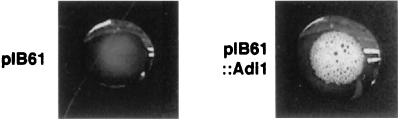
Complementation of catalase activity in yeast by expression of Adi1. Catalase-deficient Saccharomyces cerevisiae strain 578 (A. Hartig, University of Vienna) was transformed with the expression vector pIB61 (J. Pardo, Yale University School of Medicine) or with pIB61 containing the Adi1 cDNA. Transformed cells were suspended in a solution containing 1% Triton X-100 and 3% H2O2. Catalase activity is indicated by bubbling attributable to the conversion of H2O2 to H2O and O2.
Figure 5
Figure 5
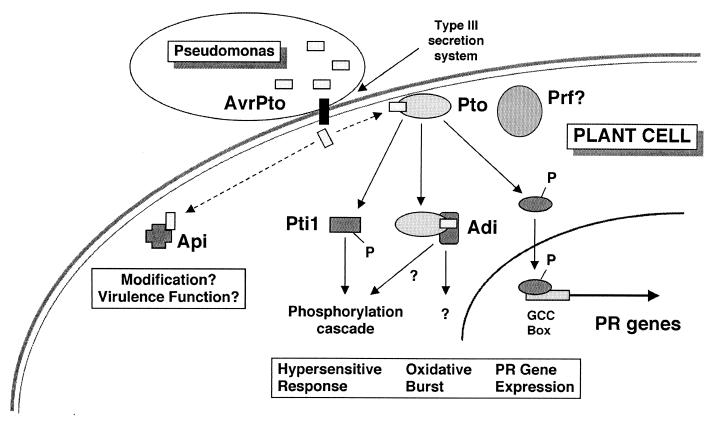
A model for disease resistance mediated by the interaction of AvrPto and Pto, and for a role of AvrPto in disease.

References

    1. Keen N T. Annu Rev Genet. 1990;24:447–463. - PubMed
    1. Dangl J L. Curr Top Microbiol Immunol. 1994;192:99–118. - PubMed
    1. Ronald P C, Salmeron J M, Carland F M, Staskawicz B J. J Bacteriol. 1992;174:1604–1611. - PMC - PubMed
    1. Salmeron J M, Staskawicz B J. Mol Gen Genet. 1993;239:6–16. - PubMed
    1. Martin G B, Brommonschenkel S H, Chunwongse J, Frary A, Ganal M W, Spivey R, Wu T, Earle E D, Tanksley S D. Science. 1993;262:1432–1436. - PubMed

Publication types

LinkOut - more resources