. 2000 Aug 1;97(16):9234-9.
doi: 10.1073/pnas.97.16.9234.

Cloning and expression of a novel human antibody-antigen pair associated with Felty's syndrome

Affiliations

Cloning and expression of a novel human antibody-antigen pair associated with Felty's syndrome

H J Ditzel et al. Proc Natl Acad Sci U S A. .

Abstract

An increasing number of studies suggest the importance of antibodies in the pathogenesis of most systemic and organ-specific autoimmune diseases, although there is considerable controversy over the precise role of the autoantibodies involved. In humans, a major obstacle to progress is the identification and cloning of the relevant autoantibodies and autoantigens. Here, an approach based on the sequential use of antibody phage display and antigen expression libraries is developed and applied to a donor suffering from rheumatoid arthritis (RA), splenomegaly, and peripheral destruction of neutrophils leading to neutropenia (Felty's syndrome). An antibody phage display library was constructed from bone marrow from the donor and a high-affinity human mAb, ANA15, selected by panning against fresh neutrophils and independently by panning against a fixed cell line. The antibody showed strong staining of neutrophils and a number of cell lines. Probing of a lambdagt11 expression library from an induced myelomonocytic cell line with the mAb ANA15 identified the eukaryotic elongation factor 1A-1 (eEF1A-1) as a novel autoantigen. The specificity of ANA15 was confirmed by reactivity with both purified and recombinant eEF1A-1. Screening of a large panel of sera revealed that 66% of patients with Felty's syndrome had elevated levels of anti-eEF1A-1 antibodies. The cloning of this antibody-antigen pair should permit rational evaluation of any pathogenicity resulting from the interaction and its significance in neutropenia.


Figures
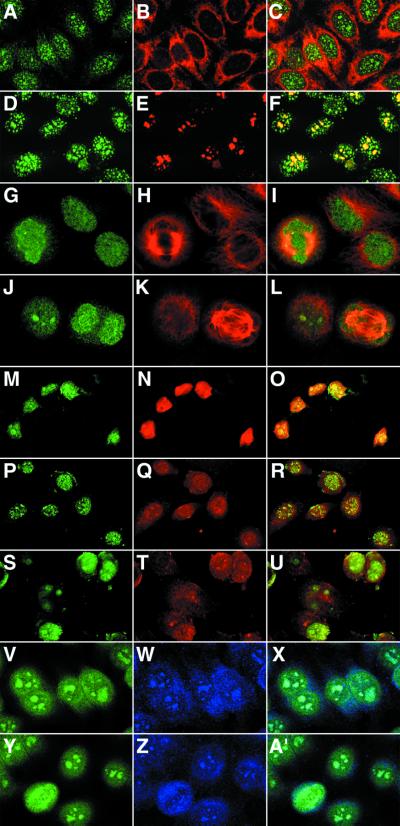
Figure 1
Figure 1
Cell distribution of eEF1A-1 in different cell types and at different stages of the cell cycle probed by Fab ANA15 with laser scanning confocal microscopy. Mammalian cell lines [HEp-2 (AL and VA′); HL-60 (MO); Cos (PR); and MB157 (SU)] were fixed, permeabilized, and stained with Fab ANA15 (all images in the first column) or mouse anti-human endoplasmic reticulum antibody (B), mouse anti-human nucleoli antibody (E), mouse anti-human α-tubulin antibody (H, K), propidium iodine (Red, N, Q, and T), or polyclonal rabbit anti-human eEF1A (W, Z). The images in column 3 are a superposition of columns 1 and 2. Cell distribution of eEF1A-1 in HEp-2 cells during metaphase (GI), and anaphase (JL) is also shown. Fab ANA15 was detected with FITC-anti-human IgG(Fab′)2 (green), the mouse antibodies with Texas Red-anti-mouse IgG (red), and the rabbit antibody with CY-5-anti-rabbit IgG antibody (blue).
Figure 2
Figure 2
Comparison of the staining patterns of Fab ANA15 and the donor serum (patient with Felty's syndrome) on ethanol-fixed HEp-2 cells and neutrophils with indirect IF. For HEp-2 cells, distinctly different staining for the two reagents was observed, whereas similar staining patterns were observed for neutrophils. Fab ANA15 stained neutrophils (arrows) but not neighboring lymphocytes (arrowheads). No staining was observed with a control Fab against HIV-1 gp120 or secondary antibody alone (not shown).
Figure 3
Figure 3
(A) SDS/PAGE analysis of fractions obtained during purification of cloned recombinant eEF1A-1 fragment. Eluates (–3), flow-through (FT), and marker (M). The gel shows that the eluted eEF1A-1 fragment has a molecular weight of ≈28 kDa. (B) Analysis of binding of Fab ANA15, polyclonal rabbit anti-human eEF1A-1 antibody, and anti-gp120 Fab L17 (negative control) to the different purification fractions (as shown in A) by using ELISA. Strong reactivity of Fab ANA15 and rabbit anti-human eEF1A-1 with the purified eEF1A-1 fragment, but no reactivity with the flow-through was observed. No binding of Fab L17 to any of the fractions was observed.
Figure 4
Figure 4
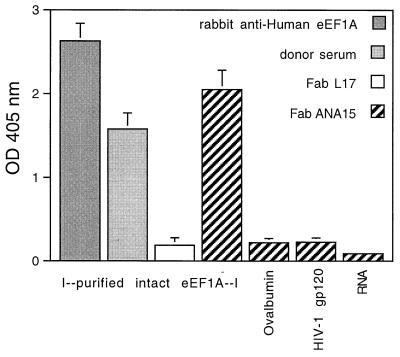
Binding of Fab ANA15 (5 μg/ml), donor serum (patient with Felty's syndrome, 1:200), polyclonal rabbit anti-human eEF1A-1 antibody (1:200), anti-gp120 Fabs L17 (negative control, 5 μg/ml) to purified intact rabbit eEF1A-1 by ELISA. To evaluate specificity, Fab ANA15 was also tested for binding to ovalbumin, HIV-1 gp120, and RNA.
Figure 5
Figure 5
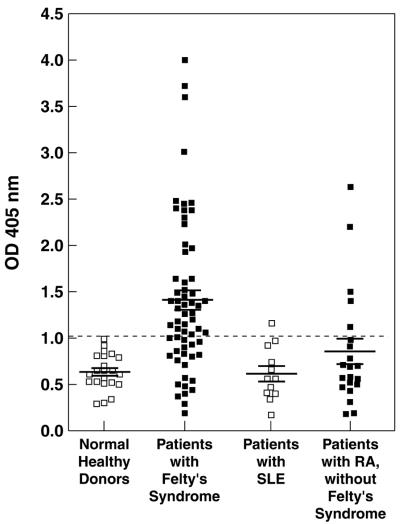
Serum antibody reactivity (1:100) against eEF1A-1 as measured by ELISA for 62 patients with Felty's syndrome, 21 patients with RA without Felty's syndrome, 11 patients with SLE, and 22 normal healthy donors. The mean and standard error for each group are shown as long and short horizontal lines, respectively.

Comment in

  • B cells in autoimmunity.
    Mitchison NA, Wedderburn LR. Mitchison NA, et al. Proc Natl Acad Sci U S A. 2000 Aug 1;97(16):8750-1. doi: 10.1073/pnas.97.16.8750. Proc Natl Acad Sci U S A. 2000. PMID: 10922029 Free PMC article. No abstract available.

References

    1. Tan E M, Cohen A S, Fries J F, Masi A T, McShane D J, Rothfield N F, Schaller J G, Talal N, Winchester R J. Arthritis Rheum. 1982;25:1271–1277. - PubMed
    1. Greaves M. Lancet. 1999;353:1348–1353. - PubMed
    1. Ziporen L, Shoenfeld Y, Levy Y, Korezyn A D. J Clin Invest. 1997;100:613–619. - PMC - PubMed
    1. Pierangeli S S, Colden-Stanfield M, Liu X, Barker J H, Anderson G L, Harris E N. Circulation. 1999;99:1997–2002. - PubMed
    1. Funauchi M, Ikoma S, Enomoto H, Ohno M, Kinoshita K, Horiuchi A, Kurata N. Intern Med. 1996;35:367–372. - PubMed

Publication types

MeSH terms

Substances

Associated data