


Review
doi: 10.1046/j.1365-2567.2000.00079.x.
Review article: ageing and the neutrophil: no appetite for killing?
Affiliations
- PMID: 10929066
- PMCID: PMC2327031
- DOI: 10.1046/j.1365-2567.2000.00079.x
Item in Clipboard
Review
Review article: ageing and the neutrophil: no appetite for killing?
Immunology.
2000 Aug.
Abstract
In the armoury of the immune system developed to combat the various micro-organisms that could invade the host, the neutrophil forms the first line of defence against rapidly dividing bacteria and fungi. However, as humans age they become more susceptible to infection with these microbes and this has been ascribed to a decline in immune status, termed immune senescence. Here we summarize the literature specifically concerning the attenuation of neutrophil function with age and the possible mechanisms underlying their reduced response to infectious agents.
Figures
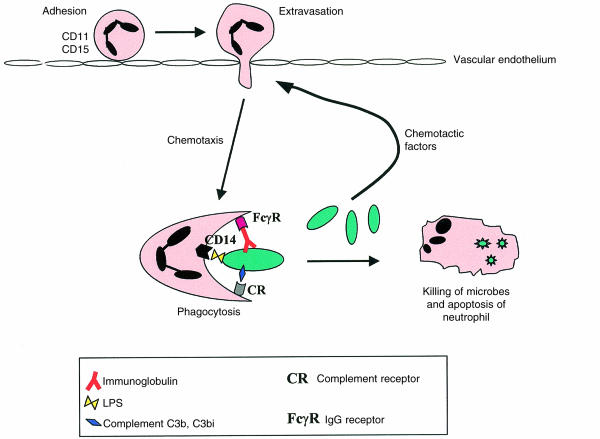
Neutrophil response to infection. The figure shows the adhesion of neutrophils to vascular endothelium, which is mediated by selectins and β2-integrins, leading to extravasation from blood into the infected tissue. Neutrophils then migrate towards the microbe along a chemotactic gradient, composed of bacterial products and activated complement molecules. The pathogenic organism is ingested by phagocytosis, which is stimulated by bacterial membrane components, complement and/or immunoglobulins, that are recognized by receptors on the neutrophil. Once ingested the microbes are killed by lytic enzymes and reactive oxygen species, and the neutrophil dies by apoptosis. LPS, lipopolysaccharide.
References
-
- Ferguson M, editor. Technology Foresight Panel on Health and Life Sciences. Progress Through Partnership Technology Foresight 4. London: HMSO; 1995.
-
- MacGregor RR, Shalit M. Neutrophil function in healthy elderly subjects. J Gerontol. 1990;45:M55. - PubMed
-
- Miller RA. The aging immune system: primer and prospectus. Science. 1996;273:70. - PubMed
-
- Fulop T. Signal transduction changes in granulocytes and lymphocytes with ageing. Immunol Lett. 1994;40:259. - PubMed
-
- Rink L, Cakman I, Kirchner H. Altered cytokine production in the elderly. Mech Ageing Dev. 1998;102:199. - PubMed
Publication types
MeSH terms
LinkOut - more resources
Full Text Sources
Medical
