. 2000 Aug;100(4):487-93.
doi: 10.1046/j.1365-2567.2000.00070.x.

Vitamin E supplementation increases T helper 1 cytokine production in old mice infected with influenza virus

Affiliations

Vitamin E supplementation increases T helper 1 cytokine production in old mice infected with influenza virus

S N Han et al. Immunology. 2000 Aug.

Abstract

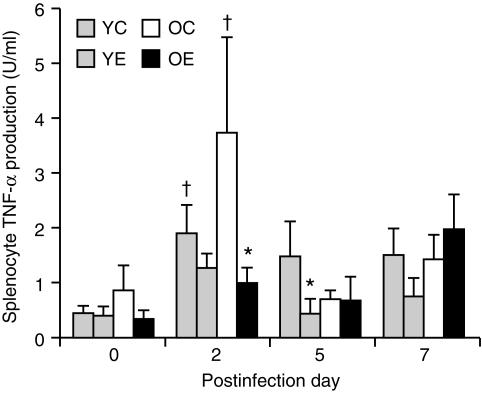
Compared with young mice, old mice infected with influenza virus have significantly higher pulmonary viral titres, although these can be reduced significantly with dietary vitamin E supplementation. T helper 1 (Th1) cytokines, especially interferon-gamma (IFN-gamma), play an important role in defending against influenza infection. However, there is an age-associated loss of Th1 cytokine production. Prostaglandin E2 (PGE2) production, which increases with age, can modulate the T helper cell function by suppressing Th1 cytokine production. To investigate the mechanism of vitamin E supplementation on reduction of influenza severity in old mice, we studied the cytokine production by splenocytes, and PGE2 production by macrophages (Mphi), in young and old C57BL mice fed semipurified diets containing 30 (control) or 500 parts per million (ppm) (supplemented) vitamin E for 8 weeks, and then infected with influenza A/PC/1/73 (H3N2). Old mice fed the control diet had significantly higher viral titres than young mice; old mice fed the vitamin E-supplemented diet had significantly lower pulmonary viral titres than those fed the control diet (P = 0.02 and 0.001 for overall age and diet effect, respectively). Following influenza infection, interleukin (IL)-2 and IFN-gamma production was significantly lower in old mice than in young mice. Vitamin E supplementation increased production of IL-2 and IFN-gamma in old mice; higher IFN-gamma production was associated with lower pulmonary viral titre. Old mice fed the control diet showed significantly higher lipopolysaccharide (LPS)-stimulated Mphi PGE2 production than old mice fed the vitamin E diet or young mice fed either diet. There was no significant age difference in IL-6, IL-1beta, or tumour necrosis factor-alpha (TNF-alpha) production by splenocytes. Young mice fed the vitamin E-supplemented diet had significantly lower IL-1beta (day 7) and TNF-alpha production (day 5) compared with those fed the control diet. Old mice fed the vitamin E-supplemented diet had significantly lower TNF-alpha production (day 2) than those fed the control diet. Our results indicate that the vitamin E-induced decrease in influenza viral titre is mediated through enhancement of Th1 cytokines, which may be the result of reduced PGE2 production caused by vitamin E.


Figures
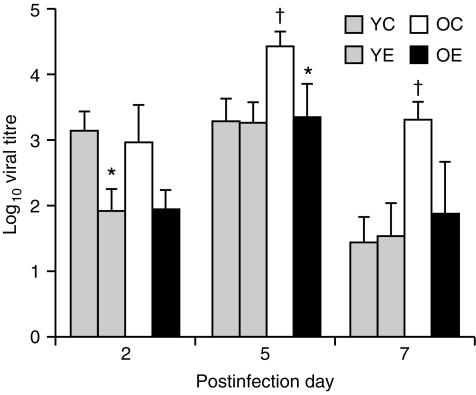
Figure 1
Figure 1
Pulmonary viral titres following infection with H3N2 influenza virus in young (6 months) and old (24 months) C57BL/6NCrlBR mice fed diets containing 30 parts per million (ppm) (control) or 500 ppm (supplemented) of dl-α-tocopheryl acetate (vitamin E) for 8 weeks. Values are expressed as mean + SEM, n = 6–9. †Significantly higher than young mice fed the control diet, at P < 0·05. *Significantly different from mice of the same age fed the control diet, as determined by Fisher's least significant test at P < 0·05. YC, young mice fed the control diet; YE, young mice fed the vitamin E-supplemented diet; OC, old mice fed the control diet; OE, old mice fed the vitamin E-supplemented diet.
Figure 2
Figure 2
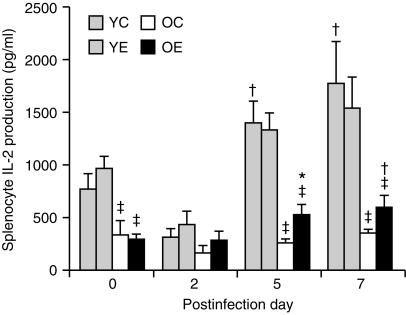
Interleukin (IL)-2 production (following infection with influenza) by splenocytes from young and old mice fed diets containing 30 parts per million (ppm) (control) or 500 ppm (supplemented) vitamin E for 8 weeks. Splenocytes (5 × 10⁶ cells/well) were stimulated with concanavalin A (Con A) (5 µg/ml) for 24 hr. Values are expressed as mean + SEM, n = 4–9. *Significantly different from mice fed the control diet, as determined by Fisher's least significant test at P < 0·05. †Significantly different from day 0 of the same age and diet group, as determined by Fisher's least significant test at P < 0·05. ‡Significantly lower than young mice of the same diet and postday at P < 0·05. YC, young mice fed the control diet; YE, young mice fed the vitamin E-supplemented diet; OC, old mice fed the control diet; OE, old mice fed the vitamin E-supplemented diet.
Figure 3
Figure 3
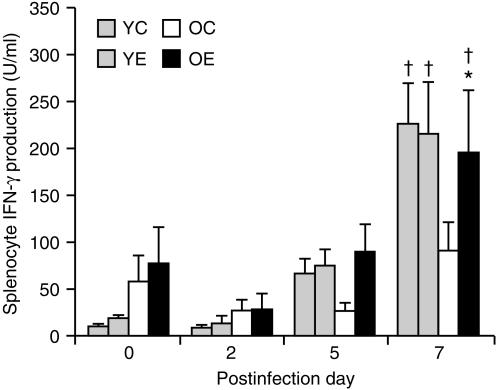
Interferon-γ (IFN-γ) production (following infection with influenza) by splenocytes from young and old mice fed diets containing 30 parts per million (ppm) (control) or 500 ppm (supplemented) vitamin E for 8 weeks. Splenocytes (5 × 10⁶ cells/well) were stimulated with concanavalin A (Con A) (5 µg/ml) for 24 hr. Values are expressed as mean + SEM, n = 4–9. *Significantly different from mice of the same age fed the control diet, as determined by Fisher's least significant test at P < 0·05. †Significantly different from day 0 of the same age and diet group, as determined by Fisher's least significant test at P < 0·05. YC, young mice fed the control diet; YE, young mice fed the vitamin E-supplemented diet; OC, old mice fed the control diet; OE, old mice fed the vitamin E-supplemented diet.
Figure 4
Figure 4
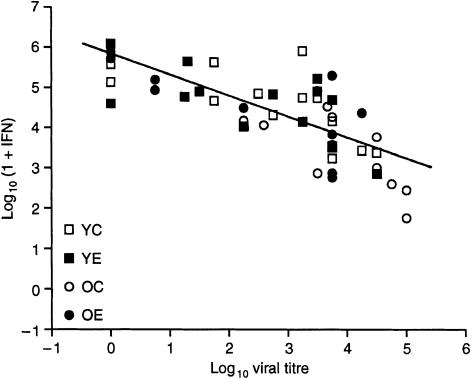
Correlation between interferon-γ (IFN-γ) levels and pulmonary viral titres on days 5 and 7. A significant, inverse correlation was observed between IFN-γ levels and viral titres (r = − 0·721, P < 0·001, n = 49), as determined by Pearson correlation.
Figure 5
Figure 5
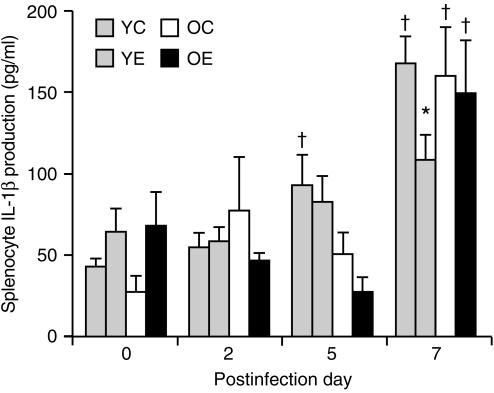
Interleukin-1β (IL-1β) production (following infection with influenza) by splenocytes from young and old mice fed diets containing 30 parts per million (ppm) (control) or 500 ppm (supplemented) vitamin E for 8 weeks. Splenocytes (5 × 10⁶ cells/well) were stimulated with lipopolysaccharide (LPS) (10 µg/ml) for 24 hr. Values are expressed as mean + SEM, n = 4–9. *Significantly different from mice fed the control diet, as determined by Fisher's least significant test at P < 0·05. †Significantly different from day 0 of the same age and diet group, as determined by Fisher's least significant test at P < 0·05. YC, young mice fed the control diet; YE, young mice fed the vitamin E-supplemented diet; OC, old mice fed the control diet; OE, old mice fed the vitamin E-supplemented diet.
Figure 6
Figure 6
Tumour necrosis factor-α (TNF-α) production (following infection with influenza) by splenocytes from young and old mice fed diets containing 30 parts per million (ppm) (control) or 500 ppm (supplemented) vitamin E for 8 weeks. Splenocytes (5 × 10⁶ cells/well) were stimulated with lipopolysaccharide (LPS) (10 µg/ml) for 24 hr. Values are expressed as mean + SEM, n = 4–9. *Significantly different from mice fed the control diet, as determined by Fisher's least significant test at P < 0·05. †Significantly different from day 0 of the same age and diet group, as determined by Fisher's least significant test at P < 0·05. YC, young mice fed the control diet; YE, young mice fed the vitamin E-supplemented diet; OC, old mice fed the control diet; OE, old mice fed the vitamin E-supplemented diet.

References

    1. Pinner RW, Teutsch SM, Simonsen L, et al. Trends in infectious diseases mortality in the United States. JAMA. 1996;275:189. - PubMed
    1. CDC. Pneumonia and influenza death rates-United States. MMWR. 1979;1995:535. - PubMed
    1. Bender BS, Johnson MP, Small PA., Jr Influenza in senescent mice: impaired cytotoxic T-lymphocyte activity is correlated with prolonged infection. Immunology. 1991;72:514. - PMC - PubMed
    1. Taylor SF, Cottey RJ, Zander DS, Bender BS. Influenza infection of β2-microglobulin-deficient (β2m–/–) mice reveals a loss of CD4+ T cell functions with aging. J Immunol. 1997;159:3453. - PubMed
    1. Rink L, Cakman I, Kirchner H. Altered cytokine production in the elderly. Mech Ageing Dev. 1998;102:199. - PubMed

Publication types

LinkOut - more resources