. 2000 Sep;74(17):8028-37.
doi: 10.1128/jvi.74.17.8028-8037.2000.

Role of human cytomegalovirus immediate-early proteins in cell growth control

Affiliations

Role of human cytomegalovirus immediate-early proteins in cell growth control

J P Castillo et al. J Virol. 2000 Sep.

Abstract

Human cytomegalovirus (HCMV) is a ubiquitous herpesvirus that has been implicated in several disorders, including an association between HCMV reactivation and the overproliferation of arterial smooth muscle cells observed in restenosis. Although HCMV can mediate a growth-arrest phenotype in infected cells, the virus can also promote an environment conducive to proliferation. Here, we present evidence that the HCMV immediate-early (IE) proteins, IE1-72 and IE2-86, may be responsible for inducing this proliferative environment by altering cell cycle control. We find that expression of either of these IE proteins can alter the cell cycle distribution of randomly cycling cells towards S and G(2)/M phases. Additionally, we find that expression of IE2-86, but not IE1-72, induces quiescent cells into S phase and delays cell cycle exit. In the absence of p53, IE1-72 expression can induce S phase and delay cell cycle exit. We also demonstrate that p53 protein levels increase in fibroblasts following the expression of IE1-72. The observed accumulation of p53 protein in IE1-72-expressing cells may account for the inability of IE1-72 to induce S phase and delay cell cycle exit. Our data suggest that expression of HCMV IE1-72 and IE2-86 is sufficient to alter the cell cycle to generate an environment conducive to proliferation.


Figures
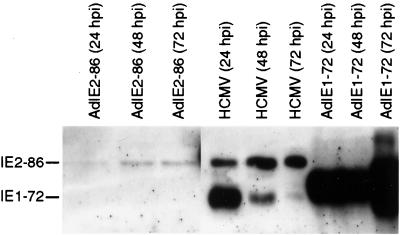
FIG. 1
FIG. 1
Expression of HCMV proteins IE1-72 and IE2-86 in REF52 cells infected with AdIE1-72 or AdIE2-86. Western blot analysis of protein from whole-cell lysates from REF52 cells infected with either AdIE1-72 or AdIE2-86 (MOI = 250) (100 μg/lane) or HEL cells infected with HCMV (Towne) (MOI = 5) (25 μg/lane). Recombinant adenovirus infections were performed at an MOI of 250. Cell lysates were harvested at the times postinfection indicated. HCMV IE proteins were identified by probing with an anti-cytomegalovirus monoclonal antibody specific for a common determinant.
FIG. 2
FIG. 2
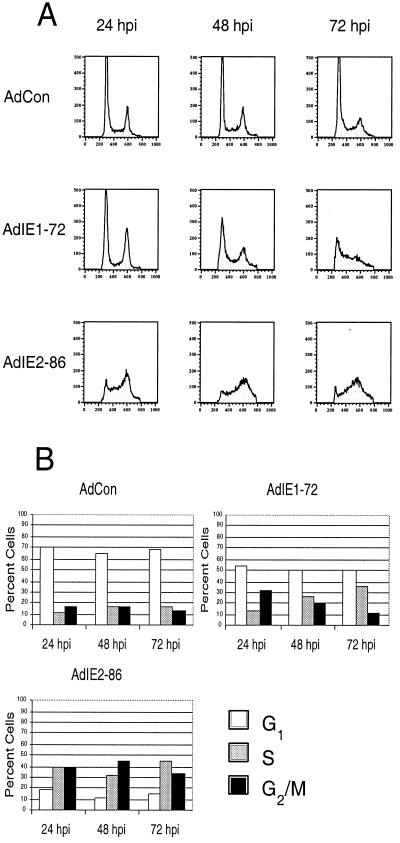
Expression of HCMV IE1-72 and IE2-86 disrupts cell cycle progression in asynchronously cycling cells. Cells were infected with AdIE1-72, AdIE2-86, or AdCon at an MOI of 500 as described in Materials and Methods. Following infection, cells were fixed at the times indicated, and stained with PI. Flow cytometric analysis for cellular DNA content was performed by assessing the levels of PI incorporated by the cells. (A) Fluorescence-activated cell sorter (FACS) analysis from infected REF52 cells stained with PI; (B) histograms summarizing FACS data from infected REF52 cells.
FIG. 3
FIG. 3
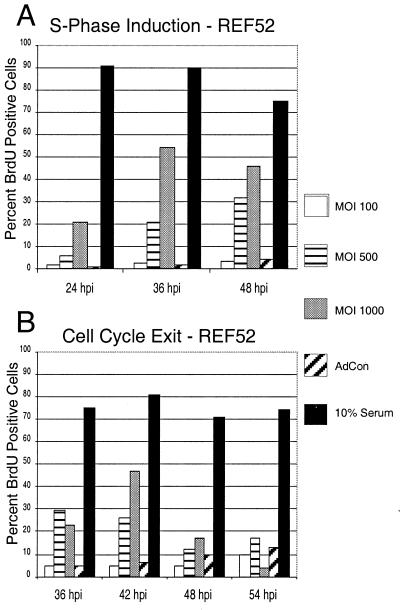
IE2-86 induces quiescent cells to proliferate and delays cell cycle exit in cells. (A) REF52 cells were rendered quiescent by culturing in the presence of 0.25% serum and then infected with AdIE2-86 (at the MOI indicated) or AdCon (MOI = 500). Cells were maintained in media containing 0.25% serum and pulsed with 10 μM BrdU for 12 h prior to harvest at the indicated times postinfection. (B) Asynchronous cultures of REF52 cells were infected with AdIE2-86 (at the MOI indicated) or AdCon (MOI = 500) and then subjected to culture in reduced serum (0.25%). Cells were pulsed with BrdU for 12 h prior to harvest at the indicated times postinfection. For both panels, cells were immunohistochemically stained for BrdU incorporation with an anti-BrdU monoclonal antibody, and the number of BrdU-positive cells was scored against the total number of cells counted per well.
FIG. 4
FIG. 4
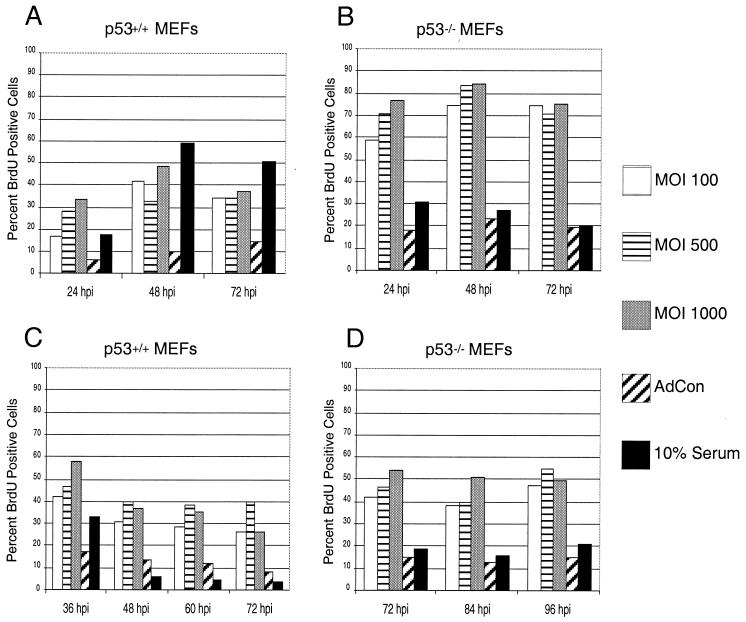
IE2-86 induces proliferation and delays cell cycle exit in p53+/+ and p53−/− MEFs. Early-passage p53+/+ (A) or p53−/− (B) MEFs were cultured under low serum conditions appropriate to induce growth arrest. Cells were then infected with AdIE2-86 at the indicated MOIs or with AdCon (MOI = 500) and maintained under low serum conditions. Cells were pulsed with BrdU for 12 h prior to harvesting at the indicated times postinfection. Early-passage p53+/+ (C) or p53−/− (D) MEFs were infected with AdIE2-86 (at the MOIs indicated) or with AdCon (MOI = 500) and then subjected to serum starvation. Cells were pulsed with BrdU for 12 h prior to harvesting at the indicated times postinfection. In each experiment shown, BrdU positive cells were identified by immunohistochemical staining and the number of BrdU-positive cells was scored against the total number of cells counted per well.
FIG. 5
FIG. 5
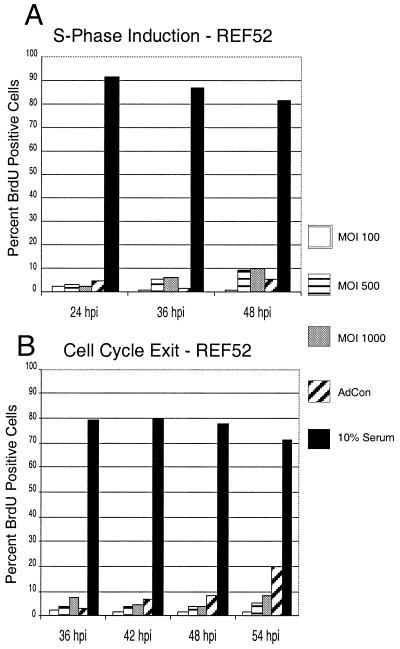
IE1-72 fails to induce quiescent cells to proliferate and does not delay cell cycle exit in REF52 cells. (A) REF52 cells were rendered quiescent by culturing in the presence of 0.25% serum and infected with AdIE1-72 (at the MOIs indicated) or AdCon (MOI = 500). Cells were maintained in media containing 0.25% serum and pulsed with 10 μM BrdU for 12 h prior to harvest. (B) Asynchronous cultures of REF52 cells were infected with AdIE1-72 (at the MOIs indicated) or AdCon (MOI = 500) and then subjected to serum withdrawal. Cells were pulsed with BrdU 12 h prior to harvesting. For both panels, cells were immunohistochemically stained for BrdU incorporation with an anti-BrdU monoclonal antibody and the number of BrdU-positive cells was scored against the total number of cells counted per well.
FIG. 6
FIG. 6
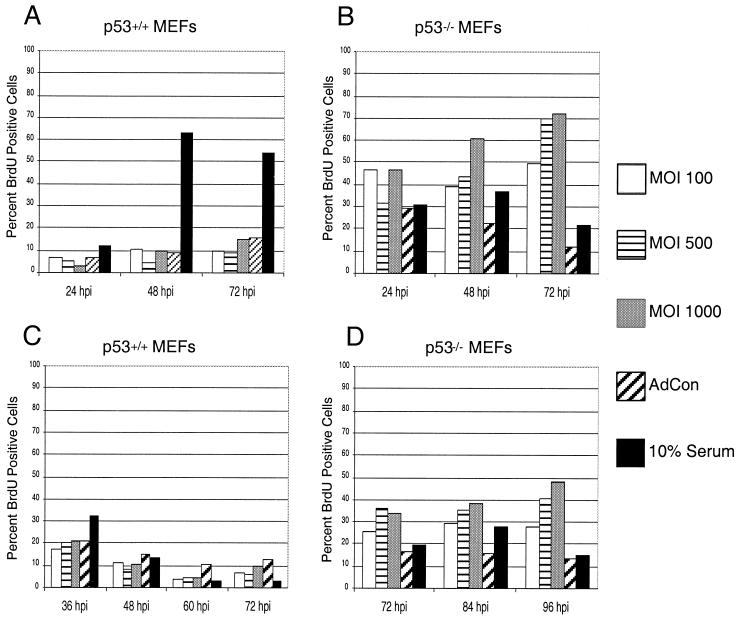
IE1-72 induces proliferation and delays cell cycle exit in the absence of p53. Early passage p53+/+ (A) and p53−/− (B) MEFs were growth arrested as described earlier and then infected with AdIE1-72 (at the MOI indicated) or AdCon (MOI = 500). Cells were pulsed with BrdU for 12 h prior to harvesting at the indicated times postinfection. Early passage p53+/+ (C) and p53−/− (D) MEFs were infected with AdIE1-72 (at the MOI indicated) or AdCon (MOI = 500) and then subjected to serum withdrawal. Cells were pulsed with BrdU for 12 h prior to harvesting at the indicated times postinfection. In each experiment, cells were immunohistochemically stained with an anti-BrdU monoclonal antibody (MAb) and the number of BrdU-positive cells scored against the total number of cells counted per well.
FIG. 7
FIG. 7
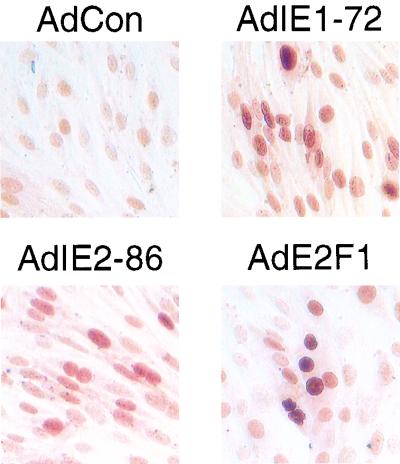
IE1-72 and IE2-86 expression promotes p53 accumulation in REF52 cells. Near-confluent cultures of REF52 cells were infected with AdIE1-72, AdIE2-86, or AdCon at an MOI of 500 and cultured under normal conditions. Cells infected with AdE2F1 served as a positive control for the experiment. At 24 h p.i., cells were harvested, fixed with formaldehyde, and immunohistochemically stained for p53 using a commercial anti-p53 MAb.

References

    1. Ahn J H, Hayward G S. The major immediate-early proteins IE1 and IE2 of human cytomegalovirus colocalize with and disrupt PML-associated nuclear bodies at very early times in infected permissive cells. J Virol. 1997;71:4599–4613. - PMC - PubMed
    1. Albrecht T, Nachtigal M, St. Jeor S C, Rapp F. Induction of cellular DNA synthesis and increased mitotic activity in Syrian hamster embryo cells abortively infected with human cytomegalovirus. J Gen Virol. 1976;30:167–177. - PubMed
    1. Bargonetti J, Reynisdottir I, Friedman P N, Prives C. Site-specific binding of wild-type p53 to cellular DNA is inhibited by SV40 T antigen and mutant p53. Genes Dev. 1992;6:1886–1898. - PubMed
    1. Boldogh I, AbuBakar S, Albrecht T. Activation of proto-oncogenes: an immediate early event in human cytomegalovirus infection. Science. 1990;247:561–564. - PubMed
    1. Bonin L R, McDougall J K. Human cytomegalovirus IE2 86-kilodalton protein binds p53 but does not abrogate G1 checkpoint function. J Virol. 1997;71:5861–5870. - PMC - PubMed

Publication types

MeSH terms

Substances