


Identification of genetic loci controlling the characteristics and severity of brain and spinal cord lesions in experimental allergic encephalomyelitis
- PMID: 10934166
- PMCID: PMC1850129
- DOI: 10.1016/S0002-9440(10)64574-9
Identification of genetic loci controlling the characteristics and severity of brain and spinal cord lesions in experimental allergic encephalomyelitis
Abstract
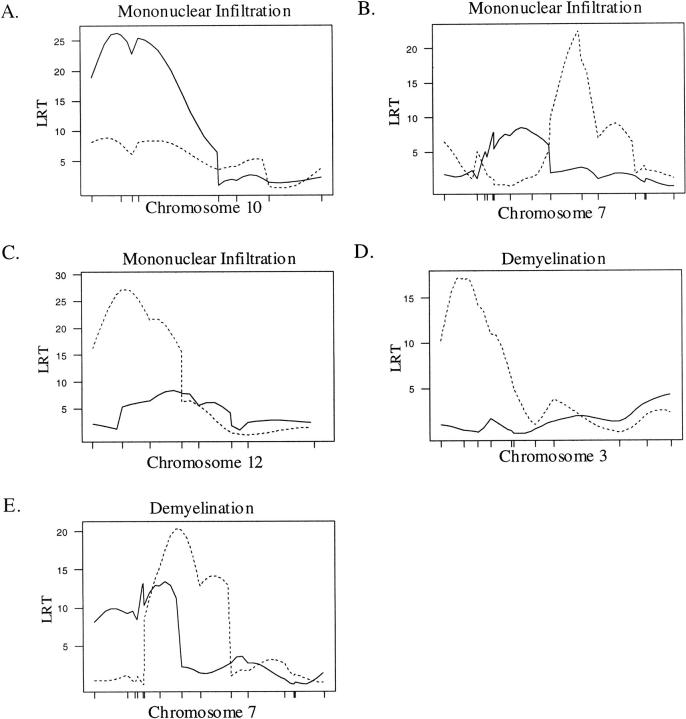
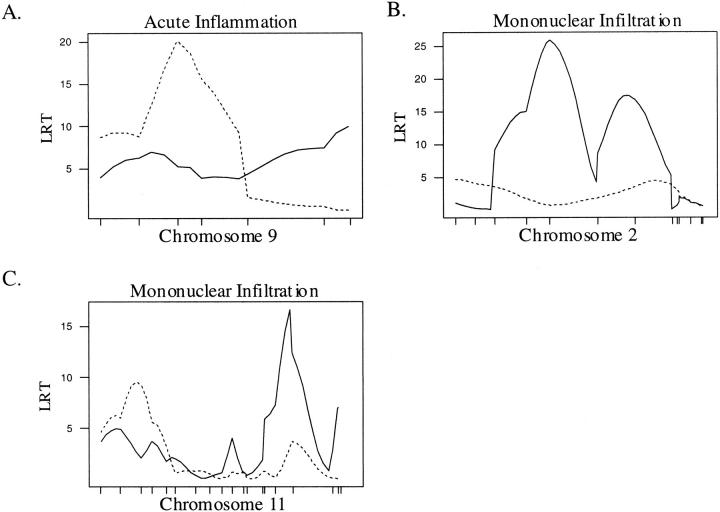
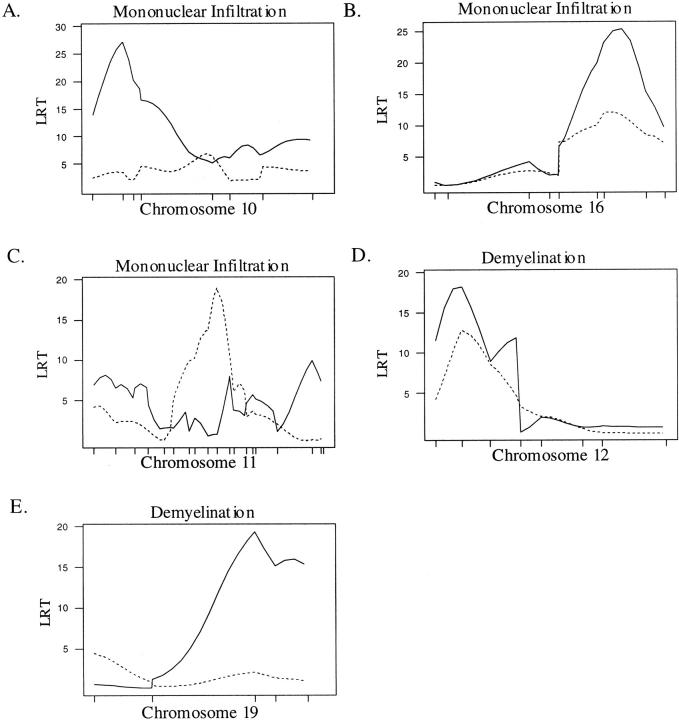
Experimental allergic encephalomyelitis (EAE) is the principal genetically determined animal model for multiple sclerosis (MS), the major inflammatory disease of the central nervous system (CNS). Although genetics clearly play a role in susceptibility to MS, attempts to identify the underlying genes have been disappointing. Considerable variation exists between MS patients with regard to the severity of clinical signs, mechanism of demyelination, and location of CNS lesions, confounding the interpretation of genetic data. A mouse-human synteny mapping approach may allow the identification of candidate susceptibility loci for MS based on the location of EAE susceptibility loci. To date, 16 regions of the mouse genome have been identified that control susceptibility or clinical signs of EAE. In this work, we examined the genetic control of histopathological lesions of EAE in an F2 intercross population generated from the EAE susceptible SJL/J and EAE resistant B10.S/DvTe mouse strains. Composite interval mapping was used to identify 10 quantitative trait loci (QTL), including seven newly identified loci controlling the distribution and severity of CNS lesions associated with murine EAE. QTL on chromosome 10 control lesions in the brain, whereas QTL on chromosomes 3, 7, and 12 control lesions in the spinal cord. Furthermore, sexually dimorphic QTL on chromosomes 2, 9, and 11 control CNS lesions in females, whereas QTL on chromosomes 10, 11, 12, 16, and 19 control lesions in males. Our results suggest that the severity and location of CNS lesions in EAE are genetically controlled, and that the genetic component controlling the character and severity of the lesions can be influenced by sex.
Figures
References
-
- Ebers GC, Sadovnick AD, Risch NJ: A genetic basis for familial aggregation in multiple sclerosis. Canadian Collaborative Study Group [see comments]. Nature 1995, 377:150-151 - PubMed
-
- Ewing C, Bernard CC: Insights into the etiology and pathogenesis of multiple sclerosis. Immunol Cell Biol 1998, 76:47-54 - PubMed
-
- Sawcer S, Jones HB, Feakes R, Gray J, Smaldon N, Chataway J, Robertson N, Clayton D, Goodfellow PN, Compston A: A genome screen in multiple sclerosis reveals susceptibility loci on chromosome 6p21 and 17q22 [see comments]. Nat Genet 1996, 13:464-468 - PubMed
-
- Haines JL, Ter Minassian M, Bazyk A, Gusella JF, Kim DJ, Terwedow H, Pericak-Vance MA, Rimmler JB, Haynes CS, Roses AD, Lee A, Shaner B, Menold M, Seboun E, Fitoussi RP, Gartioux C, Reyes C, Ribierre F, Gyapay G, Weissenbach J, Hauser SL, Goodkin DE, Lincoln R, Usuku K, Oksenberg JR: A complete genomic screen for multiple sclerosis underscores a role for the major histocompatability complex. The Multiple Sclerosis Genetics Group. Nat Genet 1996, 13:469–471 - PubMed
-
- Ebers GC, Kukay K, Bulman DE, Sadovnick AD, Rice G, Anderson C, Armstrong H, Cousin K, Bell RB, Hader W, Paty DW, Hashimoto S, Oger J, Duquette P, Warren S, Gray T, O’Connor P, Nath A, Auty A, Metz L, Francis G, Paulseth JE, Murray TJ, Pryse-Phillips W, Risch N: A full genome search in multiple sclerosis [see comments]. Nat Genet 1996, 13:472-476 - PubMed
Publication types
MeSH terms
Grants and funding
LinkOut - more resources
Full Text Sources
Other Literature Sources
Molecular Biology Databases
Miscellaneous
