Review
. 1999 Aug;1(3):197-207.
doi: 10.1038/sj.neo.7900037.

Causes and effects of heterogeneous perfusion in tumors

Affiliations
Review

Causes and effects of heterogeneous perfusion in tumors

R J Gillies et al. Neoplasia. 1999 Aug.

Abstract

A characteristic of solid tumors is their heterogeneous distribution of blood flow, with significant hypoxia and acidity in low-flow regions. We review effects of heterogeneous tumor perfusion are reviewed and propose a conceptual model for its cause. Hypoxic-acidic regions are resistant to chemo- and radiotherapy and may stimulate progression to a more metastatic phenotype. In normal tissues, hypoxia and acidity induce angiogenesis, which is expected to improve perfusion. However, aggressive tumors can have high local microvessel density simultaneously with significant regions of hypoxia and acidosis. A possible explanation for this apparent contradiction is that the mechanisms regulating growth and adaptation of vascular networks are impaired. According to a recent theory for structural adaptation of vascular networks, four interrelated adaptive responses can work as a self-regulating system to produce a mature and efficient blood distribution system in normal tissues. It is proposed that heterogeneous perfusion in tumors may result from perturbation of this system. Angiogenesis may increase perfusion heterogeneity in tumors by increasing the disparity between parallel low- and high-resistance flow pathways. This conceptual model provides a basis for future rational therapies. For example, it indicates that selective destruction of tumor vasculature may increase perfusion efficiency and improve therapeutic efficacy.


Figures

Figure 1
Figure 1
Axial and sagittal sections through magnetic resonance image of MCF-7 human breast cancer xenograft growing in mammary fat pad of SCID mouse. Two minutes before acquisition of these T1-weighted images, the animal was injected with 27 µL Magnevist (Gd DTPA), which enhances thermal relaxation of spins, yielding higher signal intensities. The signal intensity is roughly proportional to the gadolinium concentration in each voxel.
Figure 2
Figure 2
Schematic of enhancement curve as a function of time in DEMRI. Sum refers to the signal observed in each voxel as a function of time. This signal has two major components: the arterial input function, which is related to the blood flow and the vascular volume, and the leak (k21), which is related to the permeability and surface area of the blood vessels in each voxel.
Figure 3
Figure 3
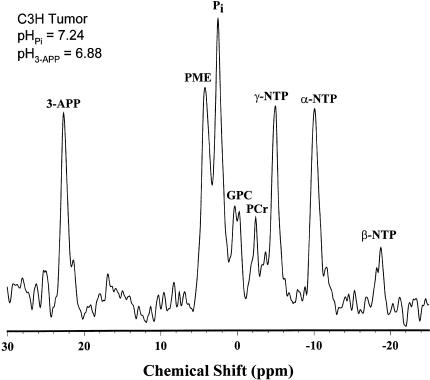
PRESS-localized 31P-MR spectrum of a C3H tumor in the mammary fat pad of a C3H/Hen mouse. 3-aminopropylphosphonate (3-APP) is an exogenous, nontoxic, and impermeant indicator of the extracellular pH. (PME, phosphomonoesters; Pi, inorganic phosphate, primarily intracellular and used as indicator of intracellular pH; GPC, glycerolphosphorylcholine; PCr, phosphocreatine; NTP, nucleoside triphosphates).
Figure 4
Figure 4
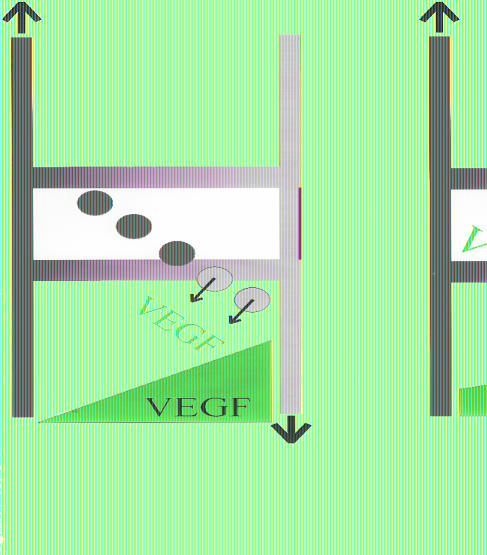
Schematic showing differences in tumor and normal tissue vasculature. The vertical segments represent the afferent (red) and efferent (blue) vessels, and the cross members represent different capillary modules. The thickness of the capillary module is inversely proportional to the resistance. The color represents oxygenated (red) and deoxygenated (blue) blood. Cells are represented as circles and are either oxygenated (red) or deoxygenated (blue). In the normal tissues, only deoxygenated cells secrete VEGF, whereas all cells secrete VEGF in the tumor. The potential morphogenetic gradient for VEGF is shown in green and is steeper in the normal tissues.
Figure 5
Figure 5
The effect of angiogenesis on blood flow. In case A, angiogenesis results in a reduction of resistance across the lower module, which results in improved blood flow to this volume (state I). In case B, angiogenesis results in addition of new vessels in parallel with the upper module, causing a decrease in resistance, and this steals blood flow from the lower module, causing a volume of decreased perfusion. In case C, angiogenesis adds vessels in series with the lower module, causing an increase in resistance and reduced flow through this module.
Figure 6
Figure 6
Diagram showing angiogenesis in series and parallel. In the addition of vessels in series, the resistance increases, causing decreased flow through the upper module. In the addition of vessels in parallel, there is a decrease in the resistance, causing an increase in flow across the lower module. This steals flow from the upper module and causes decreased perfusion there.

References

    1. Gullino PM. Tumor pathophysiology: the perfusion model. Antibiot Chemother. 1980;28:35–42. - PubMed
    1. Jain RK. The Eugene M. Landis Award Lecture 1996. Delivery of molecular and cellular medicine to solid tumors. Microcirculation. 1997;4:1–23. - PubMed
    1. Vaupel P, Kallinowski F, Okunieff P. Blood flow, oxygen consumption and tissue oxygenation of human tumors. Adv Exp Med Biol. 1990;277:895–905. - PubMed
    1. Kidney DD, Dietrich RB, Goyal AK, Yan K, Bradley WG., Jr MRI of extracranial masses in children: the usefulness of gadolinium-chelate enhancement. Pediatr Radiol. 1998;28:322–328. - PubMed
    1. Furman-Haran E, Grobgeld D, Degani H. Dynamic contrast-enhanced imaging and analysis at high spatial resolution of MCF7 human breast tumors. J Magn Reson. 1997;128:161–171. - PubMed

Publication types

LinkOut - more resources