


Review
doi: 10.1128/MCB.20.17.6185-6194.2000.
Class II transactivator: mastering the art of major histocompatibility complex expression
Affiliations
- PMID: 10938095
- PMCID: PMC86093
- DOI: 10.1128/MCB.20.17.6185-6194.2000
Item in Clipboard
Review
Class II transactivator: mastering the art of major histocompatibility complex expression
Mol Cell Biol.
2000 Sep.
No abstract available
Figures
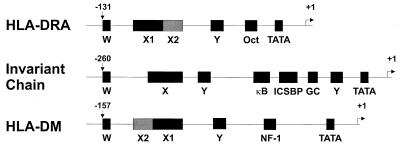
Organization of W, X, Y, and other motifs in the promoters of class II MHC and related genes. Genes coding for class II MHC and related proteins contain well conserved W, X, and Y boxes, the presence of which correlates with transcriptional regulation by CIITA.
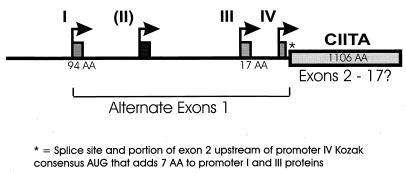
Promoter organization for CIITA. The CIITA upstream region in humans contains four promoters (I to IV) with independent start sites and alternate first exons. Significant mRNA populations have only been observed for I, III, and IV in vivo. The 3′ splice site for the first exons of promoters I and III is upstream of the translation start site for promoter IV mRNA and thus adds seven amino acid residues (∗). The core 1,106 amino acids of CIITA may be encoded by as many as 17 exons.
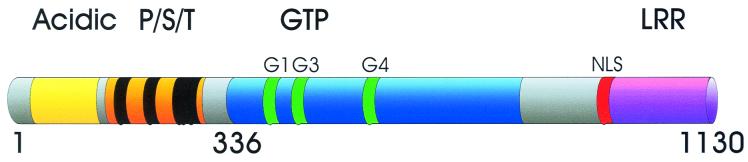
Schematic representation of protein domain organization for CIITA. Numbering corresponds to the B-cell form of CIITA. The first 336 amino acids of CIITA contain both an acidic domain and the PST domain. Residues 336 to 1130 contain the GTP-binding, NLS, and LRR motifs. G1, G3, and G4 mark the positions of specific motifs required for GTP binding (see text).
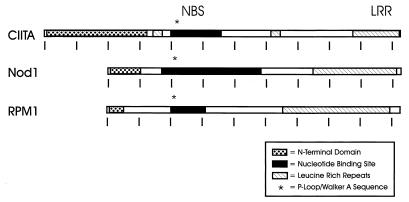
The domain organization of CIITA is similar to those of other NBS- and LRR-containing proteins. CIITA is compared to two NBS- and LRR-containing proteins, mammalian Nod1 and the plant disease resistance protein RPM1 (see text). The N-terminal domains of these proteins are dissimilar. Tick marks, intervals of approximately 100 amino acids.
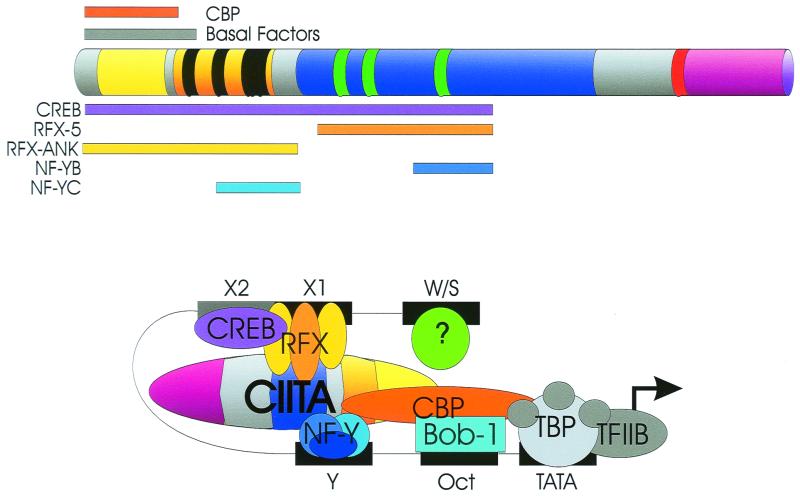
Multiple transcription factor contacts allow CIITA to function as a transcriptional scaffold and integrator. CIITA contacts components of the basal transcription machinery via its acidic domain. Interactions with RFX, RFXANK, CREB (X2BP), NF-YB, and NF-YC have been mapped. The region of CIITA required for each interaction is shown (see text). Domain markings for CIITA are the same as in Fig. 3. TBP, TATA-binding protein.
References
-
- Aisen P S. Inflammation and Alzheimer disease. Mol Chem Neuropathol. 1996;28:83–88. - PubMed
-
- Arnold H H, Braun T. Targeted inactivation of myogenic factor genes reveals their role during mouse myogenesis: a review. Int J Dev Biol. 1996;40:345–353. - PubMed
-
- Balducci-Silano P L, Suzuki K, Ohta M, Saito J, Ohmori M, Montani V, Napolitano G, Shong M, Taniguchi S I, Pietrarelli M, Lavaroni S, Mori A, Singer D S, Kohn L D. Regulation of major histocompatibility (MHC) class II human leukocyte antigen-DR alpha gene expression in thyrocytes by single strand binding protein-1, a transcription factor that also regulates thyrotropin receptor and MHC class I gene expression. Endocrinology. 1998;139:2300–2313. - PubMed
Publication types
MeSH terms
Substances
LinkOut - more resources
Full Text Sources
Other Literature Sources
Molecular Biology Databases
