. 2000 Aug;123(4):1427-36.
doi: 10.1104/pp.123.4.1427.

A plastid terminal oxidase associated with carotenoid desaturation during chromoplast differentiation

Affiliations

A plastid terminal oxidase associated with carotenoid desaturation during chromoplast differentiation

E M Josse et al. Plant Physiol. 2000 Aug.

Abstract

The Arabidopsis IMMUTANS gene encodes a plastid homolog of the mitochondrial alternative oxidase, which is associated with phytoene desaturation. Upon expression in Escherichia coli, this protein confers a detectable cyanide-resistant electron transport to isolated membranes. In this assay this activity is sensitive to n-propyl-gallate, an inhibitor of the alternative oxidase. This protein appears to be a plastid terminal oxidase (PTOX) that is functionally equivalent to a quinol:oxygen oxidoreductase. This protein was immunodetected in achlorophyllous pepper (Capsicum annuum) chromoplast membranes, and a corresponding cDNA was cloned from pepper and tomato (Lycopersicum esculentum) fruits. Genomic analysis suggests the presence of a single gene in these organisms, the expression of which parallels phytoene desaturase and zeta-carotene desaturase gene expression during fruit ripening. Furthermore, this PTOX gene is impaired in the tomato ghost mutant, which accumulates phytoene in leaves and fruits. These data show that PTOX also participates in carotenoid desaturation in chromoplasts in addition to its role during early chloroplast development.


Figures

Figure 1
Figure 1
Oxygen consumption in isolated E. coli membranes from cells expressing the Arabidopsis IMMUTANS gene product (PTOX) and control cells. a, Oxygen uptake was measured using an O2 electrode after addition of NADH as an electron donor, KCN, and n-propyl-gallate (nPG). Dithionite (Na2S2O4) was added at the end of the experiment to verify that the reactions did not proceed to complete oxygen depletion. Numbers refer to oxygen consumption in nmol O2 min−1 mg−1 protein in the linear zone of the traces (when full effect of the added compound was obtained). b, Relative respiration rate after sequential addition of NADH (set as 100), KCN, and nPG. Means of 12 experiments and se are shown. c, Same as a except that nPG was added prior to KCN. Traces are of the same scale in a given panel.
Figure 2
Figure 2
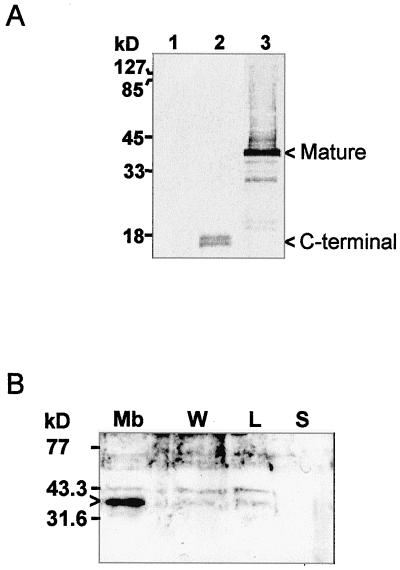
Immunodetection of the IMMUTANS polypeptide after expression in E. coli (A) and after sub-fractionation of purified chromoplasts from a ripening pepper fruit (B). A, Three E. coli strains were used: control (lane 1), expressing the 130 C-terminal amino acids (lane 2), or expressing the full mature polypeptide (lane 3). E. coli cells were grown and total protein recovered as described in “Materials and Methods.” In lane 3, the smear above the mature 41-kD band is due to incomplete resolubilization of the IMMUTANS polypeptide from inclusion bodies. B, Achlorophyllous membranes (Mb), membrane-wash fraction (W), low-density lipid fraction (L), and stroma (S) were fractionated as described in “Materials and Methods.” Protein samples were separated by SDS/12.5% (v/v) PAGE and transferred to nitrocellulose membranes. Position of size markers is shown on the left. The primary antibody was raised as described in “Materials and Methods.” A horseradish peroxidase-coupled secondary antibody was used. Detection was performed colorimetrically (A) or by enhanced chemiluminescence (B). Bands discussed in the text are indicated by arrowheads.
Figure 3
Figure 3
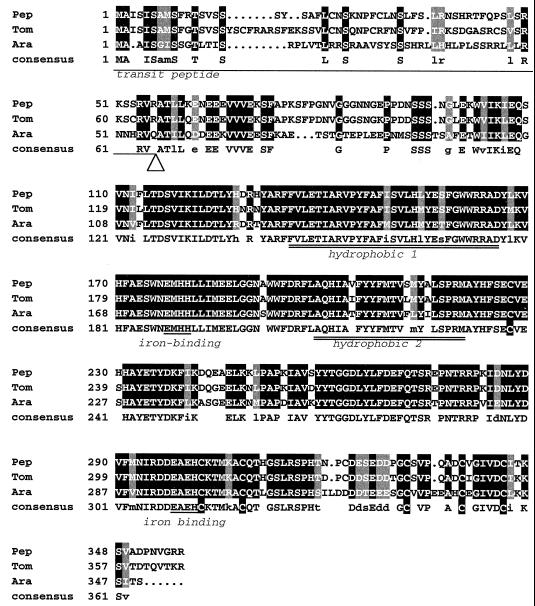
Comparison of the deduced amino acid sequences of pepper, tomato, and Arabidopsis PTOX. Amino acids identical in all sequences are boxed in black and shown in uppercase in the consensus line (where Cys are boxed). Residues identical in two sequences but substituted by an equivalent amino acid in the third are boxed in gray and shown in lowercase in the consensus line. The transit peptide, two hydrophobic domains, and two putative iron-binding sites (ExxH) are underlined. The arrowhead shows the likely cleavage site of the transit peptide.
Figure 4
Figure 4
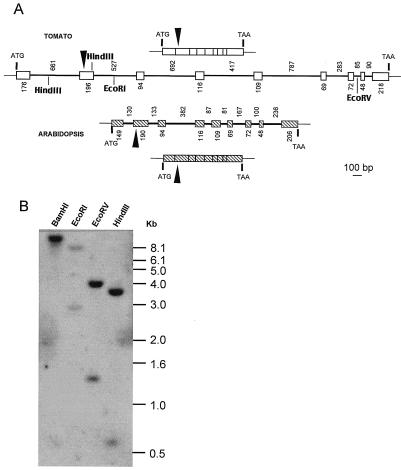
Genomic organization of PTOX from tomato and Arabidopsis. A, Schematic representation of cDNAs and genomic fragments from PTOX. Upper and lower lines represent transcripts, whereas intermediate lines represent genomic structures. Exons are indicated by boxes, introns by lines. Numbers indicate the length in base pairs of exons (below) and introns (above). Transcription start site (ATG) and stop codon (TAA) are indicated. Putative processing site of the targeting sequence is indicated with a black arrowhead. Cleavage sites for restriction enzymes used in B are shown for the tomato gene. B, Southern-blot analysis of tomato PTOX. Tomato DNA was digested with the indicated restriction endonucleases and hybridized with the radiolabeled tomato full-length cDNA probe. Size markers (kilobase pairs) are indicated on the right.
Figure 5
Figure 5
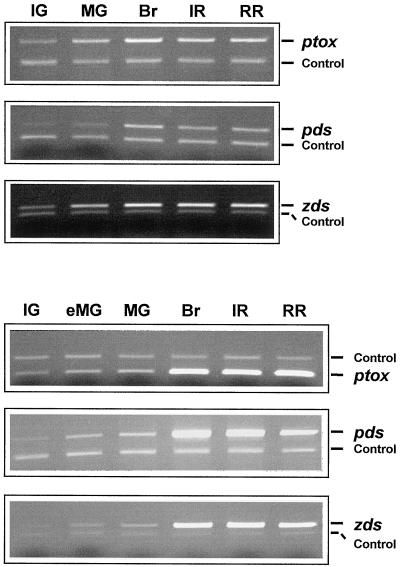
Expression of PTOX, PDS, and ZDS genes during pepper (top) and tomato (bottom) fruit development. mRNA levels were determined by RT-PCR amplification of total cellular RNA. Equal amounts of total RNA were used in each reaction. The PCR products were separated by 1.5% (v/v) agarose gel electrophoresis and visualized by ethidium bromide staining. Amplification of globin mRNA (added to the RT reaction mix) was used as a control for the RT-PCR reaction (see also “Materials and Methods”). IG, Immature green; eMG, early mature green (adult size); MG, mature green; Br, breaker; IR, intermediate red (4 d after breaker); RR, red ripe (14 d after breaker).
Figure 6
Figure 6
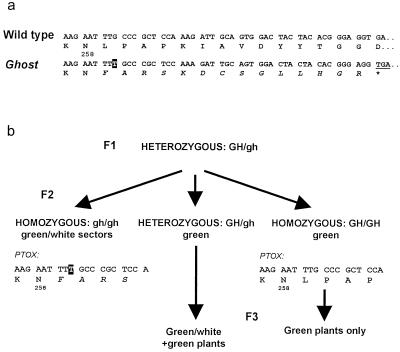
Identification of the tomato ghost gene. a, Partial sequence of the PTOX cDNA showing a T insertion (boxed) in ghost plants when compared to wild-type and deduced amino acid sequences. The amino acid sequence created by the mutation is shown in italics. b, Cosegregation of the ghost recessive phenotype and the mutation in the PTOX genomic sequence from a heterozygous F1 plant to the F2 generation. Homozygous F2 wild-type plants were discriminated from heterozygous plants in the F3 generation.

References

    1. Albrecht M, Klein A, Hugueney P, Sandmann G, Kuntz M. Molecular cloning and functional expression in E. coli of a novel plant enzyme mediating ζ-carotene desaturation. FEBS Lett. 1995;372:199–202. - PubMed
    1. Andersson ME, Nordlung P. A revised model for the active site of alternative oxidase. FEBS Lett. 1999;449:17–22. - PubMed
    1. Bartley GE, Scolnik PA, Beyer P. Two Arabidopsis thaliana carotene desaturase, expressed in Escherichia coli, catalyze a poly-cis pathway to yield pro-lycopene. Eur J Biochem. 1999;259:396–403. - PubMed
    1. Bartley GE, Vitanen PE, Pecker I, Chamovitz D, Hirschberg J, Scolnik PA. Molecular cloning and expression in photosynthetic bacteria of a soybean cDNA coding for phytoene desaturase, an enzyme of the carotenoid biosynthetic pathway. Proc Natl Acad Sci USA. 1991;88:6532–6536. - PMC - PubMed
    1. Berthold DA. Isolation of mutants of the Arabidopsis thaliana alternative oxidase (ubiquinol:oxygen oxidoreductase) resistant to salicylhydroxamic acid. Biochim Biophys Acta. 1998;1364:73–83. - PubMed

Publication types

MeSH terms