. 2000 Sep;182(17):4803-10.
doi: 10.1128/JB.182.17.4803-4810.2000.

Entry into and release of solvents by Escherichia coli in an organic-aqueous two-liquid-phase system and substrate specificity of the AcrAB-TolC solvent-extruding pump

Affiliations

Entry into and release of solvents by Escherichia coli in an organic-aqueous two-liquid-phase system and substrate specificity of the AcrAB-TolC solvent-extruding pump

N Tsukagoshi et al. J Bacteriol. 2000 Sep.

Abstract

Growth of Escherichia coli is inhibited upon exposure to a large volume of a harmful solvent, and there is an inverse correlation between the degree of inhibition and the log P(OW) of the solvent, where P(OW) is the partition coefficient measured for the partition equilibrium established between the n-octanol and water phases. The AcrAB-TolC efflux pump system is involved in maintaining intrinsic solvent resistance. We inspected the solvent resistance of delta acrAB and/or delta tolC mutants in the presence of a large volume of solvent. Both mutants were hypersensitive to weakly harmful solvents, such as nonane (log P(OW) = 5.5). The delta tolC mutant was more sensitive to nonane than the delta acrAB mutant. The solvent entered the E. coli cells rapidly. Entry of solvents with a log P(OW) higher than 4.4 was retarded in the parent cells, and the intracellular levels of these solvents were maintained at low levels. The delta tolC mutant accumulated n-nonane or decane (log P(OW) = 6. 0) more abundantly than the parent or the delta acrAB mutant. The AcrAB-TolC complex likely extrudes solvents with a log P(OW) in the range of 3.4 to 6.0 through a first-order reaction. The most favorable substrates for the efflux system were considered to be octane, heptane, and n-hexane.


Figures
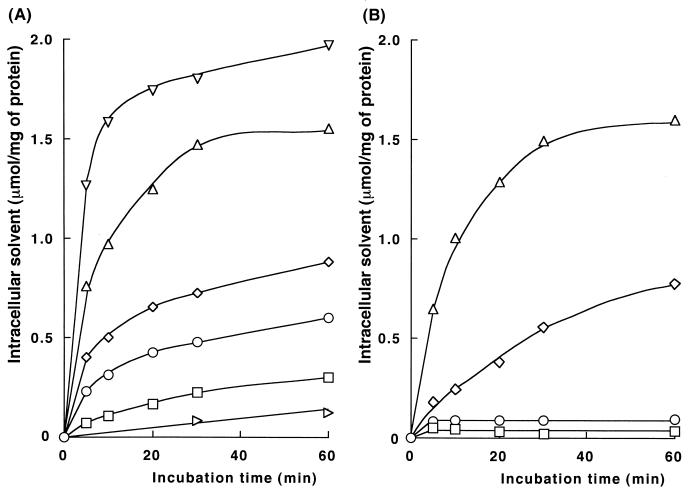
FIG. 1
FIG. 1
Entry of solvent into E. coli cells. JA300T (A) and JA300 (B) were each grown in 200 ml of LBGMg medium in a 2,000-ml Erlenmeyer flask rotated at 120 rpm. The cells in the late exponential phase (OD660, 1.5 to 2.0) were harvested by centrifugation (24°C, 4,000 × g, 6 min) and suspended in 25 ml of the medium. The suspension (5 ml) and 35 ml of the medium containing 4 ml of solvent were mixed in a 200-ml Erlenmeyer flask. The suspension was shaken at 160 rpm. Periodically, a portion of the culture was withdrawn and centrifuged (15°C, 6,000 × g, 1 min). The cells were suspended in 0.9% NaCl–10 mM MgSO4. The suspension was extracted with CHCl3, and the amount of solvent in the CHCl3 extract was measured. Each value shown is the mean value for two or three measurements. Symbols: ▿, p-xylene; ▵, cyclohexane; ◊, n-hexane; ○; heptane; □, octane; ▹, nonane.
FIG. 2
FIG. 2
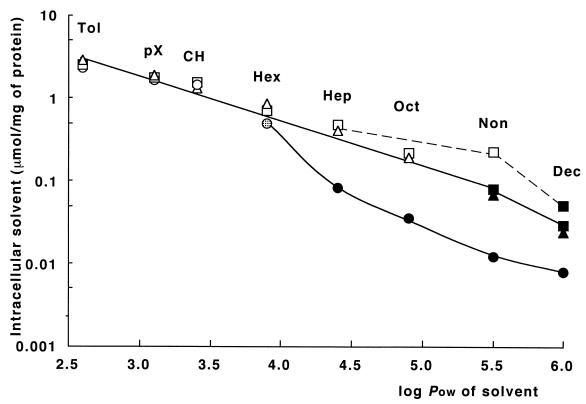
Accumulation of solvents in E. coli cells in a two-phase culture system. JA300 (circles), JA300T (squares), and JA300A (triangles) were grown in LBGMg medium and exposed to solvent in the two-phase system, as described in the legend for Fig. 1. The solvents tested were toluene (log POW = 2.64) and p-xylene (log POW = 3.14) in addition to those shown in Table 2. The suspension was shaken at 160 rpm. A portion of the culture was centrifuged (15°C, 6,000 × g, 1 min) after 30 min. The amount of solvent accumulated in the cells was measured, as described in Fig. 1. A sample was also taken 4 h after the addition of n-nonane or n-decane in the case of JA300T (the result at 4 h is shown by a broken line). Each value shown is the mean value for three measurements. The viability of the cells was examined by plating a portion of the culture on LBGMg agar. The frequency of survivors is indicated by the following symbols: open symbol, less than 10−6; dotted symbol, 10−4; solid symbol, 1. The solubilities of these solvents in water, determined at 37°C, were 5.3, 1.4, 0.68, 0.21, 0.064, 0.034, and 0.0071 mM for toluene, p-xylene, cyclohexane, n-hexane, heptane, octane, and nonane, respectively. The solubility of decane was not determined because of its low solubility.
FIG. 3
FIG. 3
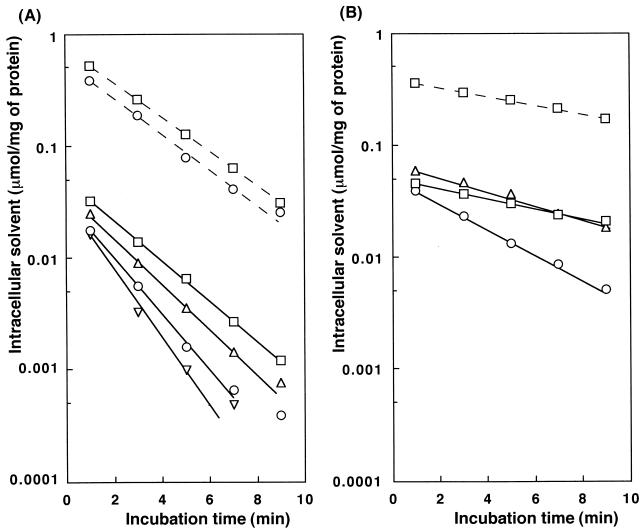
Release of intracellular solvent from E. coli cells. JA300 (○), JA300T (□), JA300A (▵), and JA300(pLKAcrAB) (▿) were loaded with n-hexane (A) or heptane (B), as described in the legend for Fig. 1. After incubation with the solvent for 30 min, the cell suspension (40 ml) was centrifuged (24°C, 6,000 × g, 1 min). The cells were suspended in 20 ml of LBGMg medium in a 50-ml Erlenmeyer flask and incubated at 37°C with shaking at 160 rpm. Time zero represents the time at which the cells were suspended in fresh medium. A portion of the cell suspension (2 ml) was withdrawn periodically and centrifuged (15°C, 6,000 × g, 1 min) at the times shown. The solvent in the cells was measured as described in the legend for Fig. 1. Solid and broken lines indicate the release of each solvent from cells in which Cc was low and high, respectively. The initial Cc was controlled by altering the volume of solvent added, as follows: for n-hexane, JA300, 0.2 or 4 ml; JA300T, 0.2 or 4 ml; JA300A, 0.2 ml; and JA300(pLKAcrAB), 0.25 ml; for heptane, JA300, 2 ml; JA300T, 0.1 or 2 ml; and JA300A, 2 ml. Each value shown is a typical example.

References

    1. Aono R, Aibe K, Inoue A, Horikoshi K. Preparation of organic solvent tolerant mutants from Escherichia coli K-12. Agric Biol Chem. 1991;55:1935–1938.
    1. Aono R, Kobayashi H. Cell surface properties of organic solvent-tolerant mutants of Escherichia coli K-12. Appl Environ Microbiol. 1997;63:3637–3642. - PMC - PubMed
    1. Aono R, Kobayashi H, Joblin K N, Horikoshi K. Effects of organic solvents on growth of Escherichia coli K-12. Biosci Biotechnol Biochem. 1994;58:2009–2014. - PubMed
    1. Aono R, Tsukagoshi N, Yamamoto M. Involvement of outer membrane protein TolC, a possible member of the mar-sox regulon, in maintenance and improvement of organic solvent tolerance of Escherichia coli K-12. J Bacteriol. 1998;180:938–944. - PMC - PubMed
    1. Fralick J A. Evidence that TolC is required for functioning of the Mar/AcrAB efflux pump of Escherichia coli. J Bacteriol. 1996;178:5803–5805. - PMC - PubMed

MeSH terms

Associated data

LinkOut - more resources