


Comment
doi: 10.1073/pnas.97.17.9351.
Resolving the relationships of resolving enzymes
Affiliations
- PMID: 10944205
- PMCID: PMC34026
- DOI: 10.1073/pnas.97.17.9351
Item in Clipboard
Comment
Resolving the relationships of resolving enzymes
Proc Natl Acad Sci U S A.
.
No abstract available
Figures
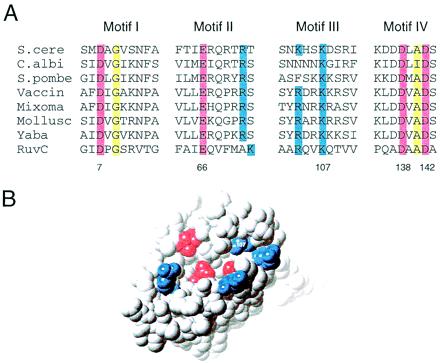
Conserved motifs in cellular junction-resolving enzymes.
(A) Sequence alignment showing the four sequence motifs
common to the mitochondrial, eubacterial, and pox viral Holliday
junction resolving enzymes. The residue numbering for E.
coli RuvC is indicated below the sequences. The four conserved
acid residues highlighted in red (D7, E66, D138, and D142) cluster in
the active site of the RuvC crystal structure (11), where they provide
ligands for the catalytic metal ions. Mutagenesis studies have shown
that all four of these acidic residues are essential for catalysis, as
are the equivalent residues E145 (E66) and D294 (D138) in the S.
cerevisiae enzyme. Basic residues conserved between RuvC and
some representatives of both the mitochondrial and pox enzymes are
highlighted in blue. Only one, K107, is absolutely conserved in all
sequences. Conserved neutral amino acids (yellow) probably play
important structural roles. Sequences are: S. cere,
Saccharomyces Cce1 (GenBank no. 416770); C. albi,
Candida Cce1 (17); S. pombe,
Schizosaccharomyces Cce1 (GenBank no. 1256525); Vaccin,
Vaccinia virus A22 protein (GenBank no. 93258); Myxoma, myxoma virus
A22 homolog (GenBank no. 6523967); Mollusc, Molluscum virus A22 homolog
(GenBank no. 1492070); Yaba, monkey pox virus A22 homolog (GenBank no.
6682807); RuvC, E. coli RuvC (GenBank no. 95767).
(B) The four acidic residues (red) and four basic
residues (blue) conserved in the eubacterial, mitochondrial, and pox
viral junction resolving enzymes are highlighted by using a
space-filling representation of a RuvC monomer (11). The residues all
group around the active site, suggesting that motifs I to IV of A are
conserved because of common roles in substrate recognition and
catalysis.
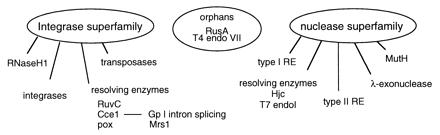
Superfamilies containing Holliday junction-resolving enzymes.
Structural studies of diverse metal ion-dependent nucleases have
revealed the existence of two superfamilies. The integrase superfamily,
whose founding member is RNaseH, includes viral transposases and
integrases as well as the Holliday junction resolving enzymes RuvC,
Cce1, and poxviral A22. The nuclease superfamily, with founder member
EcoRV, includes all of the type II and probably all of
the type I restriction enzymes, as well as diverse DNA repair endo- and
exonucleases, the archaeal resolving enzyme Hjc, and T7 endonuclease I.
The bacteriophage resolving enzymes RusA and T4 endonuclease VII cannot
be assigned to either of these superfamilies at present, although the
lineage of the former may be discernible on solution of the crystal
structure. The line lengths above bear no relationship to the degree of
divergence of family members.
Comment on
-
Bacterial-type DNA holliday junction resolvases in eukaryotic viruses.Proc Natl Acad Sci U S A. 2000 Aug 1;97(16):8926-31. doi: 10.1073/pnas.150238697. Proc Natl Acad Sci U S A. 2000. PMID: 10890916 Free PMC article.
References
-
- White M F, Giraud-Panis M-J E, Pöhler J R G, Lilley D M J. J Mol Biol. 1997;269:647–664. - PubMed
Publication types
MeSH terms
Substances
Grants and funding
LinkOut - more resources
Full Text Sources
