Effect of 1995 pill scare on rates of venous thromboembolism among women taking combined oral contraceptives: analysis of general practice research database
- PMID: 10948026
- PMCID: PMC27461
- DOI: 10.1136/bmj.321.7259.477
Effect of 1995 pill scare on rates of venous thromboembolism among women taking combined oral contraceptives: analysis of general practice research database
Abstract
Objective: To compare the incidence of venous thromboembolism among women taking combined oral contraceptives before and after the October 1995 pill scare.
Design: Analysis of General Practice Research Database.
Setting: United Kingdom, January 1993 to December 1998.
Subjects: Women aged 15-49 taking combined oral contraceptives.
Main outcome measures: Incidence of venous thromboembolism.
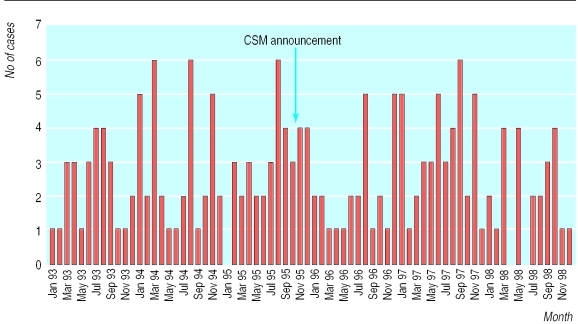
Results: Use of so called "third generation" combined oral contraceptives fell from 53% during January 1993 to October 1995 to 14% during November 1995 to December 1998. There was no significant change in the incidence of venous thromboembolism between the two periods after age was adjusted for (incidence ratio 1.04, 95% confidence interval 0.78 to 1.39).
Conclusions: The findings are not compatible with the assertion that third generation oral contraceptives are associated with a twofold increase in risk of venous thromboembolism compared with older progestogens.
PIP: In October 1995 the UK Committee on Safety of Medicines advised that combined oral contraceptives (OCs) containing either gestodene or desogestrel were associated with twice the risk of venous thromboembolism compared with older products. This study was conducted to compare the incidence of venous thromboembolism among women taking combined OCs before and after the October 1995 pill scare. Using data from the General Practice Research Database, a total of 304 practices were analyzed. Overall, results show that use of third-generation combined OCs fell from 53% during the period of January 1993 to October 1995 to 14% during the period of November 1995 to December 1998. No significant change was noted in the incidence of venous thromboembolism between the two periods after age was adjusted for (incidence ratio, 1.04; 95% confidence interval, 0.78-1.39). Based on these findings, it is concluded that third-generation OCs are not associated with a twofold increase in risk of venous thromboembolism compared with older progestogens.
Figures
Comment in
-
Pitfalls of pharmacoepidemiology.BMJ. 2000 Nov 11;321(7270):1171-2. doi: 10.1136/bmj.321.7270.1171. BMJ. 2000. PMID: 11073496 Free PMC article. No abstract available.
-
Pitfalls of pharmacoepidemiology.BMJ. 2000 Nov 25;321(7272):1352. doi: 10.1136/bmj.321.7272.1352. BMJ. 2000. PMID: 11186450 Free PMC article. No abstract available.
-
Pill claimants accuse defendants' witness of "cavalier" attitude.BMJ. 2002 May 11;324(7346):1115. doi: 10.1136/bmj.324.7346.1115. BMJ. 2002. PMID: 12003877 Free PMC article. No abstract available.
References
-
- Committee on Safety of Medicines. Combined oral contraceptives and thromboembolism. London: CSM; 1995.
-
- Poulter NR, Chang CL, Farley TMM, Meirek O, Marmot MG. World Health Organization collaborative study of cardiovascular disease and steroid hormone contraception. Venous thromboembolic disease and combined oral contraceptives: results of international multicentre case control study. Lancet. 1995;346:1575–1582. - PubMed
-
- Jick H, Jick SS, Gurewich V, Myers MW, Vasilakis C. Risk of idiopathic cardiovascular death and non-fatal venous thromboembolism in women using oral contraceptives with differing progestogen components. Lancet. 1995;346:1589–1593. - PubMed