. 2000 Aug;12(8):1467-75.
doi: 10.1105/tpc.12.8.1467.

Wound-induced expression and activation of WIG, a novel glycogen synthase kinase 3

Affiliations

Wound-induced expression and activation of WIG, a novel glycogen synthase kinase 3

C Jonak et al. Plant Cell. 2000 Aug.

Abstract

Glycogen synthase kinase 3 (GSK-3) is involved in the regulation of several physiological processes, including glycogen metabolism, protein synthesis, transcription factor activity, and developmental control. Although GSK-3-like genes have been isolated from plants, no function for any of these kinases has been defined. We report here that the alfalfa wound-induced gene (WIG, for wound-induced GSK-3), lencoding a functional plant GSK-3-like kinase, is activated when the alfalfa leaves are wounded. Although WIG transcripts are hardly detectable in mature leaves, WIG mRNA accumulates rapidly after wounding. Using a peptide antibody that specifically recognizes p53(WIG), we show that p53(WIG) kinase is activated immediately after wounding. Wound-induced activation of p53(WIG) kinase is a post-translational process, because the concentrations of p53(WIG) protein do not change in intact and wounded leaves, and inhibition of transcription or translation does not block activation by wounding. However, inactivation of p53(WIG) kinase, which usually occurs within 60 min after wounding, is dependent on transcription and translation of one or more protein factors. These data suggest that the WIG kinase is involved in wound signaling in plants.


Figures
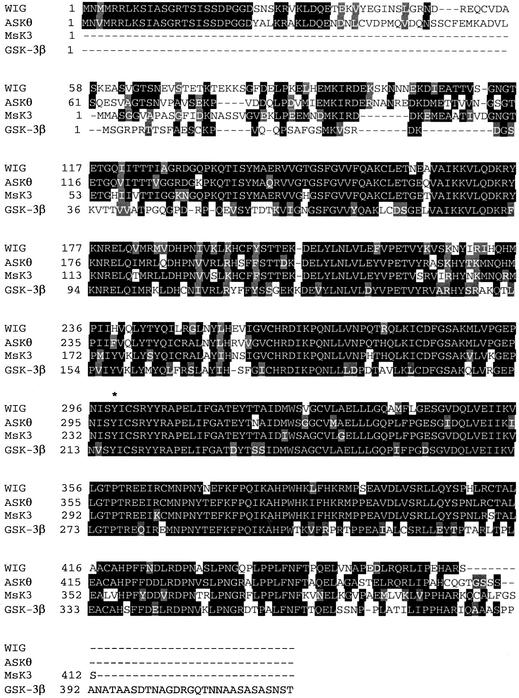
Figure 1.
Figure 1.
Alignment of the Predicted Protein Sequence of Alfalfa WIG, MsK3, Arabidopsis ASKθ, and Rat GSK-3β Protein. Identical amino acid residues are indicated by black boxes; similar amino acids are indicated with gray boxes. The tyrosine residue important for GSK-3 activity in animals and yeast is conserved in WIG and is marked with an asterisk.
Figure 2.
Figure 2.
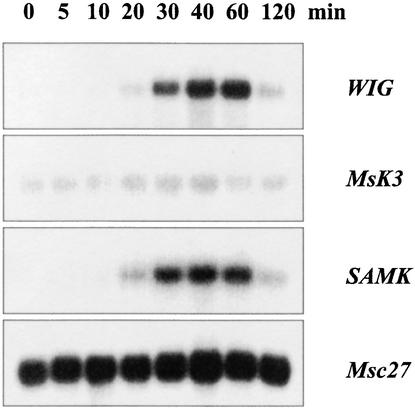
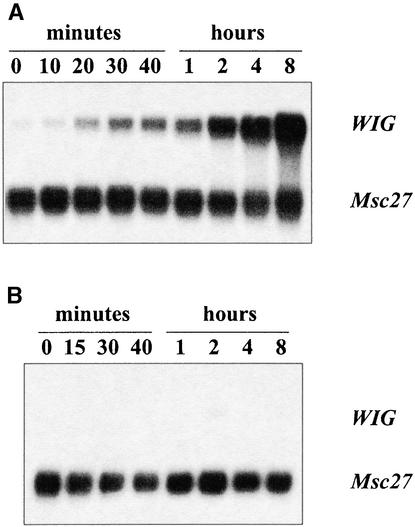
Transcriptional Induction of the WIG Gene by Wounding. RNA was extracted from leaves at the indicated times after cutting the lamina with a razor blade. Poly(A)+ RNA (1 μg per lane) was loaded on a denaturating formaldehyde gel and blotted onto a nylon membrane. The filter was sequentially hybridized with radiolabeled, 3′-specific fragments of the WIG, MsK3, and SAMK genes. As a control, the blot was hybridized with the constitutively expressed Msc27 gene.
Figure 3.
Figure 3.
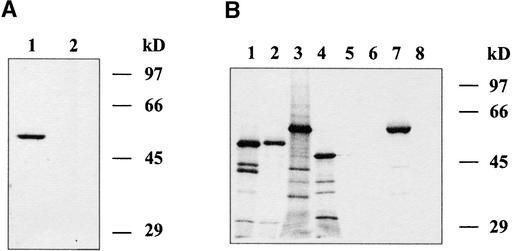
Specificity of the Anti-WIG Antibody. (A) Immunoblot of suspension-cultured alfalfa cell extract with the anti-WIG antibody without (lane 1) or with (lane 2) prior blocking of the antibody with the C-terminal WIG peptide. (B) Autoradiogram of 35S-methionine–labeled in vitro–translated proteins of MsK1, MsK4, WIG, and SAMK (lanes 1 to 4, respectively) and immunoprecipitations of in vitro–translated proteins of MsK1, MsK4, WIG, and SAMK with anti-WIG antibody (lanes 5 to 8, respectively). Numbers at the right of each gel indicate molecular mass in kilodaltons.
Figure 4.
Figure 4.
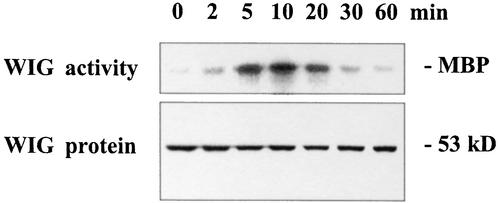
p53WIG Kinase Is Transiently Activated by Wounding, Whereas Protein Content Stays Constant. Alfalfa leaves were collected at the times indicated after wounding. (Top) Leaf extracts were immunoprecipitated with the WIG antibody. Activity of the immunoprecipitated p53WIG kinase was determined by in vitro kinase assays with γ-32P-ATP and myelin basic protein (MBP) as substrate. The phosphorylation of MBP was analyzed by autoradiography after SDS-PAGE. (Bottom) The same protein extracts were used for protein gel blot analysis with the WIG antibody.
Figure 5.
Figure 5.
Transient Insensitivity of p53WIG to Rewounding. Leaves were wounded and incubated for the times indicated before a second cutting and incubation for an additional 5 min. p53WIG kinase was immunoprecipitated from 100 μg of leaf protein extracts and assayed for kinase activity with γ-32P-ATP and MBP as substrate.
Figure 6.
Figure 6.
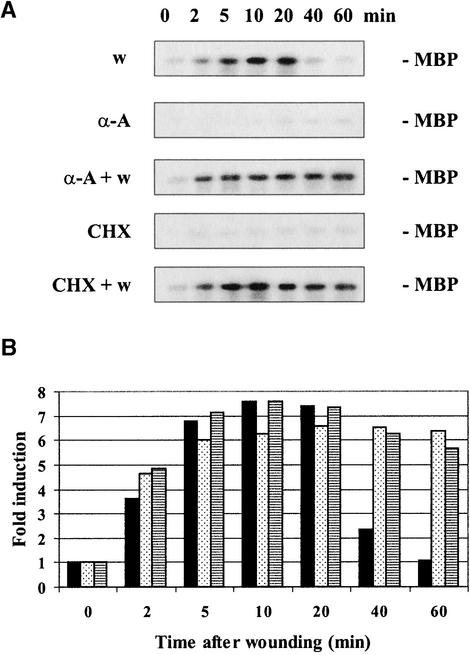
Inactivation of Wound-Induced p53WIG Activity Requires Transcription and Translation. (A) Wounded leaves were preincubated for 2 hr in medium containing no inhibitor (w), the transcription inhibitor α-amanitin at 100 μM (α-A + w), or the translation inhibitor cycloheximide at 100 μM (CHX + w). At the times indicated, leaves were collected and used to determine p53WIG activity by immunokinase assays. As a control, detached leaves were also treated with 100 μM cycloheximide (CHX) or 100 μM α-amanitin (α-A) alone. (B) PhosphorImager analysis of the p53WIG immunokinase assays after wounding in the absence (black columns) or presence (stippled columns) of 100 μM α-amanitin or 100 μM cycloheximide (striped columns). Qualitatively similar results were obtained in three independent experiments.
Figure 7.
Figure 7.
Inhibition of Protein Synthesis Provokes Sustained Wound- Induced Transcription of the WIG Gene. (A) Detached leaves were preincubated in medium containing 100 μM cycloheximide and subsequently cut with a razor blade. (B) As a control, detached leaves were treated with 100 μM cycloheximide alone. At the indicated times, leaves were collected to isolate poly(A)+ RNA. RNA gel blot analysis, using 1 μg of poly(A)+ RNA per lane, was performed simultaneously with probes specific for WIG and Msc27.

References

    1. Alessi, D.R., and Cohen, P. (1998). Mechanism of activation and function of protein kinase B. Curr. Opin. Genet. Dev. 8, 55–62. - PubMed
    1. Anderton, B.H. (1999). Alzheimer's disease: Clues from flies and worms. Curr. Biol. 9, R106–R109. - PubMed
    1. Baldwin, I.T., and Preston, C.A. (1999). The eco-physiological complexity of plant responses to insect herbivores. Planta 208, 137–145.
    1. Bianchi, M.W., Guivarc'h, D., Thomas, M., Woodgett, J.R., and Kreis, M. (1994). Arabidopsis homologs of the shaggy and GSK-3 protein kinases: Molecular cloning and functional expression in Escherichia coli. Mol. Gen. Genet. 242, 337–345. - PubMed
    1. Bögre, L., Ligterink, W., Meskiene, I., Barker, P.J. HeberleBors, E., Huskisson, N.S., and Hirt, H. (1997). Wounding induces the rapid and transient activation of a specific MAP kinase pathway. Plant Cell 9, 75–83. - PMC - PubMed

Publication types

MeSH terms

Associated data