


Efficacy of the echinocandin caspofungin against disseminated aspergillosis and candidiasis in cyclophosphamide-induced immunosuppressed mice
- PMID: 10952573
- PMCID: PMC90063
- DOI: 10.1128/AAC.44.9.2310-2318.2000
Efficacy of the echinocandin caspofungin against disseminated aspergillosis and candidiasis in cyclophosphamide-induced immunosuppressed mice
Abstract
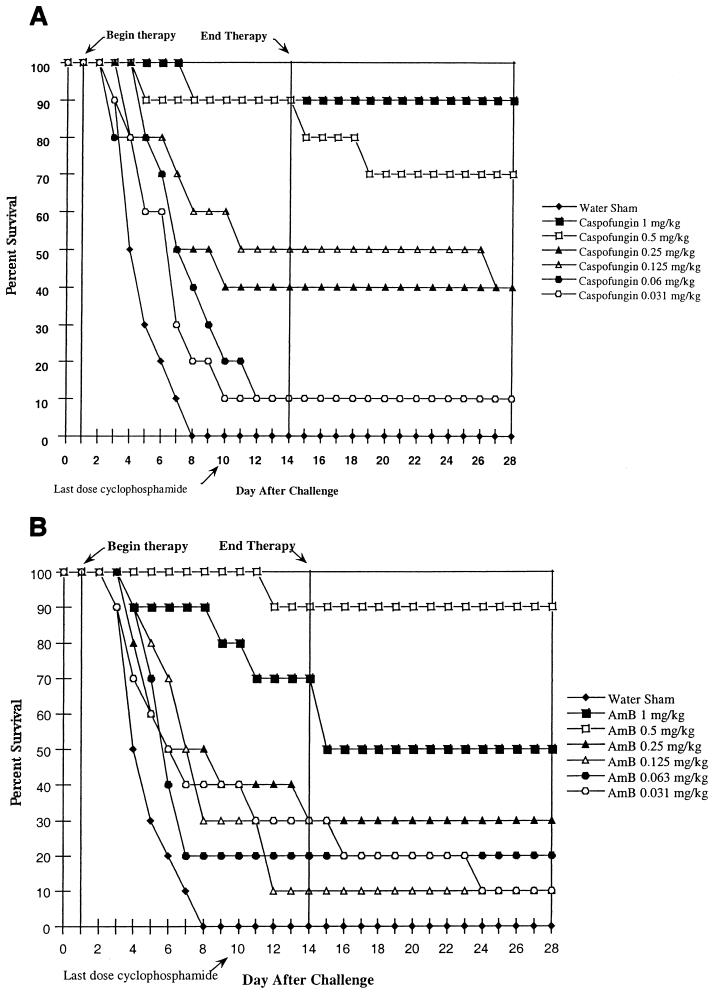
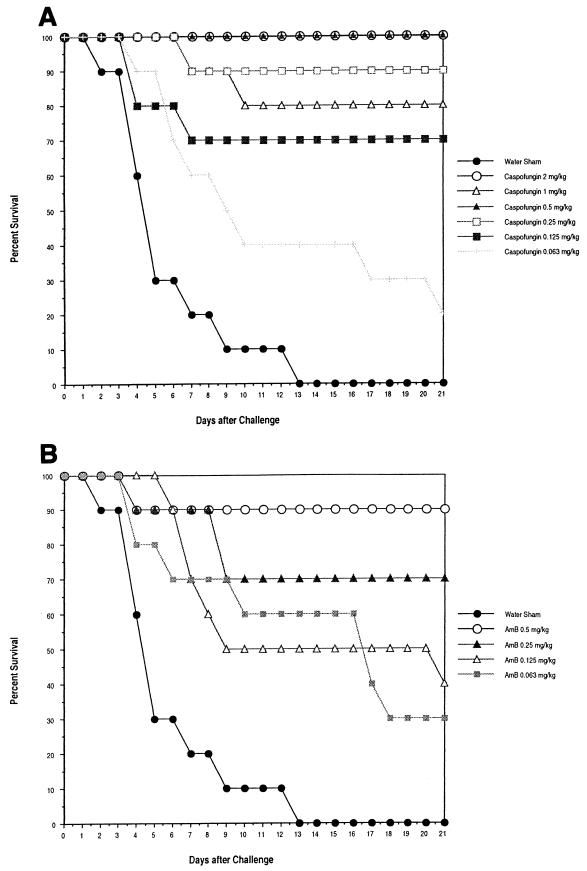
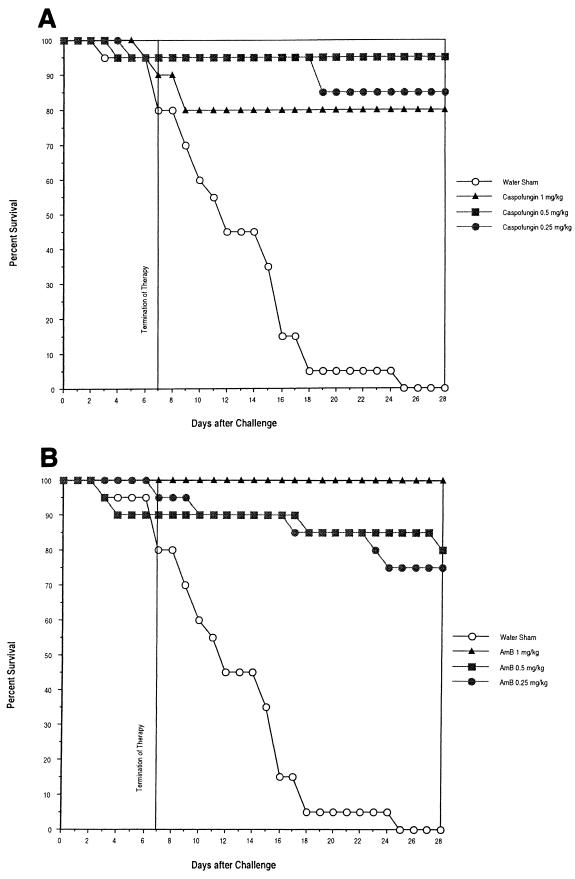
The in vivo efficacy of the echinocandin antifungal caspofungin acetate (caspofungin; MK-0991) was evaluated in models of disseminated aspergillosis and candidiasis in mice with cyclophosphamide (CY)-induced immunosuppression. Caspofungin is a 1, 3-beta-D-glucan synthesis inhibitor efficacious against a number of clinically relevant fungi including Aspergillus and Candida species. Models of CY-induced transient or chronic leukopenia were used with once daily administration of therapy initiated 24 h after microbial challenge. Caspofungin was effective in treating disseminated aspergillosis in mice that were transiently leukopenic (significant prolongation of survival at doses of > or =0.125 mg/kg of body weight and a 50% protective dose [PD(50)] of 0.245 mg/kg/day at 28 days after challenge) or chronically leukopenic (50 to 100% survival at doses of > or =0.5 mg/kg and PD(50)s ranging from 0.173 to 0.400 mg/kg/day). Caspofungin was effective in the treatment and sterilization of Candida infections in mice with transient leukopenia with a 99% effective dose based on reduction in log(10) CFU of Candida albicans/gram of kidneys of 0.119 mg/kg and 80 to 100% of the caspofungin-treated mice having sterile kidneys at caspofungin doses from 0.25 to 2.0 mg/kg. In Candida-infected mice with chronic leukopenia, caspofungin was effective at all dose levels tested (0.25 to 1.0 mg/kg), with the log(10) CFU of C. albicans/gram of kidneys of caspofungin-treated mice being significantly lower (>99% reduction) than that of sham-treated mice from day 4 to day 28 after challenge. Also, 70 to 100% of the caspofungin-treated, chronic leukopenic mice had sterile kidneys at caspofungin doses of 0.5 to 1.0 mg/kg from day 8 to 28 after challenge. Sterilization of Candida infections by caspofungin in the absence of host leukocytes provides compelling in vivo evidence for fungicidal activity against C. albicans. Further human clinical trials with caspofungin against serious fungal infections are in progress.
Figures
References
-
- Abruzzo G K, Flattery A M, Gill C J, Kong L, Smith J G, Pikounis V B, Balkovec J M, Bouffard A F, Dropinski J F, Rosen H, Kropp H, Bartizal K. Evaluation of the echinocandin antifungal MK-0991 (L-743,872): efficacies in mouse models of disseminated aspergillosis, candidiasis, and cryptococcosis. Antimicrob Agents Chemother. 1997;41:2333–2338. - PMC - PubMed
-
- Anaissie E. Opportunistic mycoses in the immunocompromised host: experience at a cancer center and review. Clin Infect Dis. 1992;14:S43–S53. - PubMed
-
- Balkovec J M, Black R M, Abruzzo G K, Bartizal K, Dreikorn S, Nollstadt K. Pneumocandin antifungal lipopeptides. The phenolic hydroxyl is required for 1,3-β-d-glucan synthesis inhibition. Bioorganic Med Chem Lett. 1993;3:2039–2042.
-
- Bills G F, Platas G, Peláez F, Mazurekar P. Reclassification of a pneumocandin-producing anamorph, Glarea lozoyensis, gen et sp. nov., previously identified as Zalerion arboricola. Mycol Res. 1998;103:179–192.
MeSH terms
Substances
LinkOut - more resources
Full Text Sources
Medical
