


Interactions between triazoles and amphotericin B against Cryptococcus neoformans
- PMID: 10952592
- PMCID: PMC90082
- DOI: 10.1128/AAC.44.9.2435-2441.2000
Interactions between triazoles and amphotericin B against Cryptococcus neoformans
Abstract
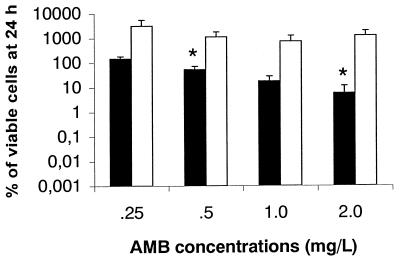
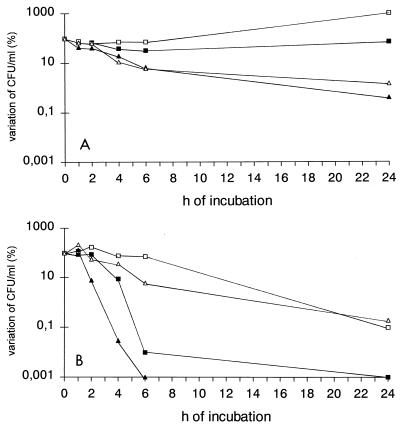
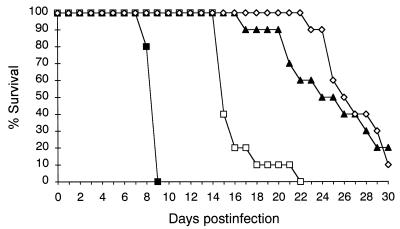
The interaction of amphotericin B (AmB) and azole antifungal agents in the treatment of fungal infections is still a controversial issue. A checkerboard titration broth microdilution-based method that adhered to the recommendations of the National Committee for Clinical Laboratory Standards was applied to study the in vitro interactions of AmB with fluconazole (FLC), itraconazole (ITC), and the new investigational triazole SCH 56592 (SCH) against 15 clinical isolates of Cryptococcus neoformans. Synergy, defined as a fractional inhibitory concentration (FIC) index of < or =0.50, was observed for 7% of the isolates in studies of the interactions of both FLC-AmB and ITC-AmB and for 33% of the isolates in studies of the SCH-AmB interactions; additivism (FICs, >0.50 to 1.0) was observed for 67, 73, and 53% of the isolates in studies of the FLC-AmB, ITC-AmB, and SCH-AmB interactions, respectively; indifference (FICs, >1.0 to < or =2.0) was observed for 26, 20, and 14% of the isolates in studies of the FLC-AmB, ITC-AmB, and SCH-AmB interactions, respectively. Antagonism (FIC >2.0) was not observed. When synergy was not achieved, there was still a decrease, although not as dramatic, in the MIC of one or both drugs when they were used in combination. To investigate the effects of FLC-AmB combination therapy in vivo, we established an experimental model of systemic cryptococcosis in BALB/c mice by intravenous injection of cells of C. neoformans 2337, a clinical isolate belonging to serotype D against which the combination of FLC and AmB yielded an additive interaction in vitro. Both survival and tissue burden studies showed that combination therapy was more effective than FLC alone and that combination therapy was at least as effective as AmB given as a single drug. On the other hand, when cells of C. neoformans 2337 were grown in FLC-containing medium, a pronounced increase in resistance to subsequent exposures to AmB was observed. In particular, killing experiments conducted with nonreplicating cells showed that preexposure to FLC abolished the fungicidal activity of the polyene. However, this apparent antagonism was not observed in vivo. Rather, when the two drugs were used sequentially for the treatment of systemic murine cryptococcosis, a reciprocal potentiation was often observed. Our study shows that (i) the combination of triazoles and AmB is significantly more active than either drug alone against C. neoformans in vitro and (ii) the concomitant or sequential use of FLC and AmB for the treatment of systemic murine cryptococcosis results in a positive interaction.
Figures
References
-
- Barchiesi F, Gallo D, Caselli F, Falconi Di Francesco L, Arzeni D, Giacometti A, Scalise G. In-vitro interactions of itraconazole with flucytosine against clinical isolates of Cryptococcus neoformans. J Antimicrob Chemother. 1999;44:65–70. - PubMed
-
- Bennet J E, Dismukes W E, Duma R J, Medoff G, Sande M A, Gallis H, et al. A comparison of amphotericin B alone and combined with flucytosine in the treatment of criptococcal meningitis. N Engl J Med. 1979;301:126–131. - PubMed
-
- Como J A, Dismukes W E. Oral azole drugs as systemic antifungal therapy. N Engl J Med. 1994;330:263–272. - PubMed
Publication types
MeSH terms
Substances
LinkOut - more resources
Full Text Sources
Other Literature Sources
Miscellaneous
