. 2000 Sep;44(9):2485-91.
doi: 10.1128/AAC.44.9.2485-2491.2000.

Concentration-dependent selection of small phenotypic differences in TEM beta-lactamase-mediated antibiotic resistance

Affiliations

Concentration-dependent selection of small phenotypic differences in TEM beta-lactamase-mediated antibiotic resistance

M C Negri et al. Antimicrob Agents Chemother. 2000 Sep.

Abstract

In this paper, the first robust experimental evidence of in vitro and in vivo concentration-dependent selection of low-level antibiotic-resistant genetic variants is described. The work is based on the study of an asymmetric competition assay with pairs of isogenic Escherichia coli strains, differing only (apart from a neutral chromosomal marker) in a single amino acid replacement in a plasmid-mediated TEM-1 beta-lactamase enzyme, which results in the new TEM-12 beta-lactamase. The mixture was challenged by different antibiotic concentrations, both in vitro and in the animal model, and the selective process of the variant population was carefully monitored. A mathematical model was constructed to test the hypothesis that measured growth and killing rates of the individual TEM variants at different antibiotic concentrations could be used to predict quantitatively the strength of selection for TEM-12 observed in competition experiments at these different concentrations.


Figures
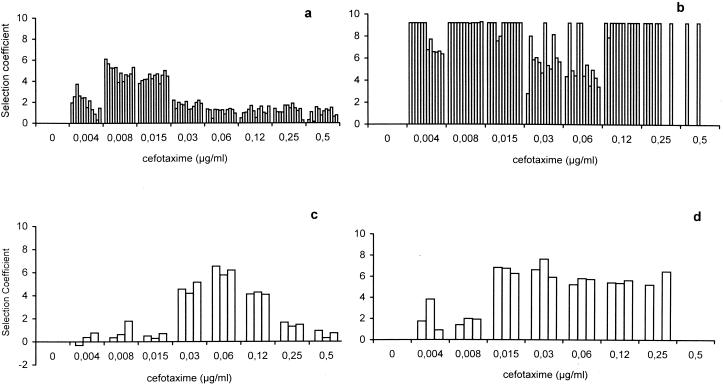
FIG. 1
FIG. 1
The top graphs show selection rates for an E. coli strain (REL606 or REL607) harboring the plasmid pBGTEM-12 (size of inoculum, 104 CFU/ml) in competition with the isogenic strain harboring pBGTEM-1 (REL607 or REL606; size of inoculum, 106 CFU/ml) in the presence of cefotaxime. For each antibiotic concentration, 12 replicated experiments are represented (6 for the direct and 6 for the inverse competitions). (a) Selection after 4 h of cefotaxime exposure. (b) Selection after 5 days of continuous challenge with each cefotaxime concentration. The bottom graphs show selection rates for the E. coli CAB281Nalr strain harboring pBGTEM-12, in competition with CAB281Nals harboring pBGTEM-1. (c) Selection after 4 h of cefotaxime exposure. (d) Selection after 5 days of continuous challenge with each cefotaxime concentration.
FIG. 2
FIG. 2
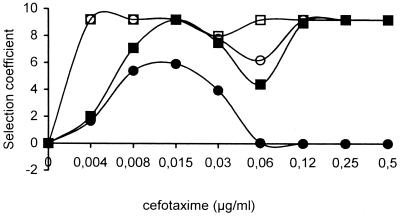
Evolution in time of the selection rates for E. coli REL606 strains harboring pBGTEM-12 in competition with REL607 harboring pBGTEM-1 in the presence of cefotaxime. Proportion in the original inoculum was 104/106 CFU/ml. Black circles, 4 h of exposure; black squares, 24 h; white circles, 48 h; white squares, 72 h.
FIG. 3
FIG. 3
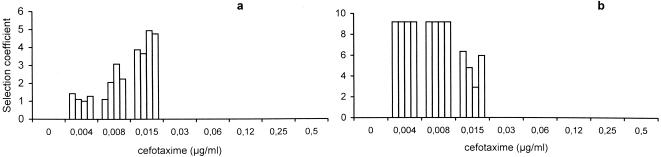
Effect of a low inoculum on selection rates of E. coli strain REL606 harboring the plasmid pBGTEM-12 (size of inoculum, 103 CFU/ml), in competition with the isogenic REL607 strain harboring pBGTEM-1 (size of inoculum, 105 CFU/ml) in the presence of different cefotaxime concentrations. Selection rates after 4 h of challenge (a) and after 5 days of continuous challenge (b) with cefotaxime are shown. For each antibiotic concentration, results from four replicated experiments are represented.
FIG. 4
FIG. 4
Growth rates of the strains REL606(pBGTEM-1) (black rhombus), REL607(pBGTEM-12) (black squares), REL606(pBGTEM-1) OmpF (dashed line and black triangles), and REL607(pBGTEM-12) OmpF (dashed line and black squares) at different cefotaxime concentrations. The points correspond to the means of two separate experiments.
FIG. 5
FIG. 5
Comparison of selection coefficients of the strain containing TEM-12 as predicted for the mathematical model (squares) and those obtained from data of experimental competition experiments. Competition between homologous E. coli strains containing either pBGTEM-12 or pBGTEM-1 was done in the presence of cefotaxime for 4 h (a) and 5 days (b). Mean (± 1 SD) experimental selection rates for six experiments with TEM-1 in REL606 (triangles) or REL607 (circles) are shown. White squares, model predictions.
FIG. 6
FIG. 6
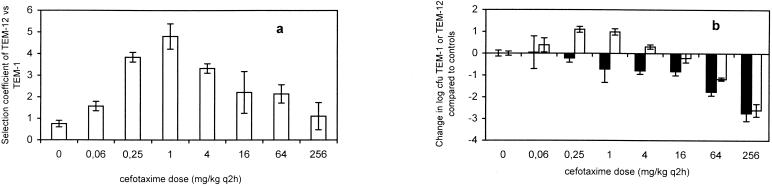
(a) Selection coefficients r (calculated according to equation 1) ± the SD of the E. coli CAB281NalR-TEM-12 strain under in vivo competition experiments with CAB281-TEM-1. Cefotaxime doses are given as mg/kg/dose; six doses were administered q12h. (b) Changes (log10 CFU) in bacteria containing TEM1 (black bars) and TEM12 (white bars) ± the SD at various cefotaxime doses, relative to controls. Most bars are negative, indicating that fewer bacteria were recovered in treated animals. Positive bars indicate that more TEM-12 bacteria were recovered from treated animals than from controls at specified concentrations.

References

    1. Baquero F, Blázquez J. Evolution of antibiotic resistance. Trends Ecol Evol. 1997;12:482–487. - PubMed
    1. Baquero F, Negri M C. Selective compartments for resistant microorganisms in antibiotic gradients. Bioessays. 1997;19:731–736. - PubMed
    1. Baquero F, Negri M C, Morosini M I, Blázquez J. Antibiotic selective environments. Clin Infect Dis. 1998;27(Suppl. 1):5–11. - PubMed
    1. Blázquez J, Morosini M I, Negri M C, González-Leiza M, Baquero F. Single amino acid replacements at positions altered in naturally occurring extended-spectrum TEM β-lactamases. Antimicrob Agents Chemother. 1995;39:145–149. - PMC - PubMed
    1. Blázquez J, Morosini M I, Negri M C, Baquero F. Selection of naturally occurring extended-spectrum TEM β-lactamase variants by fluctuating β-lactam pressure. Antimicrob Agents Chemother. 2000;44:2182–2184. - PMC - PubMed

MeSH terms

LinkOut - more resources