


Comparative Study
doi: 10.1128/AAC.44.9.2549-2553.2000.
Molecular characterization of FOX-4, a new AmpC-type plasmid-mediated beta-lactamase from an Escherichia coli strain isolated in Spain
Affiliations
- PMID: 10952615
- PMCID: PMC90105
- DOI: 10.1128/AAC.44.9.2549-2553.2000
Item in Clipboard
Comparative Study
Molecular characterization of FOX-4, a new AmpC-type plasmid-mediated beta-lactamase from an Escherichia coli strain isolated in Spain
Antimicrob Agents Chemother.
2000 Sep.
Abstract
A clinical strain of Escherichia coli (Ec GCE) displayed resistance to cefoxitin, cefotetan, cefotaxime, and ceftazidime. Susceptibility was not restored by the addition of clavulanic acid. Two beta-lactamases with apparent pIs of 5.4 and 6.4 were identified; the beta-lactamase with a pI of 6.4 was transferred by conjugation and associated with a 40-kb plasmid. Analysis of the nucleotide sequence showed a new ampC beta-lactamase gene that is closely related to those encoding the FOX-3, FOX-2, and FOX-1 beta-lactamases but whose product has four novel amino acid mutations, at positions 11 (M-->T), 43 (A-->E), 233 (V-->A), and 280 (Y-->H). This first cephamycinase from Spain was named FOX-4.
Figures
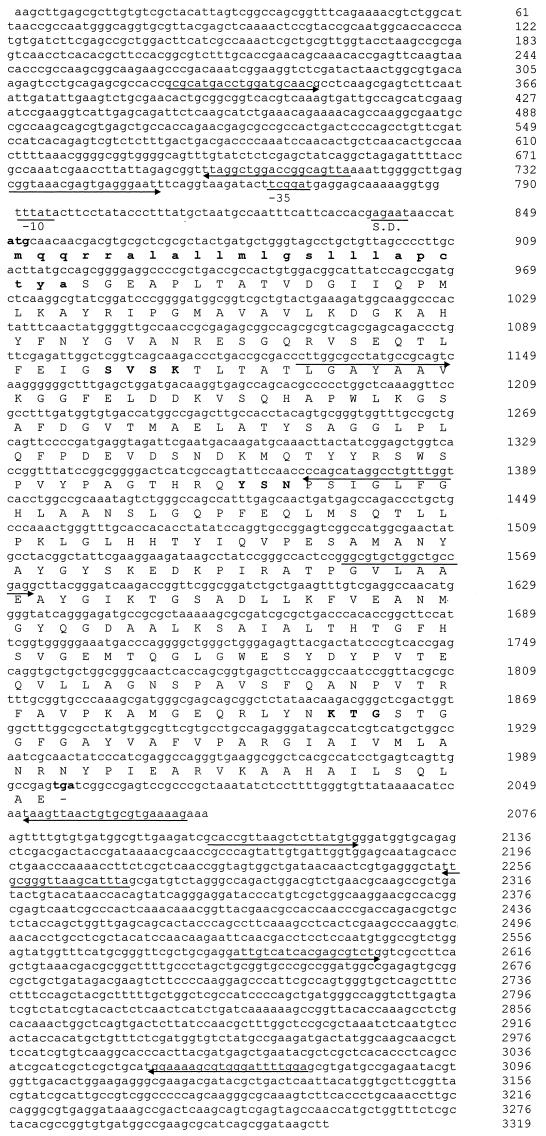
Nucleotide sequence of the 3.3-kb fragment. The deduced amino acid sequence of FOX-4 β-lactamase is shown in the line below the nucleotide triplets. The boldface ATG and TGA represent the initiation and termination codons, respectively. A putative Shine-Dalgarno (S.D.) ribosomal recognition site and −10 and −35 consensus sequences are indicated. The positions of the primers used to sequence the gene are indicated by arrows. The β-lactamase active site SVSK, the conserved triad KTG, and the typical class C motif YXN are presented in boldface. Nucleotides 1 to 64 and 2353 to 3319 correspond to ORF341, previously identified in the In7 integron. Nucleotides 65 to 808 and 2059 to 2352 correspond to a conserved region in the same In7 integron (EMBL database accession no. L06418).
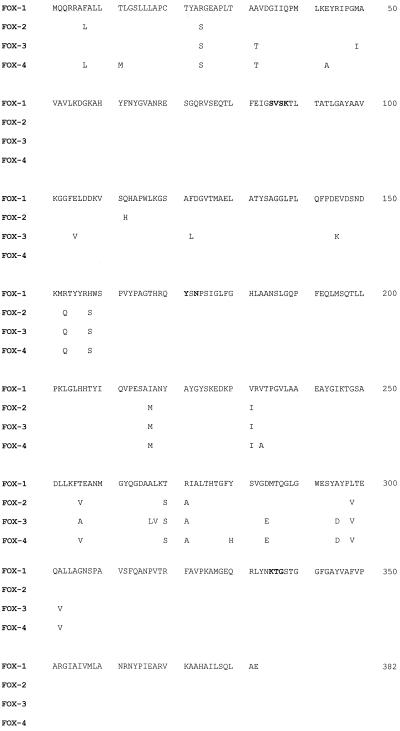
Amino acid sequences of the FOX enzymes. Amino acid replacements are indicated. The β-lactamase active site SVSK, the conserved triad KTG, and the typical class C motif YXN are presented in boldface.
References
-
- Ambler R P. The structure of β-lactamases. Philos Trans R Soc Lond B. 1980;289:321–331. - PubMed
Publication types
MeSH terms
Substances
Associated data
- Actions
LinkOut - more resources
Full Text Sources
Other Literature Sources
Research Materials
Miscellaneous
