. 2000 Aug;130(8):1859-64.
doi: 10.1038/sj.bjp.0703511.

Ginsenoside-induced relaxation of human bronchial smooth muscle via release of nitric oxide

Affiliations

Ginsenoside-induced relaxation of human bronchial smooth muscle via release of nitric oxide

J Tamaoki et al. Br J Pharmacol. 2000 Aug.

Abstract

Ginsenoside, an extract of Panax ginseng, is an essential constituent of anti-asthmatic Chinese herbal medicine. To elucidate whether ginsenoside affects airway smooth muscle tone and, if so, what the mechanism of action is, we studied relaxant responses of human bronchial strips under isometric condition in vitro, and directly measured the release of nitric oxide (NO) by an amperometric sensor for this molecule. Addition of ginsenoside relaxed the tissues precontracted with acetylcholine in a dose-dependent manner, the maximal relaxation and the ginsenoside concentration required to produce 50% relaxation being 67+/-8% and 210+/-29 microg ml(-1), respectively. The relaxant responses to ginsenoside were inhibited by N(G)-nitro-L-arginine methylester (L-NAME) and removal of the epithelium, but not by N(G)-nitro-D-arginine methylester (D-NAME) or tetrodotoxin. This inhibitory effect of L-NAME was reversed by L-arginine but not by D-arginine. Addition of ginsenoside to the medium containing bronchial tissues dose-dependently increased NO-selective electrical current, and this effect was greatly attenuated by the epithelial removal or Ca(2+)-free medium. Ginsenoside also increased tissue cyclic GMP contents, an effect that was abolished in the presence of L-NAME. It is concluded that ginsenoside induces relaxation of human bronchial smooth muscle via stimulation of NO generation predominantly from airway epithelium and cyclic GMP synthesis. This action might account for the anti-asthmatic effect of Panax ginseng.


Figures
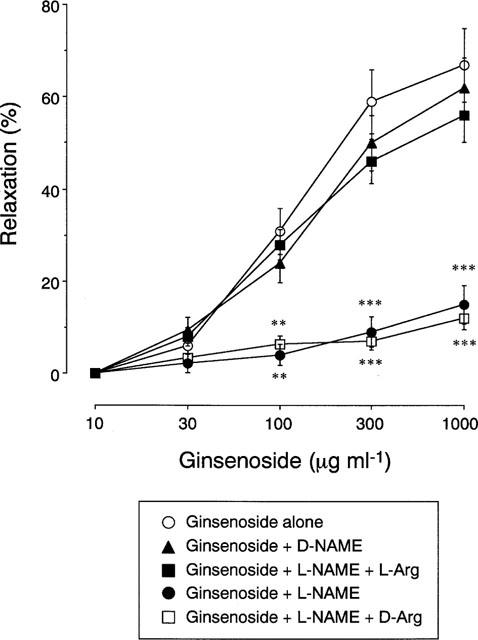
Figure 1
Figure 1
Concentration-dependent relaxation of human bronchial strips induced by ginsenoside. Ginsenoside was cumulatively applied to the tissues precontracted with acetylcholine in the absence or presence of the following drug(s): L-arginine (L-Arg, 10−2M), D-arginine (D-Arg, 10−2M), NG-nitro-L-arginine methylester (L-NAME, 10−3M), and NG-nitro-D-arginine methylester (D-NAME, 10−3M). Responses are expressed as per cent of relaxation. Data are means±s.e.mean, n=11 for each point. **P<0.01, ***P<0.001, significantly different from the response to ginsenoside alone.
Figure 2
Figure 2
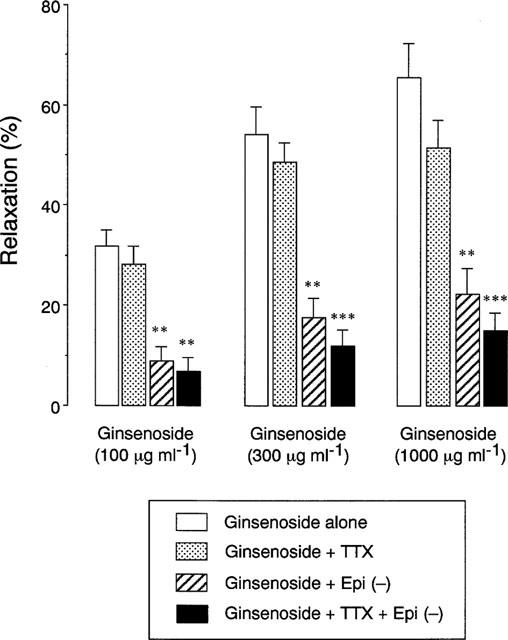
Effects of tetrodotoxin (TTX, 10−6M) and mechanical removal of epithelium (Epi (−)) on the relaxant responses of human bronchial strips to various concentrations of ginsenoside. Responses are expressed as per cent of relaxation of acetylcholine-contracted tissues. Data are means±s.e.mean, n=10 for each column. **P<0.01, ***P<0.001, significantly different from the response to ginsenoside alone.
Figure 3
Figure 3
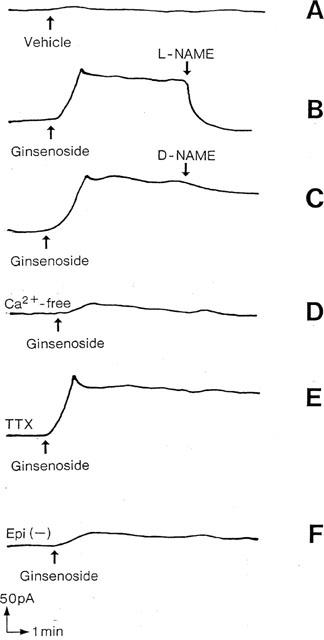
Representative tracing of the current detected by an NO-selective electrode in the medium containing human bronchial strips. (A) response of electrical current in the medium after addition of the vehicle of ginsenoside (Krebs-Henseleit solution). (B and C) ginsenoside (1000 μg ml−1) was added and, when the response reached a plateau, NG-nitro-L-arginine methylester (L-NAME, 10−3M) or NG-nitro-D-arginine methylester (D-NAME, 10−3M) was added. (D and E) the tissues were incubated with Ca2+-free medium containing EGTA (10−3M) or with tetrodotoxin (TTX, 10−6M) and ginsenoside (1000 μg ml−1) was added. (F) ginsenoside (1000 μg ml−1) was applied to epithelium-denuded tissues (Epi(−)).
Figure 4
Figure 4
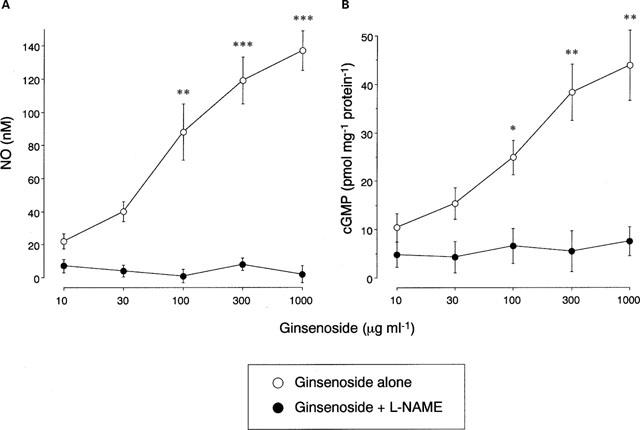
Concentration-dependent effect of ginsenoside on nitric oxide (NO) generation (A) and cyclic GMP synthesis (B) in human bronchial tissues. Various concentrations of ginsenoside were applied in the absence or presence of NG-nitro-L-arginine methylester (L-NAME, 10−3M). Values are expressed as the concentrations of NO in the medium and the tissue cyclic GMP contents. Data are means±s.e.mean, n=8 for each point. *P<0.05, **P<0.01, ***P<0.001, significantly different from the response to ginsenoside alone.

References

    1. ASANO K., CHEE C.B.E., GASTON B., LILLY C.M., GERARD C., DRAZEN J.M., STAMLER J.S. Constitutive and inducible nitric oxide synthase gene expression, regulation, and activity in human lung epithelial cells. Proc. Natl. Acad. Sci. U.S.A. 1994;91:10089–10093. - PMC - PubMed
    1. BARNES P.J., BELVISI M.G. Nitric oxide and lung disease. Thorax. 1993;48:1034–1043. - PMC - PubMed
    1. BOHME E., GRAF H., SCHULTZ G. Effects of sodium ntiroprusside and other smooth muscle relaxants on cyclic GMP formation in smooth muscle and platelets. Adv. Cyclic Nucleotide Res. 1978;9:131–143. - PubMed
    1. BROOKER G., HARPER J.F., TERASAKI W.L., MOYLAN R.D. Radioimmunoassay of cyclic AMP and cyclic GMP. Adv. Cyclic Nucleotide Res. 1979;10:1–33. - PubMed
    1. CHEN X., GILLS C.N., MAOLLI R. Vascular effects of ginsenosides in vitro. Br. J. Pharmacol. 1984;82:485–491. - PMC - PubMed

Publication types

MeSH terms

LinkOut - more resources