. 2000 Aug;130(8):1865-70.
doi: 10.1038/sj.bjp.0703513.

Human urotensin-II is an endothelium-dependent vasodilator in rat small arteries

Affiliations

Human urotensin-II is an endothelium-dependent vasodilator in rat small arteries

F E Bottrill et al. Br J Pharmacol. 2000 Aug.

Abstract

The possible role of the endothelium in modulating responses to human urotensin-II (U-II) was investigated using isolated segments of rat thoracic aorta, small mesenteric artery, left anterior descending coronary artery and basilar artery. Human U-II was a potent vasoconstrictor of endothelium-intact isolated rat thoracic aorta (EC(50)=3.5+/-1.1 nM, R(max)=103+/-10% of control contraction induced by 60 mM KCl and 1 microM noradrenaline). However the contractile response was not significantly altered by removal of the endothelium or inhibition of nitric oxide synthesis with L-NAME (100 microM). Human U-II did not cause relaxation of noradrenaline-precontracted, endothelium-intact rat aortae. Human U-II contracted endothelium-intact rat isolated left anterior descending coronary arteries (EC(50)=1.3+/-0.8 nM, R(max)=20.1+/-4.9% of control contraction induced by 10 microM 5-HT). The contractile response was significantly enhanced by removal of the endothelium (R(max)=55.4+/-16.1%). Moreover, human U-II caused concentration-dependent relaxation of 5-HT-precontracted arteries, which was abolished by L-NAME or removal of the endothelium. No contractile effects of human U-II were found in rat small mesenteric arteries. However the peptide caused potent, concentration- and endothelium-dependent relaxations of methoxamine-precontracted vessels. The relaxant responses were potentiated by L-NAME (300 microM) but abolished in the additional presence of 25 mM KCl (which inhibits the actions of endothelium-derived hyperpolarizing factor). The present study is the first to show that human U-II is a potent endothelium-dependent vasodilator in some rat resistance vessels, and acts through release of EDHF as well as nitric oxide. Our findings have also highlighted clear anatomical differences in the responses of different vascular beds to human U-II which are likely to be important in determining the overall cardiovascular activity of this peptide.


Figures
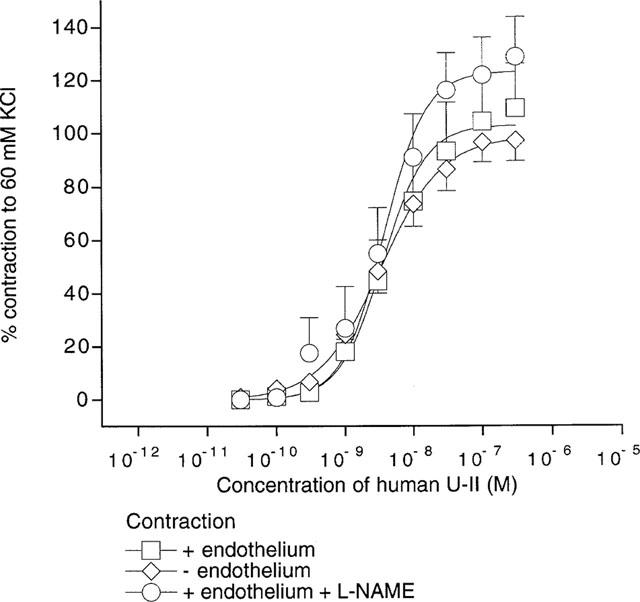
Figure 1
Figure 1
Contractile effects of human U-II in rat isolated proximal descending thoracic aorta. Data (presented as mean±s.e.mean) indicate the contractile effects of the peptide in resting arteries, expressed as a percentage of the initial test contraction induced by 60 mM KCl. Data were fitted to the logistic equation and the parameters are given in the text.
Figure 2
Figure 2
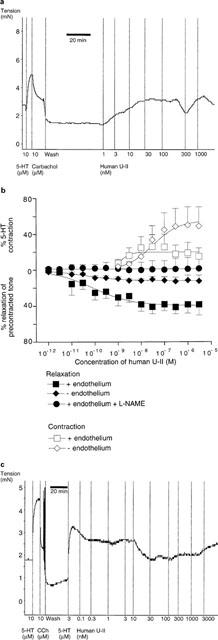
(a) Original experimental record showing the contractile effect of human U-II in rat isolated left anterior descending coronary artery. Vertical lines denote addition of drugs at the concentrations indicated. Note that the addition of carbachol shows this to be an endothelium-intact vessel, and also that some relaxant effects were observed at high concentrations of human U-II (100 and 1000 nM). (b) Contractile and relaxant effects of human U-II in rat isolated left anterior descending coronary artery. Data (presented as mean±s.e.mean) above zero indicate the contractile effects of the peptide in resting arteries, whilst the data below zero denote the relaxant effects of human U-II in 5-HT-precontracted vessels. Data were fitted to the logistic equation and the parameters are given in the text. (c) Original experimental record showing the relaxant effect of human U-II in rat isolated coronary artery precontracted with 5-HT (3 μM). Vertical lines denote addition of drugs at the concentrations indicated. Note that the addition of carbachol shows this to be an endothelium-intact vessel, and also that some contractile effects were observed at high concentrations of human U-II (above 100 nM). The apparent ‘stepped' nature of the tension responses is due to a lack of resolution in the recording system at the high gain required to measure these small responses.
Figure 3
Figure 3
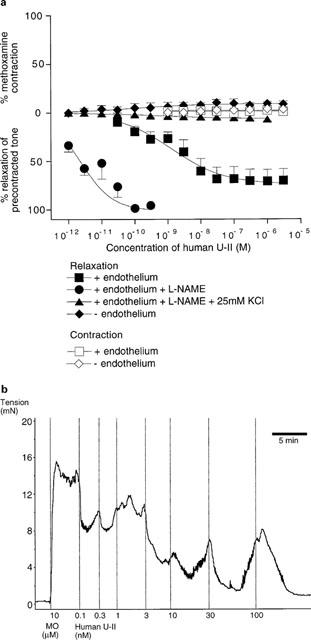
(a) Contractile and relaxant effects of human U-II in rat isolated mesenteric artery. Data above zero indicate the contractile effects of the peptide in resting arteries, whilst the data below zero denote the relaxant effects of human U-II in methoxamine-precontracted vessels. Where appropriate, data were fitted to the logistic equation and the parameters are given in the text. (b) Original experimental record showing the relaxant effect of human U-II in rat isolated mesenteric artery precontracted with methoxamine (10 μM). Vertical lines denote addition of drugs at the concentrations indicated.
Figure 4
Figure 4
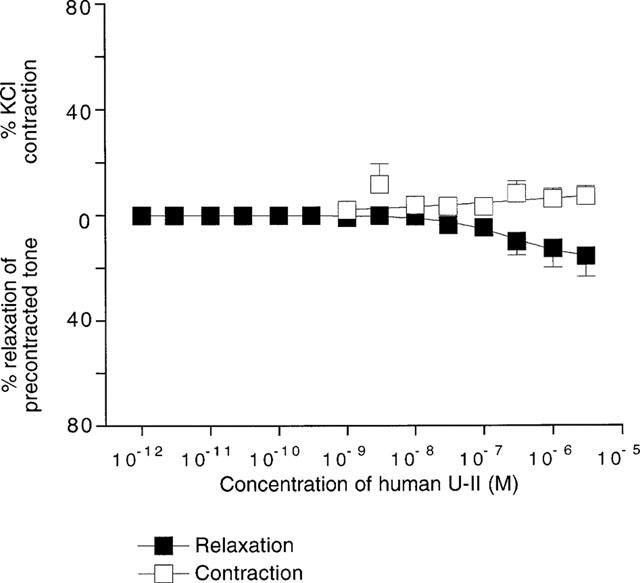
Contractile and relaxant effects of human U-II in rat isolated basilar artery. Data above zero indicate the contractile effects of the peptide in resting arteries, whilst the data below zero denote the relaxant effects of human U-II in vessels precontracted with 40 mM KCl. Responses were too small for data to be fitted to the logistic equation.

References

    1. AMES R.S., SARAU H.M., CHAMBERS J.K., WILLETTE R.N., AIYAR N.V., ROMANIC A.M., LOUDEN C.S., FOLEY J.J., SAUERMELCH C.F., COATNEY R.W., AO Z., DISA J., HOLMES S.D., STADEL J.M., MARTIN J.D., LIU W.-S., GLOVER G.I., WILSON S., MCNULTY D.E., ELLIS C.E., ELSHOURBAGY N.A., SHABON U., TRILL J.J., HAY D.W.P., OHLSTEIN E.H., BERSGMA D.J., DOUGLAS S.A. Human urotensin-II is a potent vasoconstrictor and agonist for the orphan receptor GPR14. Nature. 1999;401:282–286. - PubMed
    1. COULOUARN Y., LIHRMANN I., JEGOU S., ANOUAR Y., TOSTIVINT H., BEAUVILLIAN J.C., CONLON J.M., BERN H.A., VAUDRY H. Cloning of the cDNA encoding the urotensin II precursor in frog and human reveals intense expression of the urotensin II gene in motoneurons of the spinal cord. Proc. Natl. Acad. Sci. U.S.A. 1998;95:15803–15808. - PMC - PubMed
    1. FUKAO M., HATTORI Y., KANNO M., SAKUMA I., KITABATAKE A. Sources of Ca2+ in relation to generation of acetylcholine-induced endothelium-dependent hyperpolarization in rat mesenteric artery. Br. J. Pharmacol. 1997;120:1328–1334. - PMC - PubMed
    1. GIBSON A. Complex effects of Gillichthys urotensin II on rat aortic strips. Br. J. Pharmacol. 1987;91:205–212. - PMC - PubMed
    1. GIBSON A., BERN H.A., GINSBURG M., BOTTING J.H. Neuropeptide-induced contraction and relaxation of the mouse anococcygeus muscle. Proc. Natl. Acad. Sci. U.S.A. 1984;81:625–629. - PMC - PubMed

Publication types

MeSH terms

LinkOut - more resources