


Sphingosine-1-phosphate and sphingosylphosphorylcholine constrict renal and mesenteric microvessels in vitro
- PMID: 10952677
- PMCID: PMC1572273
- DOI: 10.1038/sj.bjp.0703515
Sphingosine-1-phosphate and sphingosylphosphorylcholine constrict renal and mesenteric microvessels in vitro
Abstract
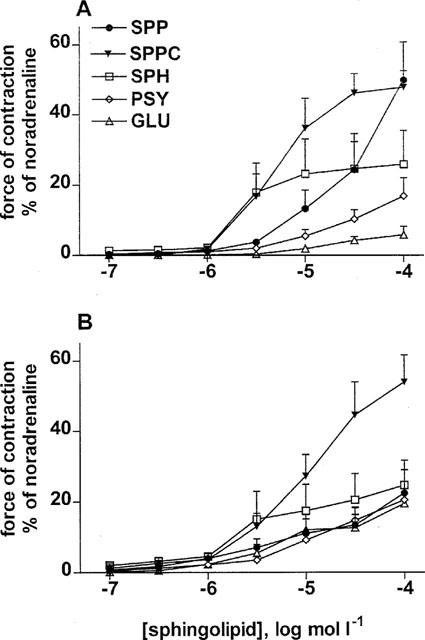
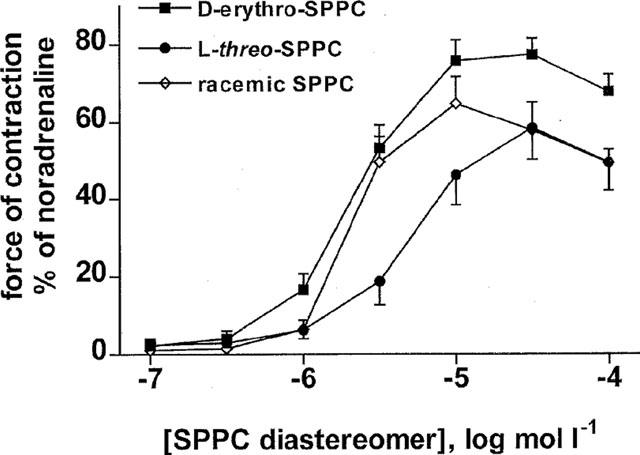
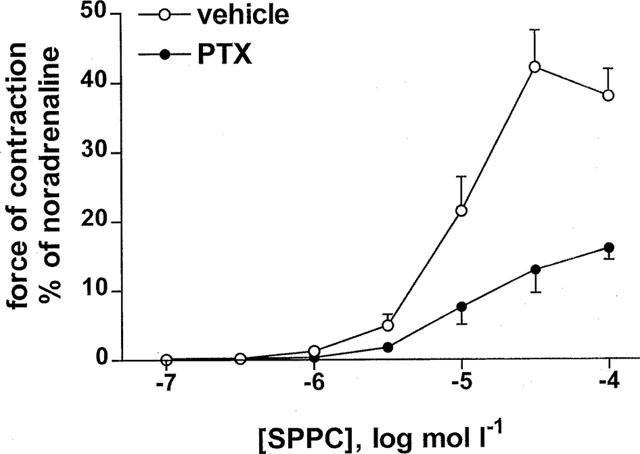
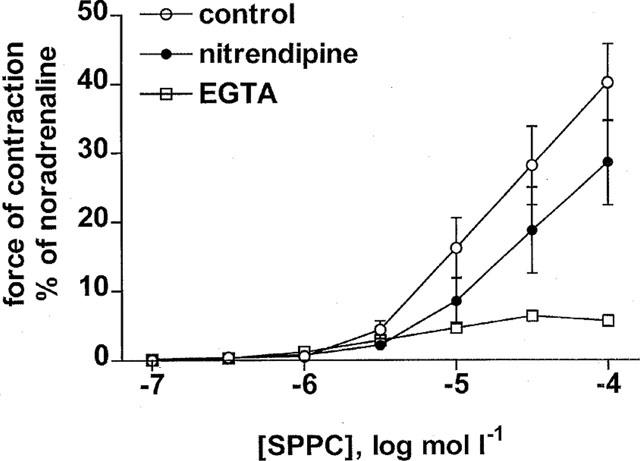
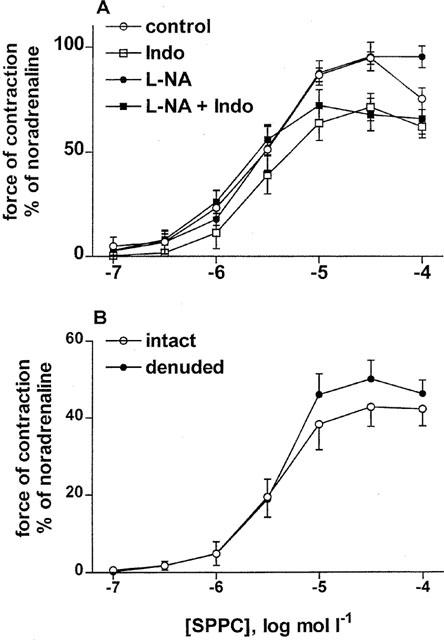
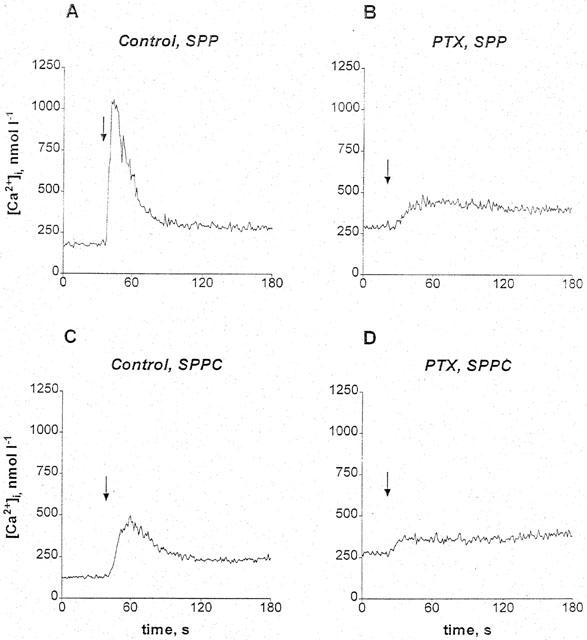
Sphingolipids such as sphingosine-1-phosphate (SPP) and sphingosylphosphorylcholine (SPPC) can act both intracellularly and at G-protein-coupled receptors, some of which were cloned and designated as Edg-receptors. Sphingolipid-induced vascular effects were determined in isolated rat mesenteric and intrarenal microvessels. Additionally, sphingolipid-induced elevations in intracellular Ca(2+) concentration were measured in cultured rat aortic smooth muscle cells. SPPC and SPP (0.1-100 micromol l(-1)) caused concentration-dependent contraction of mesenteric and intrarenal microvessels (e.g. SPPC in mesenteric microvessels pEC(50) 5.63+/-0.17 and E(max) 49+/-3% of noradrenaline), with other sphingolipids being less active. The vasoconstrictor effect of SPPC in mesenteric microvessels was stereospecific (pEC(50) D-erythro-SPPC 5.69+/-0.08, L-threo-SPPC 5.31+/-0.06) and inhibited by pretreatment with pertussis toxin (E(max) from 44+/-5 to 19+/-4%), by chelation of extracellular Ca(2+) with EGTA and by nitrendipine (E(max) from 40+/-6 to 6+/-1 and 29+/-6%, respectively). Mechanical endothelial denudation or NO synthase inhibition did not alter the SPPC effects, while indomethacin reduced them (E(max) from 87+/-3 to 70+/-4%). SPP and SPPC caused transient increases in intracellular Ca(2+) concentrations in rat aortic smooth muscle cells in a pertussis toxin-sensitive manner. Our data demonstrate that SPP and SPPC cause vasoconstriction of isolated rat microvessels and increase intracellular Ca(2+) concentrations in cultured rat aortic smooth muscle cells. These effects appear to occur via receptors coupled to pertussis toxin-sensitive G-proteins. This is the first demonstration of effects of SPP and SPPC on vascular tone and suggests that sphingolipids may be an hitherto unrecognized class of endogenous regulators of vascular tone.
Figures
References
-
- AN S., BLEU T., HUANG W., HALLMARK O.G., COUGHLIN S.R., GOETZL E.J. Identification of cDNAs encoding two G protein-coupled receptors for lysosphingolipids. FEBS Lett. 1997;417:279–282. - PubMed
-
- AN S., BLEU T., ZHENG Y. Transduction of intracellular calcium signals through G protein-mediated activation of phospholipase C by recombinant sphingosine 1-phosphate receptors. Mol. Pharmacol. 1999;55:787–794. - PubMed
-
- ANCELLIN N., HLA T. Differential pharmacological properties and signal transduction of the sphingosine 1-phosphate receptors EDG-1, EDG-3, and EDG-5. J. Biol. Chem. 1999;274:18997–19002. - PubMed
-
- BORNFELDT K.E., GRAVES L.M., RAINES E.W., IGARASHI Y., WAYMAN G., YAMAMURA S., YATOMI Y., SIDHU J.S., KREBS E.G., HAKOMORI S., ROSS R. Sphingosine-1.phosphate inhibits PDGF-induced chemotaxis of human arterial smooth muscle cells: Spatial and temporal modulation of PDGF chemotactic signal transduction. J. Cell Biol. 1995;130:193–206. - PMC - PubMed
Publication types
MeSH terms
Substances
LinkOut - more resources
Full Text Sources
Other Literature Sources
Miscellaneous
