


Insulin-like effect of pinitol
- PMID: 10952686
- PMCID: PMC1572278
- DOI: 10.1038/sj.bjp.0703523
Insulin-like effect of pinitol
Abstract
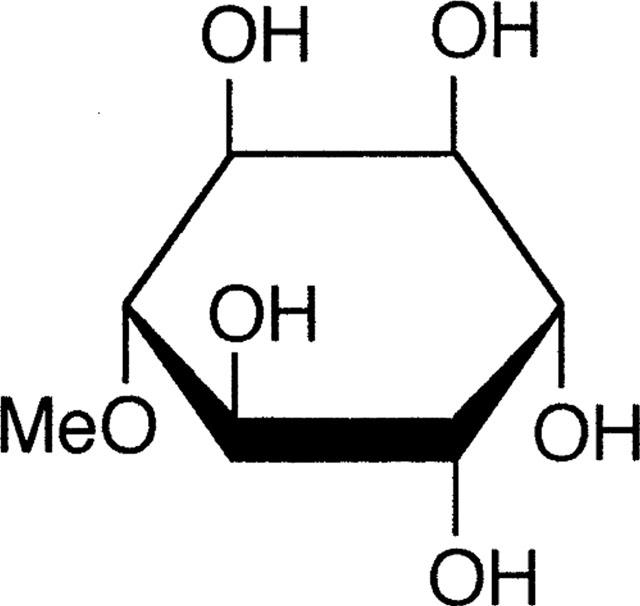
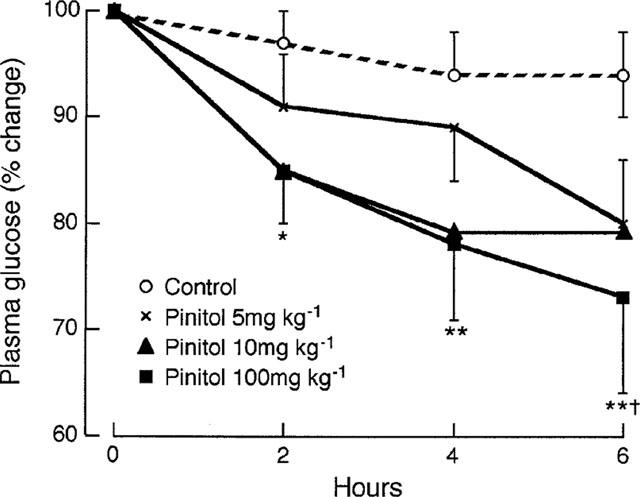
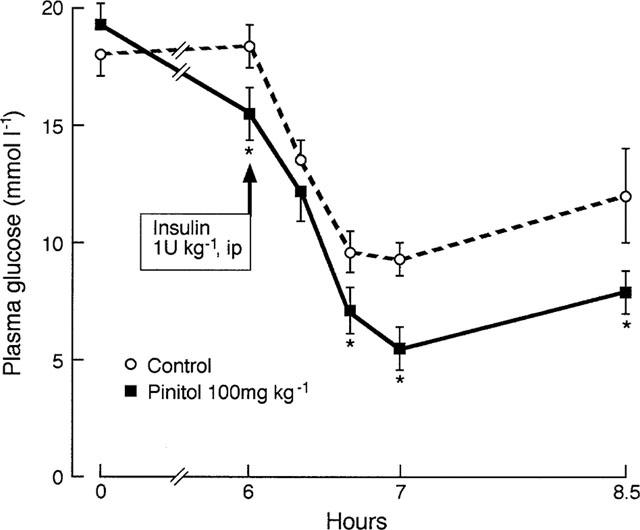
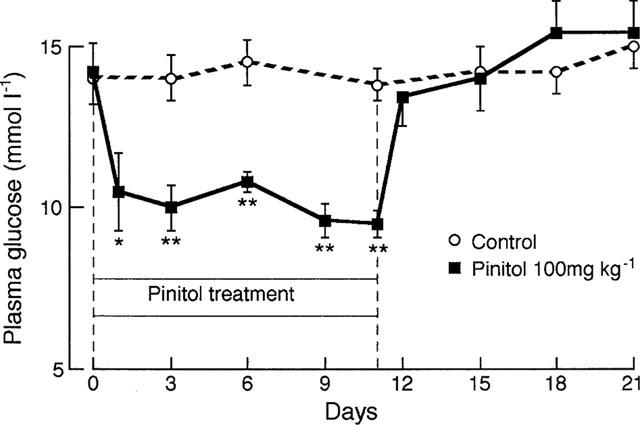
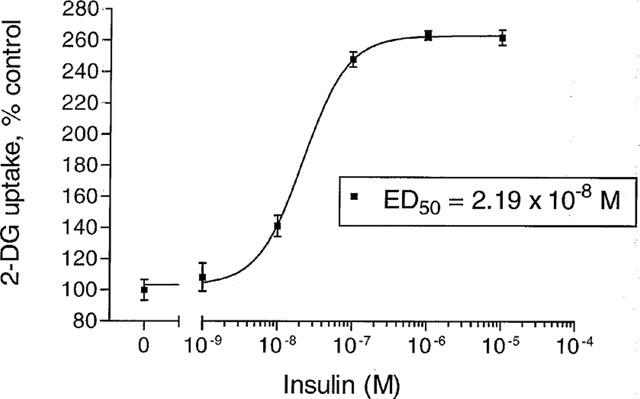
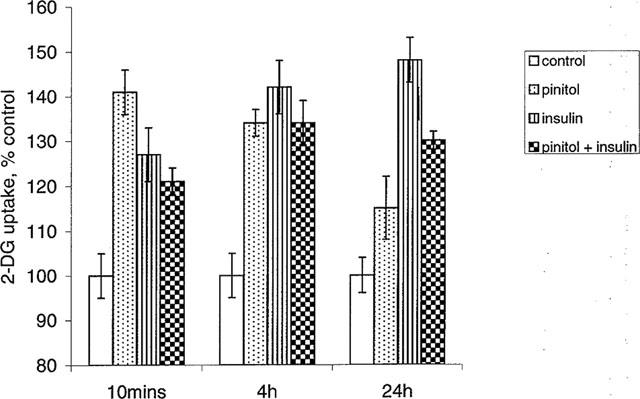
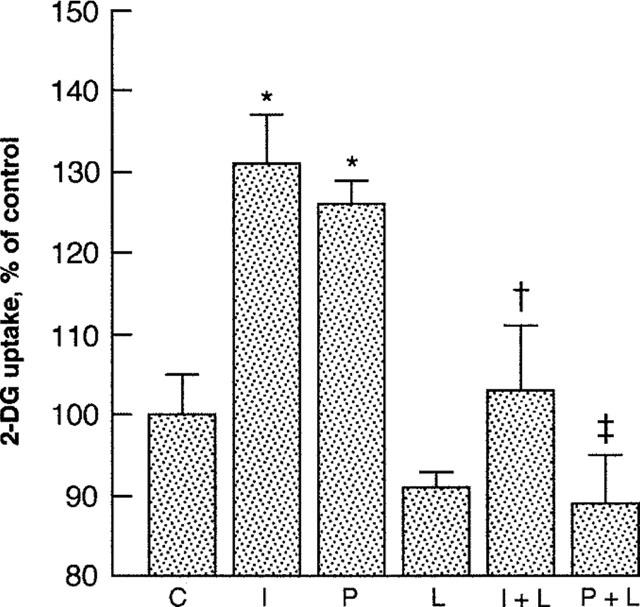
D-pinitol (3-O-methyl-chiroinositol), an active principle of the traditional antidiabetic plant Bougainvillea spectabilis, is claimed to exert insulin-like effects. This study investigates the effect of D-pinitol on glucose homeostasis in animal models of diabetes, and on glucose transport by cultured muscle cells. Plasma glucose concentrations were measured in normal, obese-diabetic (ob/ob) and streptozotocin (STZ)-diabetic mice after oral (p.o.) and intraperitoneal (i.p.) administration of D-pinitol. Glucose transport was measured in L6 rat muscle cells by 2-deoxyglucose (2DG) uptake. In STZ-diabetic mice, 100 mg kg(-1) p.o. D-pinitol acutely decreased the hyperglycaemia (by 22% at 6 h). A similar decrease in plasma glucose (by 21%) was observed after 100 mg kg(-1) i.p. D-pinitol. Insulin concentrations and the rate of insulin-induced (1 unit kg(-1) actrapid i.p.) glucose disappearance were not altered by 100 mg kg(-1) p.o. D-pinitol. Chronic administration of D-pinitol (100 mg kg(-1) i.p. twice daily for 11 days) to STZ-diabetic mice maintained a reduction in plasma glucose concentrations from about 14 to 10 mmol l(-1). In normal non-diabetic and severely insulin resistant ob/ob mice, 100 mg kg(-1) p.o. D-pinitol did not significantly affect plasma glucose or insulin during acute studies. Incubation of L6 muscle cells with D-pinitol (10(-3) M) increased basal 2DG uptake by 41% after 10 min and by 34% after 4 h. The effect of D-pinitol was inhibited by the phosphatidylinositol 3-kinase inhibitor LY294002. D-pinitol did not increase insulin-stimulated 2DG uptake by L6 cells. The data support the view that D-pinitol can exert an insulin-like effect to improve glycaemic control in hypoinsulinaemic STZ-diabetic mice. D-pinitol may act via a post-receptor pathway of insulin action affecting glucose uptake.
Figures
References
-
- BAILEY C.J., FLATT P.R. Animal syndromes of non-insulin dependent diabetes mellitus Textbook of Diabetes 1997Oxford: Blackwell; 23.1–23.25.2nd end. ed. Pickup, J.C. & Williams, G. pp
-
- BAILEY C.J., FLATT P.R., ATKINS T.W. Influence of genetic background and age on the expression of the obese hyperglycaemic syndrome in Aston ob/ob mice. Int. J. Obesity. 1982;6:11–21. - PubMed
-
- FLATT P.R., BAILEY C.J. Abnormal plasma glucose and insulin responses in heterozygous lean (ob/+) mice. Diabetologia. 1981;20:573–577. - PubMed
-
- FONTELES M.C., HUANG L.C., LARNER J. Infusion of pH 2.0 D-chiroinositol glycan insulin putative mediator normalizes plasma glucose in streptozotocin diabetic rats at a dose equivalent to insulin without inducing hypoglycaemia. Diabetologia. 1996;39:731–734. - PubMed
-
- HOLMAN G.D., KASUGA M. From receptor to transporter: insulin signalling to glucose transport. Diabetologia. 1997;40:991–1003. - PubMed
MeSH terms
Substances
LinkOut - more resources
Full Text Sources
Other Literature Sources
Medical
Miscellaneous
