. 2000 Sep;74(18):8487-93.
doi: 10.1128/jvi.74.18.8487-8493.2000.

Avian nephritis virus (ANV) as a new member of the family Astroviridae and construction of infectious ANV cDNA

Affiliations

Avian nephritis virus (ANV) as a new member of the family Astroviridae and construction of infectious ANV cDNA

T Imada et al. J Virol. 2000 Sep.

Abstract

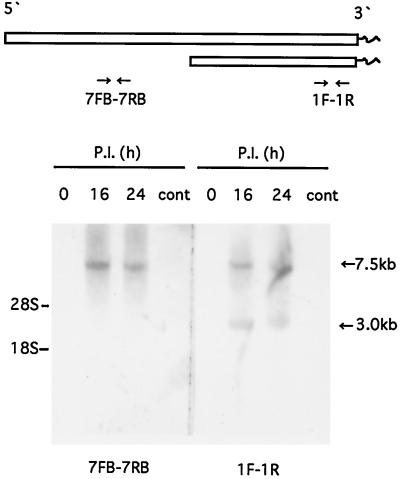
The complete RNA genome of the avian nephritis virus (ANV) associated with acute nephritis in chickens has been molecularly cloned and sequenced. Excluding the poly(A) tail, the genome comprises 6,927 nucleotides and contains three sequential open reading frames (ORFs). The first ORF (ORF 1a) contains a sequence encoding a serine protease motif, and the second ORF (ORF 1b) has a sequence encoding an RNA-dependent RNA polymerase. ORF 1a may be linked to the second ORF by a ribosomal frameshifting mechanism. The third ORF (ORF 2) may encode the virion structural proteins as a polyprotein precursor. Two RNAs, probably genonic and subgenonic RNA (7.5 and 3.0 kb), were detected in the cytoplasm of ANV-infected cells. ANV and human astroviruses have the same genonic organization, and both are characterized by the presence of two RNA bands. The amino acid homologies of the products of ORF 1a, 1b, and 2 were 20.3, 41.9, and 25.8% to products of the corresponding ORFs of human astrovirus serotype 1 (A/88 Newcastle strain). We have constructed a genonic-length cDNA clone of ANV to test whether the in vitro transcript is infectious. When a chicken kidney cell culture was transfected with RNA transcribed in vitro and the cDNA clone, infectious virus was produced with cytopathic effects in the absence of trypsin. These observations suggested that the ANV (G-4260 strain) is a new genus of the family Astroviridae.


Figures
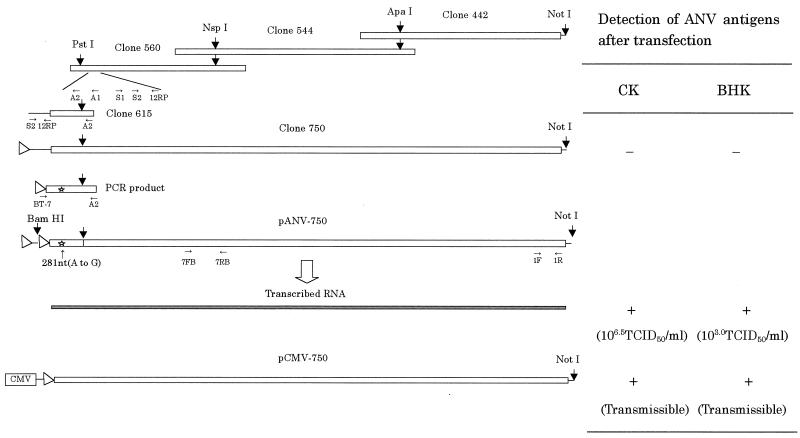
FIG. 1
FIG. 1
Construction of the full-length ANV cDNA clone and infectivity. Open boxes, partial and full-length viral cDNA; solid box, RNA transcribed in vitro from pANV-750; arrowheads, T7 promoter; CMV, human cytomegalovirus immediate-early gene promoter; star, point mutation introduced by PCR; small arrow, primer direction and position (see Table 1); −, negative for infectious virus; +, positive for infectious virus (see Fig. 7). In vitro transcripts prepared from the full-length ANV cDNA clone or a plasmid which can transcribe the genonic-size ANV RNA under the control of the CMV promoter were transfected onto CK or BHK cells using Lipofectin reagent (Bethesda Research Laboratories). The cells were tested for the presence of ANV antigens by FA tests 2 days after transfection.
FIG. 2
FIG. 2
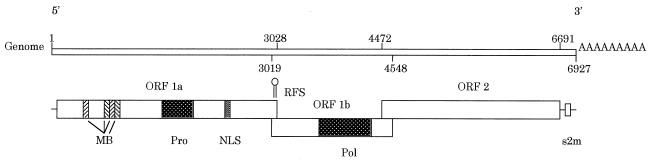
Schematic representation of the ANV genome. Open boxes, ORFs. The locations of three ORFs, predicted transmembrane helices (MB), protease (Pro), nuclear localization signal (NLS), ribosomal frameshift structure (RFS), RNA-dependent RNA polymerase (Pol), and stem-loop II-like motif (s2m) are indicated. Numbering is according to the ANV genonic sequence (accession no. AB033998).
FIG. 3
FIG. 3
RNA blot hybridization analysis. Total cytoplasmic RNA isolated from ANV-infected cells and uninfected cells at the indicated hours p.i. were resolved in a 1.0% agarose gel which contained 0.1% sodium dodecyl sulfate, transferred to a nylon membrane, and probed with DIG-labeled ANV probes (7FB-7RB, 5′ end; 1F-1R, 3′ end). The positions of the 28S and 18S rRNAs are indicated on the left; those of genonic (7.5-kb) and subgenonic (3.0-kb) RNAs are indicated on the right. cont, control.
FIG. 4
FIG. 4
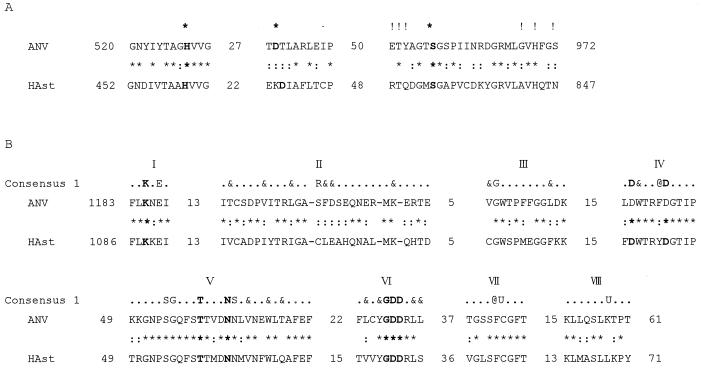
Amino acid sequence homology of the predicted functional domains of ANV (G-4260) with those of HAst 1 (A/88 Newcastle). (A) Putative 3C-like serine protease domains (ORF 1a). ∗∗, putative catalytic residues; !, residues implicated in substrate binding (16); ∗, identical residues; colons, similar residues. (B) Putative RNA-dependent RNA polymerase domains (ORF 1b). Consensus 1 shows amino acid residues that are conserved in at least 80% of the polymerases of supergroup I (16, 19). U, bulky aliphatic residue (I, L, M, or V); @, aromatic residue, (F, Y, or W); &, bulky hydrophobic residue (aliphatic or aromatic); ·, any residue. Residues conserved in the (putative) polymerases of all positive-strand RNA viruses of eukaryotes are in boldface. Distances between the aligned conserved motifs and from the protein termini are indicated.
FIG. 5
FIG. 5
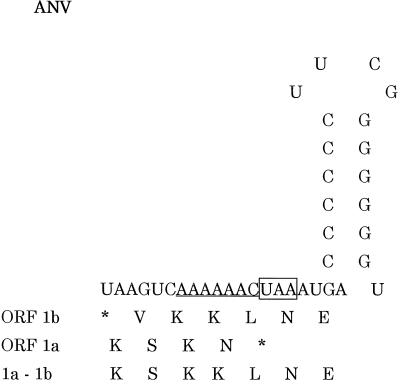
Nucleotide sequence and predicted RNA secondary structure of the overlap region of ANV ORFs 1a and 1b. The deduced amino acid sequences encoded by ORF 1a, 1b, and 1a-1b surrounding the frameshift site are shown (17). The putative frameshift site (shifty heptanucleotide sequence) is underlined, and the termination codon of ORF 1a is boxed.
FIG. 6
FIG. 6
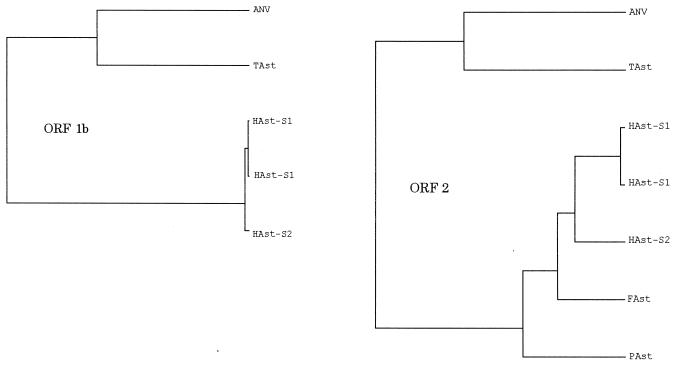
Phylogenetic relationship for ORF 1b (RdRp) and ORF 2 (structural polyprotein) of astroviruses. Amino acid sequences were analyzed using GENETYX-WIN, version 4 (Software Development Co., Ltd.). The phylogenetic trees were constructed by the unweighted pair group method by arithmetic averaging. The following nucleotide sequences were obtained from GenBank/EMBL/DDBJ: HAst 1, Z25771 and L23513; HAst 2, L13745; FAst (feline astrovirus), AF056197; PAst (porcine astrovirus), AB037272; TAst (turkey astrovirus), AF206663.
FIG. 7
FIG. 7
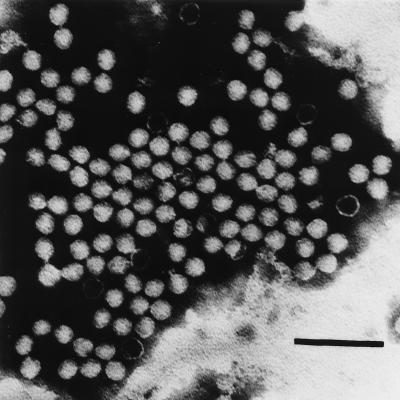
Electron micrograph of purified ANV (G-4260 strain) particles. Bar = 100 nm.
FIG. 8
FIG. 8
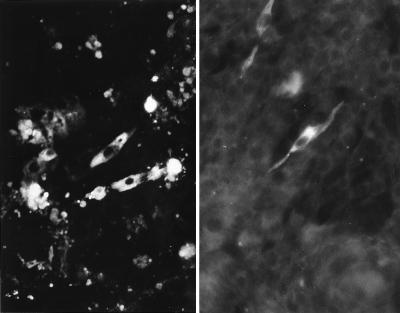
Immunofluorescence of CK (left) and BHK (right) cells transfected with in vitro-transcribed RNA from pANV-750 or a plasmid which can transcribe the full-length ANV cDNA under the control of a cytomegalovirus promoter. Fluorescing fine granules are disseminated in the cytoplasm of the cells. The viruses produced in these cells were transmissible to CK cells 96 h p.t. Magnification, ×360.

References

    1. Bass D M, Qiu S. Proteolytic processing of the astrovirus capsid. J Virol. 2000;74:1810–1814. - PMC - PubMed
    1. Brierley I, Digard P, Inglis S C. Characterization of an efficient coronavirus ribosomal frameshifting signal: requirement for an RNA pseudoknot. Cell. 1989;57:537–547. - PMC - PubMed
    1. Carter M J, Willcocks M M. The molecular biology of astroviruses. Arch Virol Suppl. 1996;12:277–285. - PubMed
    1. Chamorro M, Parkin N, Varmus H E. An RNA pseudoknot and an optimal heptameric shift site are required for highly efficient ribosomal frameshifting on a retroviral messenger RNA. Proc Natl Acad Sci USA. 1992;89:713–717. - PMC - PubMed
    1. Connor T J, McNeilly F, McFerran J B, McNulty M S. A survey of avian sera from Northern Ireland for antibody to avian nephritis virus. Avian Pathol. 1987;16:15–20. - PubMed

MeSH terms

Associated data

LinkOut - more resources