Eukaryote-specific domains in translation initiation factors: implications for translation regulation and evolution of the translation system
- PMID: 10958635
- PMCID: PMC310937
- DOI: 10.1101/gr.10.8.1172
Eukaryote-specific domains in translation initiation factors: implications for translation regulation and evolution of the translation system
Abstract
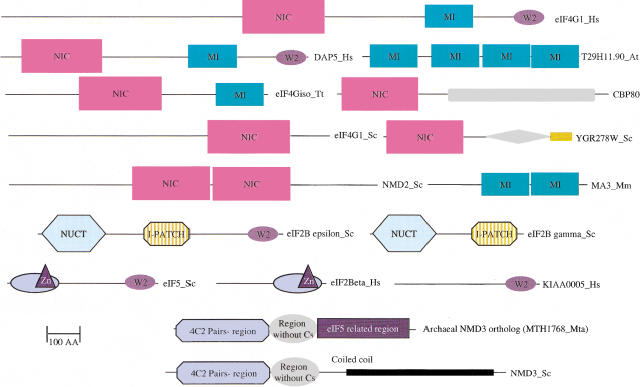
Computational analysis of sequences of proteins involved in translation initiation in eukaryotes reveals a number of specific domains that are not represented in bacteria or archaea. Most of these eukaryote-specific domains are known or predicted to possess an alpha-helical structure, which suggests that such domains are easier to invent in the course of evolution than are domains of other structural classes. A previously undetected, conserved region predicted to form an alpha-helical domain is delineated in the initiation factor eIF4G, in Nonsense-mediated mRNA decay 2 protein (NMD2/UPF2), in the nuclear cap-binding CBP80, and in other, poorly characterized proteins, which is named the NIC (NMD2, eIF4G, CBP80) domain. Biochemical and mutagenesis data on NIC-containing proteins indicate that this predicted domain is one of the central adapters in the regulation of mRNA processing, translation, and degradation. It is demonstrated that, in the course of eukaryotic evolution, initiation factor eIF4G, of which NIC is the core, conserved portion, has accreted several additional, distinct predicted domains such as MI (MA-3 and eIF4G ) and W2, which probably was accompanied by acquisition of new regulatory interactions.
Figures
References
-
- Aoki H, Adams SL, Turner MA, Ganoza MC. Molecular characterization of the prokaryotic efp gene product involved in a peptidyltransferase reaction. Biochimie. 1997;79:7–11. - PubMed
-
- Aravind L, Koonin EV. Gleaning non-trivial structural, functional and evolutionary information about proteins by iterative database searches. J Mol Biol. 1999a;287:1023–1040. - PubMed
-
- ————— Novel predicted RNA-binding domains associated with the translation machinery. J Mol Evol. 1999b;48:291–302. - PubMed
MeSH terms
Substances
LinkOut - more resources
Full Text Sources
Molecular Biology Databases
Miscellaneous