Inducible nitric oxide synthase-derived superoxide contributes to hypereactivity in small mesenteric arteries from a rat model of chronic heart failure
- PMID: 10960065
- PMCID: PMC1572288
- DOI: 10.1038/sj.bjp.0703528
Inducible nitric oxide synthase-derived superoxide contributes to hypereactivity in small mesenteric arteries from a rat model of chronic heart failure
Abstract
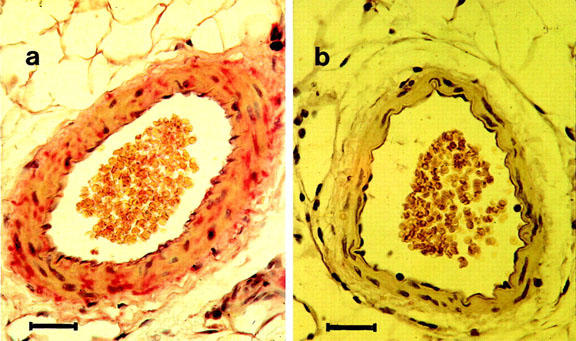
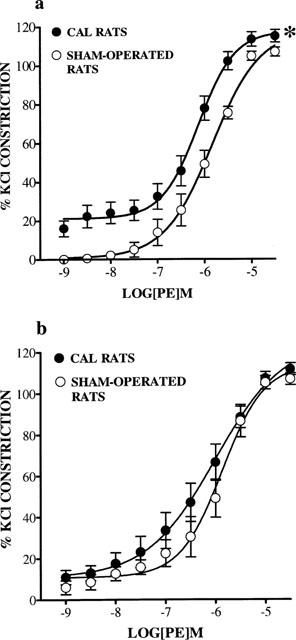
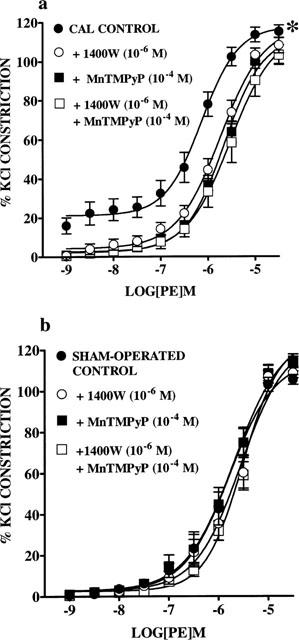
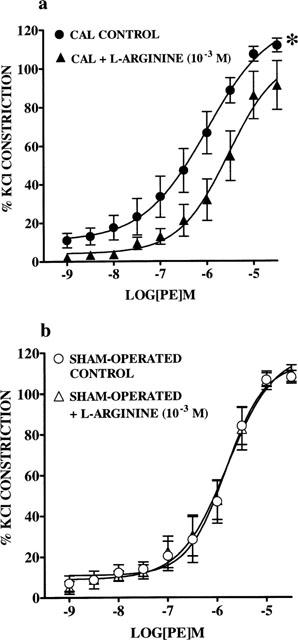
The aims of this study were to (a) determine whether inducible nitric oxide synthase (iNOS) is expressed in small mesenteric arteries from rats with chronic heart failure (CHF), (b) investigate the functional significance of this potential source of nitric oxide (NO) on vascular responsiveness and (c) investigate the role that superoxide plays in modulating vascular function in these arteries. CHF was induced in male Wistar rats by coronary artery ligation (CAL). In sham-operated rats the ligature was not tied but pulled under the artery. Six weeks after surgery CAL rats had left ventricular (LV) infarctions and elevated LV end-diastolic pressures. Immunoreactive iNOS was found in endothelial cells, vascular smooth muscle cells and in the adventitia of small mesenteric arteries from CAL rats but not those from sham-operated rats. Third order mesenteric arteries (300-350 microm) were mounted in a small vessel pressure myograph. Endothelium-intact arteries from CAL rats were more responsive to phenylephrine (PE) than arteries from sham-operated rats (pD(2) value, CAL, 6.2+/-0.1; sham-operated, 5.9+/-0.1, P<0.05). Both the selective iNOS inhibitor, N-(3-(Aminomethyl) benzyl) acetamidine dihydrochloride (1400W; 10(-6) M) and the superoxide dismutase mimetic, Mn [III] tetrakis [1-methyl-4-pyridyl] porphyrin, (MnTMPyP; 10(-4) M) reversed the hyperesponsiveness (pD(2) values, 1400W, 5.9+/-0.1; MnTMPyP, 5.81+/-0.1, P<0.05). The NOS substrate, L-arginine (10(-3) M), reduced responsiveness of endothelium-denuded small mesenteric arteries from CAL rats (P<0.01). None of these drugs altered responses to PE in arteries from sham-operated rats. In summary, this study demonstrates that iNOS is expressed in mesenteric arteries from rats with CHF. However, instead of generating large quantities of NO, iNOS appears to be generating superoxide, perhaps because of a deficiency in its substrate, L-arginine. Increased superoxide generation from iNOS contributes to the hyperesponsive nature of endothelium-intact small mesenteric arteries from rats with CHF.
Figures
References
-
- ADAMS V., YU J., MOBIUS-WINKLER S., LINKE A., WEIGL C., HILBRICH L., SCHULER G., HAMBRECHT R. Increased inducible nitric oxide synthase in skeletal muscle biopsies from patients with chronic heart failure. Biochem. Mol. Med. 1997;61:152–160. - PubMed
-
- BAUERSACHS J., BOULOUMIÉ A., FRACCAROLLO D., HU K., BUSSE R., ERTL G. Endothelial dysfunction in chronic myocardial infarction despite increased vascular endothelial nitric oxide synthase and soluble guanylate cyclase expression. Role of enhanced vascular superoxide production. Circulation. 1999;100:292–298. - PubMed
-
- CARVILLE C., ADNOT S., SEDIAME S., BENACERRAF S., CASTAIGNE A., CALVO F., DE CREMOU P., DUBOIS-RANDÉ J.-L. Relation between impairment of nitric oxide pathway and clinical status in patients with congestive heart failure. J. Cardiovasc. Pharmacol. 1998;32:562–570. - PubMed
-
- DREXLER H., HAYOZ D., MUNZEL T., HORNIG B., JUST H., BRUNNER H.R., ZELIS R. Endothelial function in chronic congestive heart failure. Am. J. Cardiol. 1992;69:1596–1601. - PubMed
Publication types
MeSH terms
Substances
LinkOut - more resources
Full Text Sources
Medical