. 2000 Sep;131(1):43-50.
doi: 10.1038/sj.bjp.0703532.

Study of A(2A) adenosine receptor gene deficient mice reveals that adenosine analogue CGS 21680 possesses no A(2A) receptor-unrelated lymphotoxicity

Affiliations

Study of A(2A) adenosine receptor gene deficient mice reveals that adenosine analogue CGS 21680 possesses no A(2A) receptor-unrelated lymphotoxicity

S G Apasov et al. Br J Pharmacol. 2000 Sep.

Abstract

Cell surface A(2A) adenosine receptor (A(2A)R) mediated signalling affects a variety of important processes and adenosine analogues possess promising pharmacological properties. Demonstrating the receptor specificity of potentially lymphotoxic adenosine-based drugs facilitates their development for clinical applications. To distinguish between the receptor-dependent and -independent lymphotoxicity and apoptotic activity of adenosine and its analogues we used lymphocytes from A(2A)R-deficient mice. Comparison of A(2A)R-expressing (+/+) and A(2A)R-deficient (-/-) cells in cyclic AMP accumulation assays confirmed that the A(2A)R agonist CGS 21680 is indeed selective for A(2A) receptors in T-lymphocytes. Incubation of A(2A)R-expressing thymocytes with extracellular adenosine or CGS 21680 in vitro results in the death of about 7-15% of thymocytes. In contrast, no death was induced in parallel assays in cells from A(2A)R-deficient mice, providing genetic evidence that CGS 21680 does not display adenosine receptor-independent intracellular cytotoxicity. The A(2A) receptor-specific lymphotoxicity of CGS 21680 is also demonstrated in a long-term (6-day) in vitro model of thymocyte positive selection where addition of A(2A)R antagonist ZM 241,385 did block the effects of CGS 21680, allowing the survival of T cells. The use of cells from adenosine receptor-deficient animals is proposed as a part of the screening process for potential adenosine-based drugs for their receptor-independent cytotoxicity and lymphotoxicity.


Figures
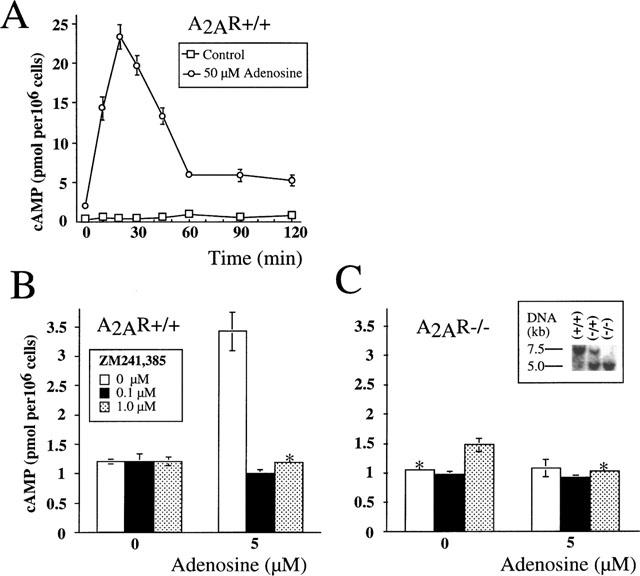
Figure 1
Figure 1
Measurement of cyclic AMP accumulation in murine thymocytes after incubation with adenosine. Results are representative of four independent experiments with P<0.01. (*indicates that standard deviations are not visible on the graph). Ex vivo thymocytes from A2AR wild type (+/+) (A,B) and from homozygous (−/−) A2AR-deficient ‘knock-out' mice (C) were incubated with adenosine in the presence or absence of A2AR antagonist ZM 241385 and cyclic AMP accumulation was measured as described in Methods. (A) Transient accumulation of cyclic AMP in thymocytes from A2AR wild type (+/+) mice during 2 h incubation with 50 μM adenosine. Thymocytes from A2AR wild type (+/+) mice (B) or A2AR (−/−) mice (C) were incubated 30 min with 5 μM adenosine in the presence or absence ZM 241385 at indicated concentrations. Inset illustrates Southern blot screening procedure for identification of wild type (+/+), heterozygous (+/−) and homozygous (−/−) mice.
Figure 2
Figure 2
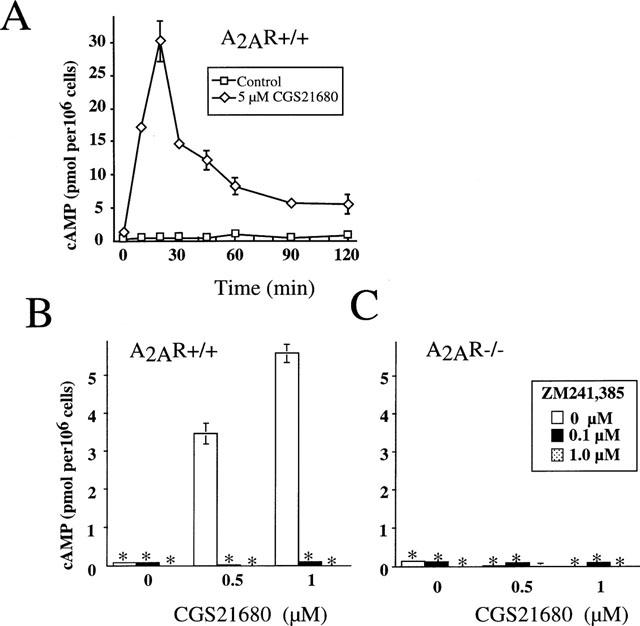
Measurements of cyclic AMP accumulation in murine thymocytes after incubation with adenosine analogue CGS 21680. Results are representative of four independent experiments with P<0.01. (*Indicates that standard deviations are not visible on the graph). Ex vivo thymocytes from A2AR wild type (+/+) (A,B) and from homozygous (−/−) A2AR-deficient ‘knock out' mice (C) were incubated with CGS 21680 in the presence or absence of A2AR antagonist ZM 241385 and cyclic AMP accumulation was measured as described in Methods. (A) transient accumulation of cyclic AMP in thymocytes from A2AR wild type (+/+) mice during 2 h incubation with 5 μM CGS 21680. Thymocytes from A2AR wild type (+/+) mice (B) or A2AR-deficient (−/−) mice (C) were incubated 30 min with 0.5 μM or 1 μM CGS 21680 in the presence or absence ZM 241385 at indicated concentrations.
Figure 3
Figure 3
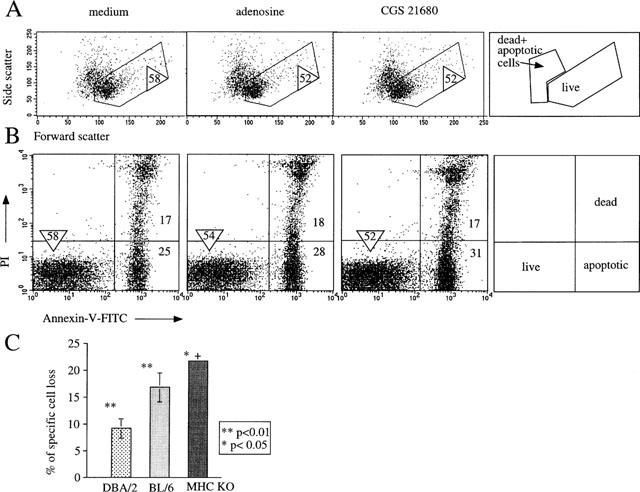
Extracellular adenosine and CGS 21680 induce hymocytes death. Ex vivo thymocytes from DBA/2, wild type (A2AR+/+) mice were incubated with media alone (control) and with adenosine (125 μM) or CGS 21680 (300 nM, (A,B) or 1 μM, (C) for 16 h in parallel assays. The survival of thymocytes after 16 h of incubation was measured by flow cytometry assays using Side scatter vs Forward scatter analysis (A) or Propidium Iodide (PI) staining vs Annexin V (B) to discriminate between live, dead and apoptotic cells as described in Methods and illustrated on cartoons. The percentage of survived, live cells (gated) is indicated by a circled number. The data are representative of eight separate experiments. The selection of gates was based on results of multiple earlier experiments where flow cytometry parameters were correlated with other methods of determination of cell death, including trypan blue and DNA fragmentation. (C) CGS 21680 induces death in a small proportion of thymocytes. Demonstration of variability in susceptibility of thymocytes from different strains of mice. DBA/2 (three experiments); BL/6 (three experiments) and double MHC class I and II gene deficient mice (two experiments). *Indicates P<0.05; **indicates P<0.01; +indicates that standard deviation is not visible on the graph.
Figure 4
Figure 4
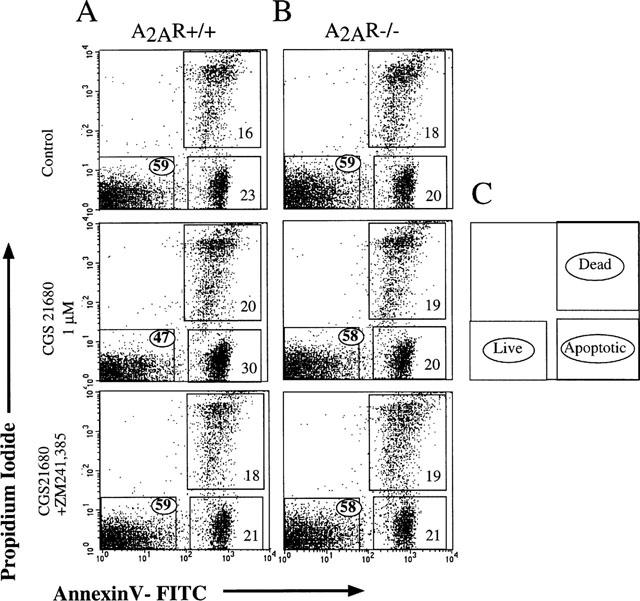
Extracellular adenosine and CGS 21680 are not lymphotoxic with A2AR deficient thymocytes. Ex vivo thymocytes from wild type (A, +/+) and from A2AR−/−) mice (B) were incubated in parallel assays with media alone (control) and with adenosine or CGS 21680. The survival of thymocytes after 16 h of incubation was measured by flow cytometry using Propidium Iodide vs Annexin V staining analysis to discriminate between live, dead and apoptotic cells as described in Methods and illustrated in C. Results are representative of four independent experiments with an analysis of 20×103 cells in each sample. The percentage of survived, live cells (gated) is indicated by a circled number.
Figure 5
Figure 5
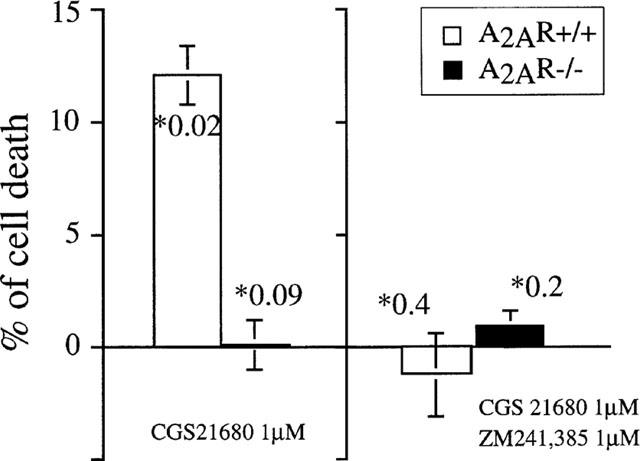
CGS 21680 does not possess A2AR unrelated lymphotoxicity. Results of three parallel independent cell death assays are summarized to demonstrate the presence of a thymocyte subset which is susceptible to CGS 21680-induced death in A2AR+/+ but not in A2AR−/− mice. Concentrations of CGS 21680 and ZM 241385 are indicated on the graph. *Number indicates P value for each point.
Figure 6
Figure 6
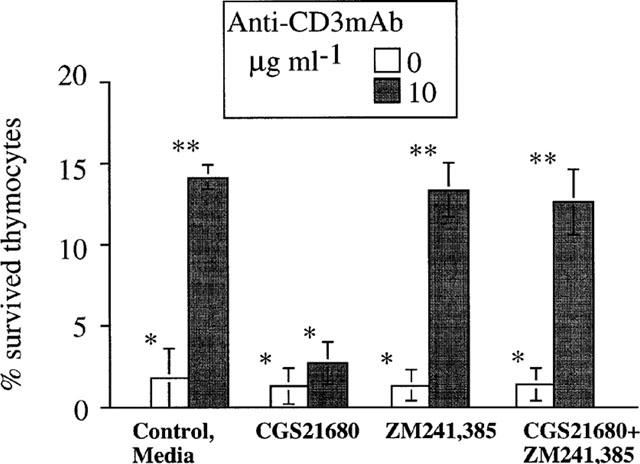
Selectivity of CGS 21680 and ZM 24385 mediated effects on thymocytes. CGS 212680 and ZM 241385 are not lymphotoxic in long thymocyte survival assay. Ex vivo thymocytes from wild type (A2AR+/+) DBA/2 mice were incubated in parallel assays alone or with thymocyte-activating anti-CD3/TCR mAb (10 μg ml−1) in the presence of media (control) or CGS 21680 (1 μM), ZM 241385 (1 μM) alone or both ZM 241385 and CGS 21680 as indicated on the graph. The survival of thymocytes after 5–6 days of incubation was measured by flow cytometry as described in Methods. The results represent a summary of five independent experiments. *Indicates P<0.4; **indicates P<0.07.

References

    1. ABBRACCHIO M.P. P1 and P2 receptors in cell growth and differentiation. Drug Devel. Res. 1996;39:393–406.
    1. ABBRACCHIO M.P., CERUTI S., BARBIERI D., FRANCESCHI C., MALORNI W., BIONDI L., BURNSTOCK G., CATTABENI F. A novel action for adenosine: apoptosis of astroglial cells in rat brain primary cultures. Biochem. Biophys. Res. Commun. 1995;213:908–915. - PubMed
    1. ABBRACCHIO M.P., RAINALDI G., GIAMMARIOLI A.M., CERUTI S., BRAMBILLA R., CATTABENI F., BARBIERI D., FRANCESCHI C., JACOBSON K.A., MALORNI W. The A3 adenosine receptor mediates cell spreading, reorganization of actin cytoskeleton, and distribution of Bcl-XL: studies in human astroglioma cells. Biochem. Biophys. Res. Commun. 1997;241:297–304. - PMC - PubMed
    1. APASOV S., KOSHIBA M., REDEGELD F., SITKOVSKY M. Role of extracellular ATP and P1 and P2 classes of purinergic receptors in T-cell development and cytotoxic T lymphocyte effector functions. Immunol. Rev. 1995;146:5–19. - PubMed
    1. APASOV S., SITKOVSKY M. The extracellular versus intracellular mechanism of inhibition of TCR-triggered activation in thymocytes by adenosine under conditions of inhibited adenosine deaminase. Int. Immunol. 1999;11:179–189. - PubMed

Publication types

MeSH terms

Substances

LinkOut - more resources