. 2000 Aug;11(8):417-24.

RING3 kinase transactivates promoters of cell cycle regulatory genes through E2F

Affiliations

RING3 kinase transactivates promoters of cell cycle regulatory genes through E2F

G V Denis et al. Cell Growth Differ. 2000 Aug.

Abstract

RING3 is a novel, nuclear-localized, serine-threonine kinase that has elevated activity in human leukemias. RING3 transforms NIH/3T3 cells and is activated by mitogenic signals, all of which suggest that it may play a role in cell cycle-responsive transcription. We tested this hypothesis with transient transfection of RING3 into fibroblasts and assayed transactivation of the promoters of cyclin D11 cyclin A, cyclin E, and dihydrofolate reductase (dhfr) genes. RING3 transactivates these promoters in a manner dependent on ras signaling. A kinase-deficient point mutant of RING3 does not transactivate. Mutational analysis of the dhfr promoter reveals that transactivation also depends on the presence of a functional E2F binding site. Furthermore, ectopic expression of Rb protein, a negative regulator of E2F activity, suppresses the RING3-dependent transactivation of this promoter. Consistent with a potential role of E2F in RING3-dependent transcription, anti-RING3 immunoaffinity chromatography or recombinant RING3 protein affinity chromatography of nuclear extracts copurified a protein complex that contains E2F-1 and E2F-2. These data suggest that RING3 is a potentially important regulator of E2F-dependent cell cycle genes.


Figures
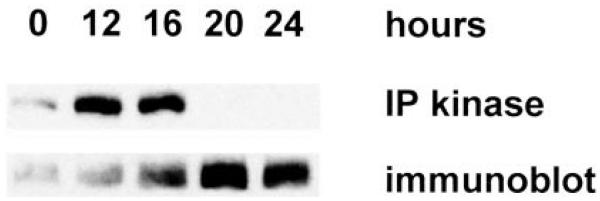
Fig. 1
Fig. 1
RING3 kinase activity and protein level after serum stimulation of fibroblasts. Extracts were prepared at progressive times from 107 serum-stimulated Swiss/3T3 cells and immunoprecipitated with αRING3 rabbit polyclonal antibody. Immune complexes were separated by SDS-PAGE, electroblotted to PVDF, and subjected to autophosphorylation assay (Ref. ; IP kinase) or αRING3 immunoblot.
Fig. 2
Fig. 2
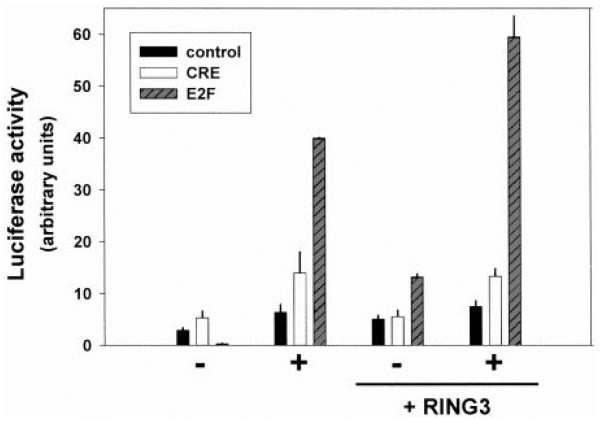
Reporter screen. NIH/3T3 cells were transiently transfected in duplicate with luciferase reporters, either enhancerless (■) or containing CRE (□) or E2F sites (dark gray, hatched) and expression constructs for RING3 or empty vector control. Cells were starved of serum overnight (−) and then stimulated with 10% serum (for the E2F-reporter and enhancerless plasmid transfections) or 50 μM forskolin (for the CRE-reporter transfections) overnight (1) and then harvested for assay of luciferase. Bars, SE.
Fig. 3
Fig. 3
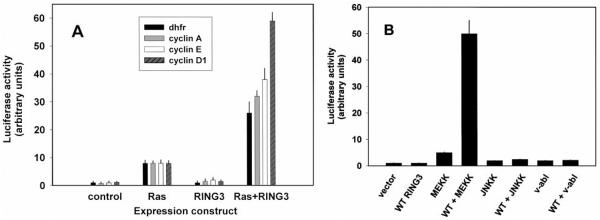
Transactivation of cyclin promoters. A, NIH/3T3 cells were transiently transfected with luciferase reporters for various cell cycle genes (cyclin D1, gray, hatched; cyclin A, gray; cyclin E, □; dhfr, ■) and expression constructs for H-ras, wild-type RING3, or empty vector control. Activity after 2 days was normalized for ras transactivation of each reporter, and a representative experiment is shown. Bars, SE. B, cells were cotransfected in duplicate with the dhfr reporter from A and various kinase constructs.
Fig. 4
Fig. 4
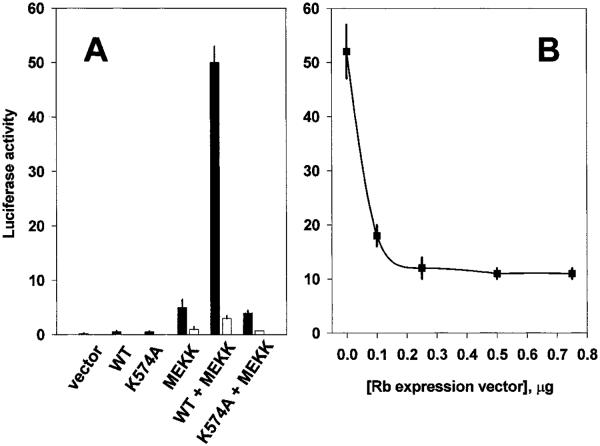
E2F dependence of dhfr promoter transactivation. A, NIH/3T3 cells were transiently transfected in duplicate with a luciferase reporter that contained the wild-type E2F binding site of dhfr (from Fig. 3; ■) or a mutated E2F binding site (□) and various kinase constructs, including wild-type RING3 (WT), catalytically inactive RING3 (K574A), and constitutively active MEKK. B, the maximal RING3-dependent transcription in A was titrated with wild-type Rb protein and wild-type E2F binding site. Bars, SE.
Fig. 5
Fig. 5
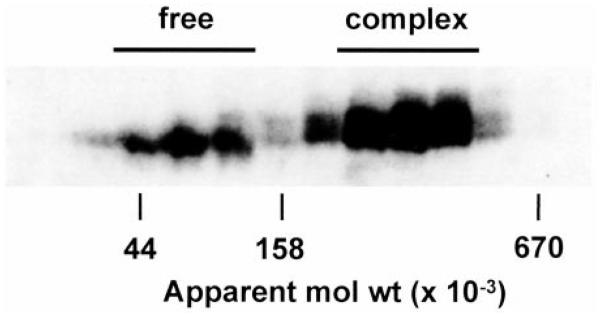
RING3 is part of a large nuclear complex. RING3 proteins in HeLa nuclear extract were resolved into free and complexed forms by size-exclusion chromatography on Superose-6. Proteins in column fractions were subjected to αRING3 immunoprecipitation, SDS-PAGE, and then autophosphorylation assay (1). The apparent molecular weights (mol wt) of protein standards are indicated (ovalbumin, Mr 44,000; aldolase, Mr 158,000; thyroglobulin, Mr 670,000).
Fig. 6
Fig. 6
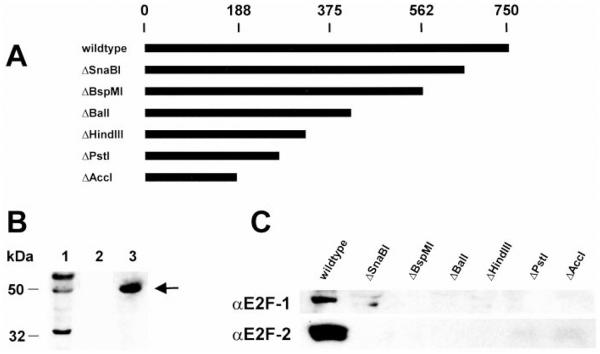
Nuclear complexes that contain E2Fs interact with RING3. A, diagram of COOH-terminal deletions of RING3 N-tagged with six histidines (ΔSnaBI, ΔBspMI, ΔBalI, ΔHindIII, ΔPstI, and ΔAccI), with the number of amino acids in RING3 shown on a scale (above). B, input HeLa nuclear extract (Lane 1) and eluted proteins (Lanes 2 and 3) from a nonimmune rabbit IgG affinity column (Lane 2) or αRING3 rabbit IgG affinity column (Lane 3) were separated by SDS-PAGE, electroblotted to PVDF, and probed with rabbit polyclonal antibody specific for all E2Fs (arrow). C, HeLa nuclear proteins were eluted from Ni-NTA columns charged with wild-type recombinant RING3 protein or with equal moles of the deletion mutants listed in A. Eluted fractions were immunoblotted with anti-E2F-1 or anti-E2F-2.

References

    1. Denis GV, Green MR. A novel, mitogen-activated nuclear kinase is related to a Drosophila developmental regulator. Genes Dev. 1996;10:261–271. - PubMed
    1. Rachie NA, Seger R, Valentine MA, Ostrowski J, Bomsztyk K. Identification of an inducible 85-kDa nuclear protein kinase. J. Biol. Chem. 1993;268:22143–22149. - PubMed
    1. Ostrowski J, Florio SK, Denis GV, Suzuki H, Bomsztyk K. Stimulation of p85/RING3 kinase in multiple organs after systemic administration of mitogens into mice. Oncogene. 1998;16:1223–1227. - PubMed
    1. Jiang YW, Veschambre P, Erdjument-Bromage H, Tempst P, Conaway JW, Conaway RC, Kornberg RD. Mammalian mediator of transcriptional regulation and its possible role as an end-point of signal transduction pathways. Proc. Natl. Acad. Sci. USA. 1998;95:8538–8543. - PMC - PubMed
    1. Beck S, Hanson I, Kelly A, Pappin DJC, Trowsdale J. A homologue of the Drosophila female sterile homeotic (fsh) gene in the class II region of the human MHC. DNA Seq. 1992;2:203–210. - PubMed

Publication types

MeSH terms

LinkOut - more resources