Toluene-degrading bacteria are chemotactic towards the environmental pollutants benzene, toluene, and trichloroethylene
- PMID: 10966434
- PMCID: PMC92264
- DOI: 10.1128/AEM.66.9.4098-4104.2000
Toluene-degrading bacteria are chemotactic towards the environmental pollutants benzene, toluene, and trichloroethylene
Abstract
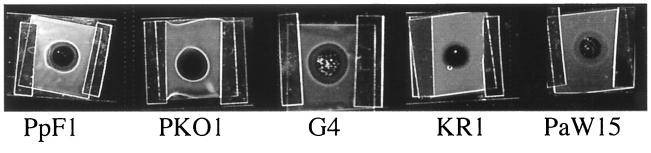
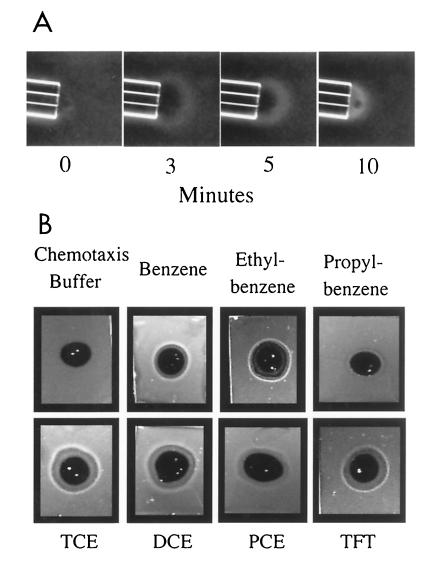
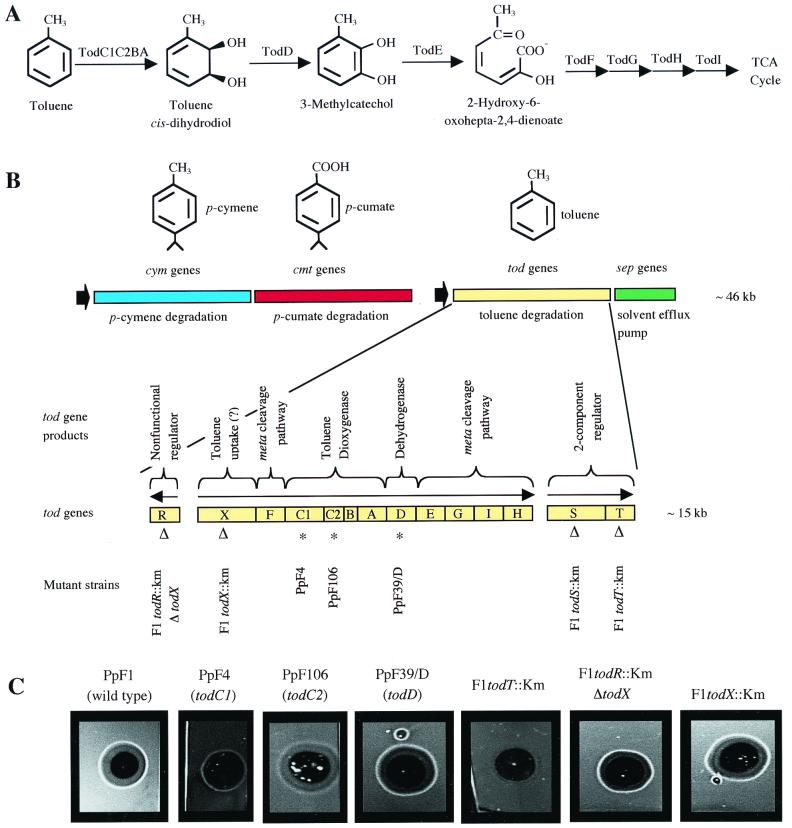
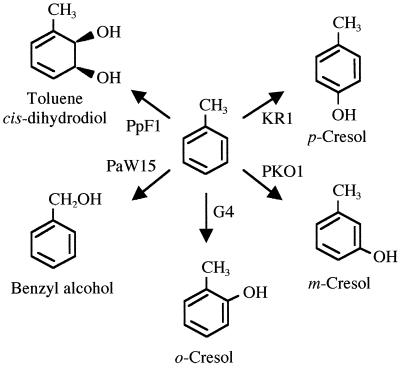
The bioremediation of polluted groundwater and toxic waste sites requires that bacteria come into close physical contact with pollutants. This can be accomplished by chemotaxis. Five motile strains of bacteria that use five different pathways to degrade toluene were tested for their ability to detect and swim towards this pollutant. Three of the five strains (Pseudomonas putida F1, Ralstonia pickettii PKO1, and Burkholderia cepacia G4) were attracted to toluene. In each case, the response was dependent on induction by growth with toluene. Pseudomonas mendocina KR1 and P. putida PaW15 did not show a convincing response. The chemotactic responses of P. putida F1 to a variety of toxic aromatic hydrocarbons and chlorinated aliphatic compounds were examined. Compounds that are growth substrates for P. putida F1, including benzene and ethylbenzene, were chemoattractants. P. putida F1 was also attracted to trichloroethylene (TCE), which is not a growth substrate but is dechlorinated and detoxified by P. putida F1. Mutant strains of P. putida F1 that do not oxidize toluene were attracted to toluene, indicating that toluene itself and not a metabolite was the compound detected. The two-component response regulator pair TodS and TodT, which control expression of the toluene degradation genes in P. putida F1, were required for the response. This demonstration that soil bacteria can sense and swim towards the toxic compounds toluene, benzene, TCE, and related chemicals suggests that the introduction of chemotactic bacteria into selected polluted sites may accelerate bioremediation processes.
Figures
Similar articles
-
Trichloroethylene degradation by toluene-oxidizing bacteria grown on non-aromatic substrates.Biodegradation. 2004 Feb;15(1):19-28. doi: 10.1023/b:biod.0000009947.09125.35. Biodegradation. 2004. PMID: 14971854
-
Cometabolic degradation of trichloroethylene by Burkholderia cepacia G4 with poplar leaf homogenate.Can J Microbiol. 2014 Jul;60(7):487-90. doi: 10.1139/cjm-2014-0095. Epub 2014 Jun 16. Can J Microbiol. 2014. PMID: 24992516
-
Addition of aromatic substrates restores trichloroethylene degradation activity in Pseudomonas putida F1.Appl Environ Microbiol. 2004 May;70(5):2830-5. doi: 10.1128/AEM.70.5.2830-2835.2004. Appl Environ Microbiol. 2004. PMID: 15128539 Free PMC article.
-
Ralstonia pickettii in environmental biotechnology: potential and applications.J Appl Microbiol. 2007 Oct;103(4):754-64. doi: 10.1111/j.1365-2672.2007.03361.x. J Appl Microbiol. 2007. PMID: 17897177 Review.
-
Tactic responses to pollutants and their potential to increase biodegradation efficiency.J Appl Microbiol. 2013 Apr;114(4):923-33. doi: 10.1111/jam.12076. Epub 2012 Dec 18. J Appl Microbiol. 2013. PMID: 23163356 Review.
Cited by
-
Burkholderia spp. alter Pseudomonas aeruginosa physiology through iron sequestration.J Bacteriol. 2004 Apr;186(8):2376-84. doi: 10.1128/JB.186.8.2376-2384.2004. J Bacteriol. 2004. PMID: 15060040 Free PMC article.
-
Assessment of bioavailability of soil-sorbed atrazine.Appl Environ Microbiol. 2003 Jun;69(6):3288-98. doi: 10.1128/AEM.69.6.3288-3298.2003. Appl Environ Microbiol. 2003. PMID: 12788728 Free PMC article.
-
Biodegradation, biotransformation, and biocatalysis (b3).Appl Environ Microbiol. 2002 Oct;68(10):4699-709. doi: 10.1128/AEM.68.10.4699-4709.2002. Appl Environ Microbiol. 2002. PMID: 12324310 Free PMC article. Review. No abstract available.
-
Elastin degradation product isodesmosine is a chemoattractant for Pseudomonas aeruginosa.Microbiology (Reading). 2015 Jul;161(7):1496-503. doi: 10.1099/mic.0.000090. Epub 2015 Apr 8. Microbiology (Reading). 2015. PMID: 25855762 Free PMC article.
-
Bacterial swimming, swarming and chemotactic response to heavy metal presence: which could be the influence on wastewater biotreatment efficiency?World J Microbiol Biotechnol. 2012 Sep;28(9):2813-25. doi: 10.1007/s11274-012-1091-5. Epub 2012 Jun 8. World J Microbiol Biotechnol. 2012. PMID: 22806721
References
-
- Boyd D R, Sharma N D, Byrne B, Hand M V, Malone J F, Sheldrake G N, Blacker J, Dalton H. Enzymatic and chemoenzymatic synthesis and stereochemical assignment of cis-dihydrodiol derivatives of monosubstituted benzenes. J Chem Soc Perkin Trans 1. 1998;1998:1935–1943.
Publication types
MeSH terms
Substances
Grants and funding
LinkOut - more resources
Full Text Sources