


Small subunit ribosomal DNA sequence shows Paracoccidioides brasiliensis closely related to Blastomyces dermatitidis
- PMID: 10970355
- PMCID: PMC87351
- DOI: 10.1128/JCM.38.9.3190-3193.2000
Small subunit ribosomal DNA sequence shows Paracoccidioides brasiliensis closely related to Blastomyces dermatitidis
Abstract
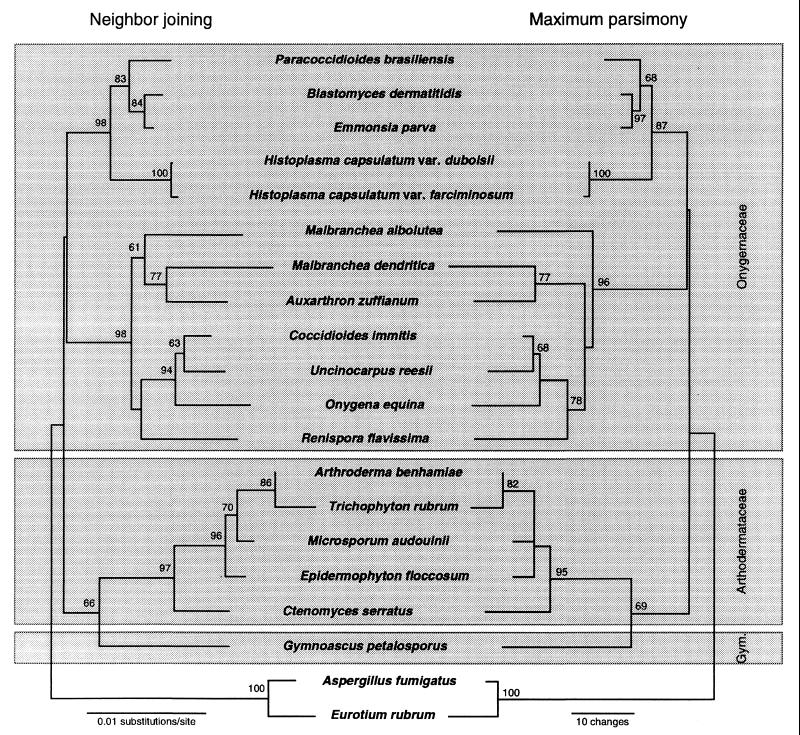
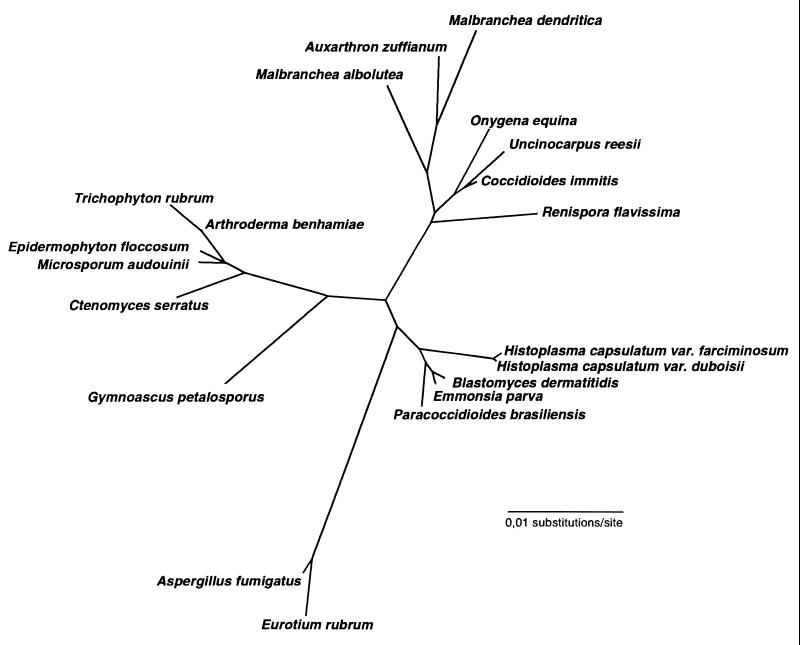
The similarities of paracoccidioidomycosis and blastomycosis are highly suggestive of a close relation of the two etiological agents. Whereas the agent of the first disease is exclusively endemic in Latin America, the agent of the latter one is endemic in North America and Africa. In symptomatic travelers visiting both areas of endemicity, differentiation of the diseases might be impossible, even though therapy and prognosis for these two diseases differ significantly. In order to identify differences in the 18S rRNA gene (rDNA) for use as molecular diagnostic tools, we sequenced this gene from five isolates of Paracoccidioides brasiliensis and compared them to known sequences of other fungi. Neighbor-joining, maximum parsimony, and maximum likelihood analyses and, finally, the Kishino-Hasegawa test revealed that P. brasiliensis, Blastomyces dermatitidis, and Emmonsia parva are more closely related than Histoplasma capsulatum and B. dermatitidis, whose teleomorphic forms belong to one genus, Ajellomyces. In accordance with the work of other investigators who have used internal transcribed spacer and large subunit rDNA sequences, our small subunit rDNA data show that the dimorphic fungus P. brasiliensis must be grouped within the order Onygenales and is closely related to members of the family Onygenaceae. There are hints in the molecular phylogenetic analysis that the family Onygenaceae might be further divided into two families. The subgroup that includes P. brasiliensis comprises all zoopathogenic species. The differences in the 18S rDNAs appear to be too small to allow species identification of the members of the family Onygenaceae pathogenic for humans by use of target sequences within this gene.
Figures
References
-
- Bowman B F, Taylor J W, White T J. Molecular evolution of the fungi: human pathogens. Mol Biol Evol. 1992;9:893–904. - PubMed
-
- Guého E, Leclerc M C, de Hoog G S, Dupont B. Molecular taxonomy and epidemiology of Blastomyces and Histoplasma species. Mycoses. 1997;40:69–81. - PubMed
-
- Leclerc M C, Philippe H, Guého E. Phylogeny of dermatophytes and dimorphic fungi based on large subunit ribosomal RNA sequence comparisons. J Med Vet Mycol. 1994;32:331–341. - PubMed
-
- Peterson S W, Sigler L. Molecular genetic variation in Emmonsia crescens and Emmonsia parva, etiologic agents of adiaspiromycosis, and their phylogenetic relationship to Blastomyces dermatitidis (Ajellomyces dermatitidis) and other systemic fungal pathogens. J Clin Microbiol. 1998;36:2918–2925. - PMC - PubMed
Publication types
MeSH terms
Substances
Associated data
- Actions
LinkOut - more resources
Full Text Sources
Molecular Biology Databases
