. 2000 Sep;106(5):R31-8.
doi: 10.1172/JCI10841.

Mutations in the protein kinase A R1alpha regulatory subunit cause familial cardiac myxomas and Carney complex

Affiliations

Mutations in the protein kinase A R1alpha regulatory subunit cause familial cardiac myxomas and Carney complex

M Casey et al. J Clin Invest. 2000 Sep.

Erratum in

  • J Clin Invest 2001 Jan;107(2):235

Abstract

Cardiac myxomas are benign mesenchymal tumors that can present as components of the human autosomal dominant disorder Carney complex. Syndromic cardiac myxomas are associated with spotty pigmentation of the skin and endocrinopathy. Our linkage analysis mapped a Carney complex gene defect to chromosome 17q24. We now demonstrate that the PRKAR1alpha gene encoding the R1alpha regulatory subunit of cAMP-dependent protein kinase A (PKA) maps to this chromosome 17q24 locus. Furthermore, we show that PRKAR1alpha frameshift mutations in three unrelated families result in haploinsufficiency of R1alpha and cause Carney complex. We did not detect any truncated R1alpha protein encoded by mutant PRKAR1alpha. Although cardiac tumorigenesis may require a second somatic mutation, DNA and protein analyses of an atrial myxoma resected from a Carney complex patient with a PRKAR1alpha deletion revealed that the myxoma cells retain both the wild-type and the mutant PRKAR1alpha alleles and that wild-type R1alpha protein is stably expressed. However, in this atrial myxoma, we did observe a reversal of the ratio of R1alpha to R2beta regulatory subunit protein, which may contribute to tumorigenesis. Further investigation will elucidate the cell-specific effects of PRKAR1alpha haploinsufficiency on PKA activity and the role of PKA in cardiac growth and differentiation.


Figures
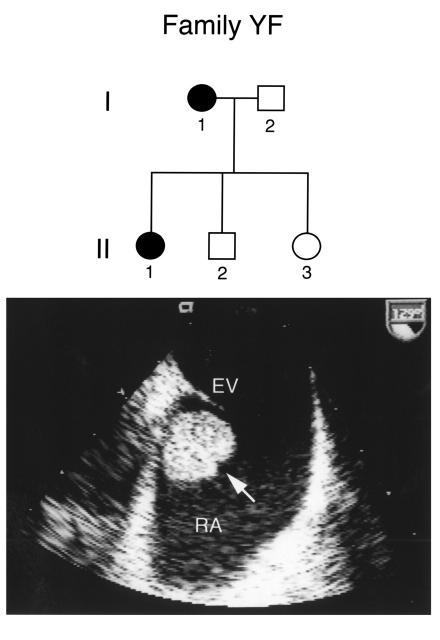
Figure 1
Figure 1
Pedigree of family YF and cardiac myxoma in a proband. The subject number and disease status of each family member analyzed are indicated. Squares denote male family members, and circles females. Affected and unaffected individuals are represented by closed and open symbols, respectively. Carney complex is transmitted in an autosomal dominant fashion. Transesophageal echocardiography of individual I-1 revealed an unusual posterior mass (arrow) in the right atrium (RA) below the eustachian valve (EV). Pathologic analysis at surgery revealed that the mass was a cardiac myxoma.
Figure 2
Figure 2
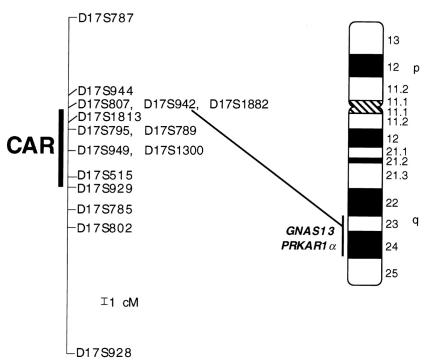
Ideogram of chromosome 17 with Giemsa banding pattern showing localization of the Carney complex locus and the PRKAR1α gene. Positive bands are black and the pericentromeric region is gray. Numbers indicate cytogenetic designations for bands. The genetic map locations of polymorphic loci analyzed from 17q are given. One centimorgan (cM) is indicated. Linkage data suggested that the gene responsible for Carney complex is located in the 12-cM interval between D17S1882 and D17S929 (CAR). Both GNAS13 and PRKAR1α map cytogenetically to chromosome 17q23-q24.
Figure 3
Figure 3
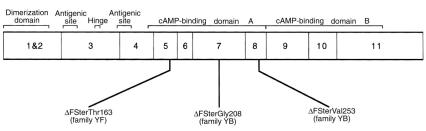
Three frameshift mutations in PRKAR1α that cause Carney complex. A schematic representation of PRKAR1α cDNA shows exons 1–11. Regions that encode functional domains (dimerization domain, antigenic sites, hinge/pseudophosphorylation site, cAMP-binding domains A and B) of R1α are denoted (13). Location of the PRKAR1α deletion mutations ΔFSterGly208 in family YA, ΔFSterVal253 in family YB, and ΔFSterThr163 in family YF are shown. Mutations are denoted by ΔFSter to indicate a deletion with resultant frameshift and premature stop codon, and by the first amino acid residue affected by the deletion.
Figure 4
Figure 4
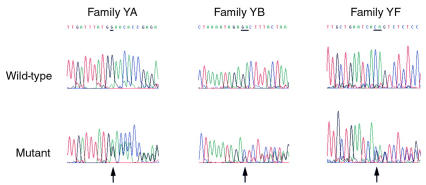
Mutational analysis of PRKAR1α in Carney complex families YA, YB, and YF. Automated sequence analyses of wild-type and mutant exons 7, 8, and 5 amplified from normal and affected individuals in families YA, YB, and YF, respectively, are shown. Sequence of the sense strand is shown for family YA, and the antisense strand for families YB and YF. A heterozygous 1-bp deletion is noted in family YA, and 2-bp deletions in families YB and YF (arrows; deleted bases are underlined). These mutations all result in a frameshift with consequent premature stop codons.
Figure 5
Figure 5
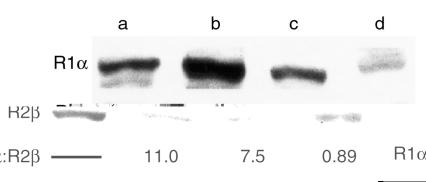
Western blot analysis of R1α and R2β in normal lymphoblasts, Carney complex lymphoblasts, and Carney complex cardiac myxoma. (a) Positive controls for antibodies to R1α and R2β were electrophoresed and Western blotted as described in Methods. (b, c) Protein lysates of lymphoblasts from (b) a normal individual and (c) an individual affected by Carney complex (family YA, IV-1) were electrophoresed and analyzed. Densitometry revealed similar levels of R2β protein in the two samples but a 60% decrease in R1α levels. (d) R1α and R2β were analyzed in lysate from a left atrial myxoma resected from individual IV-1 in family YA. Densitometry was used to determine R1α and R2β expression in all samples, and the ratio of R1α:R2β was calculated. A reversal of the R1α:R2β ratio is observed in the tumor sample compared with affected and unaffected lymphocytes.

References

    1. Reynen K. Cardiac myxomas. N Engl J Med. 1995;333:1610–1617. - PubMed
    1. Ferrans VJ, Roberts WC. Structural features of cardiac myxomas: histology, histochemistry, and electron microscopy. Hum Pathol. 1973;4:111–146. - PubMed
    1. Burke AP, Virmani R. Cardiac myxomas: a clinicopathologic study. Am J Clin Pathol. 1993;100:671–680. - PubMed
    1. Kanda T, et al. Interleukin-6 and cardiac myxoma. Am J Cardiol. 1994;74:965–967. - PubMed
    1. OMIM™: Online Mendelian Inheritance in Man. Center for Medical Genetics, Johns Hopkins University, Baltimore, Maryland, USA, and National Center for Biotechnology Information, National Library of Medicine, Bethesda, Maryland, USA. http://www.ncbi.nlm.nih.gov/omim/.

Publication types

Substances