


Dpc-4 protein is expressed in virtually all human intraductal papillary mucinous neoplasms of the pancreas: comparison with conventional ductal adenocarcinomas
- PMID: 10980115
- PMCID: PMC1885701
- DOI: 10.1016/S0002-9440(10)64589-0
Dpc-4 protein is expressed in virtually all human intraductal papillary mucinous neoplasms of the pancreas: comparison with conventional ductal adenocarcinomas
Abstract
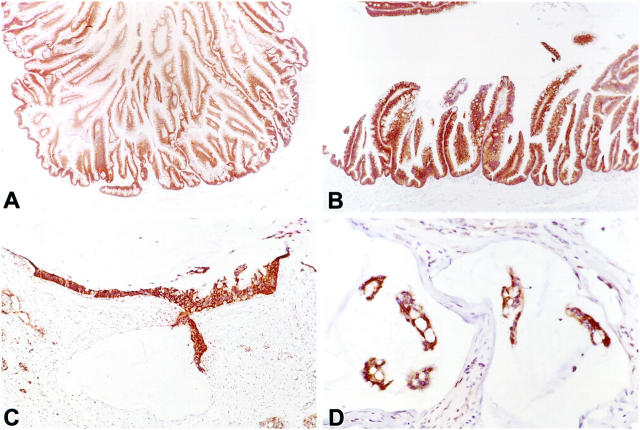
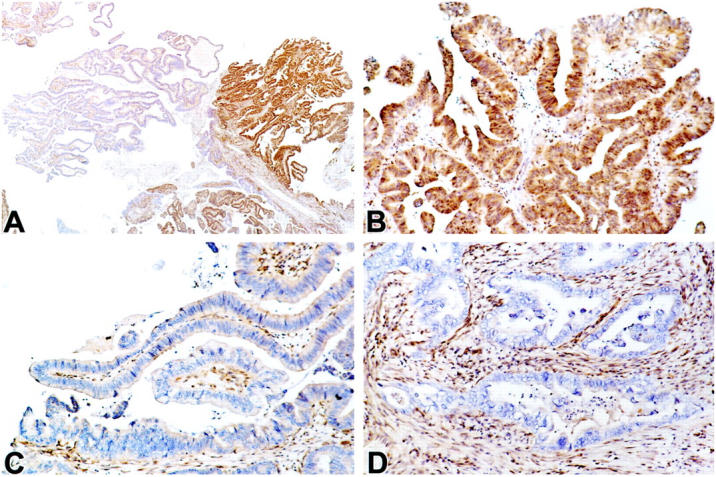
DPC4 (MADH4, SMAD4) encodes a nuclear transcription factor shown to be genetically inactivated in over one-half of conventional infiltrating ductal adenocarcinomas of the pancreas. Intraductal papillary mucinous neoplasms (IPMNs) of the pancreas have been suggested to be distinct neoplasms with a significantly less aggressive course than conventional ductal adenocarcinomas of the pancreas, but molecular comparisons of these tumor types have previously been impaired by technical difficulties. Recently, immunohistochemical labeling for the DPC4 gene product has been shown to be an extremely sensitive and specific marker for DPC4 gene alterations in pancreatic adenocarcinomas. Therefore, we analyzed the immunohistochemical expression of Dpc4 protein in 79 IPMNs using a previously characterized monoclonal antibody. Twenty-nine of the IPMNs also had an associated infiltrating adenocarcinoma available for analysis. The labeling patterns observed were compared to those we have previously reported for conventional ductal carcinomas. All 79 of the intraductal components of the IPMNs strongly expressed Dpc4 protein. In 77 of the 79 cases (97%), the labeling was diffusely positive, and in 2 of the 79 (3%) the labeling was focally positive. Dpc4 expression was seen in 28 (97%) of the associated 29 invasive cancers. The one infiltrating carcinoma that showed loss of Dpc4 expression was associated with an intraductal component which showed focal loss of Dpc4 expression. The strong and almost universal expression of Dpc4 in IPMNs contrasts sharply with the loss of Dpc4 expression seen in approximately 30% of in situ adenocarcinomas of the pancreas (so-called pancreatic intraepithelial neoplasms, grade 3; P: < 0.001) and in 55% of pancreatic duct carcinomas (P: < 0.0001). Differences in Dpc4 expression between IPMNs and ductal carcinomas suggest a fundamental genetic difference in tumorigenesis, which may relate to the significantly better clinical outcomes observed for IPMNs.
Figures
References
-
- Ohhashi K, Murakami Y, Takekoshi T: Four cases of “mucin producing” cancer of the pancreas on specific findings of the papilla of Vater. Prog Diagn Endosc 1982, 20:348–351 (abstr.)
-
- Morohoshi T, Kanda M, Asanuma K, Klöppel G: Intraductal papillary neoplasms of the pancreas: a clinicopathologic study of six patients. Cancer 1989, 64:1329-1335 - PubMed
-
- Furukawa T, Takahashi T, Kobari M, Matsuno S: The mucus-hypersecreting tumor of the pancreas. Cancer 1992, 70:1505-1513 - PubMed
-
- Fukushima N, Mukai K, Kanai Y, Hasebe T, Shimada K, Ozaki H, Kinoshita T, Kosuge T: Intraductal papillary tumors and mucinous cystic tumors of the pancreas: clinicopathologic study of 38 cases. Hum Pathol 1997, 28:1010-1017 - PubMed
-
- Fukushima N, Mukai K: Pancreatic neoplasms with abundant mucus production: emphasis on intraductal papillary-mucinous tumors and mucinous cystic tumors. Adv Anat Pathol 1999, 6:65-77 - PubMed
Publication types
MeSH terms
Substances
Grants and funding
LinkOut - more resources
Full Text Sources
Medical
Miscellaneous
