. 2000 Sep 15;28(18):3535-41.
doi: 10.1093/nar/28.18.3535.

Covalent attachment of oligodeoxyribonucleotides to amine-modified Si (001) surfaces

Affiliations

Covalent attachment of oligodeoxyribonucleotides to amine-modified Si (001) surfaces

T Strother et al. Nucleic Acids Res. .

Abstract

A recently described reaction for the UV-mediated attachment of alkenes to silicon surfaces is utilized as the basis for the preparation of functionalized silicon surfaces. UV light mediates the reaction of t-butyloxycarbonyl (t-BOC) protected omega-unsaturated aminoalkane (10-aminodec-1-ene) with hydrogen-terminated silicon (001). Removal of the t-BOC protecting group yields an aminodecane-modified silicon surface. The resultant amino groups can be coupled to thiol-modified oligodeoxyribonucleotides using a heterobifunctional crosslinker, permitting the preparation of DNA arrays. Two methods for controlling the surface density of oligodeoxyribonucleotides were explored: in the first, binary mixtures of 10-aminodec-1-ene and dodecene were utilized in the initial UV-mediated coupling reaction; a linear relationship was found between the mole fraction of aminodecene and the density of DNA hybridization sites. In the second, only a portion of the t-BOC protecting groups was removed from the surface by limiting the time allowed for the deprotection reaction. The oligodeoxyribonucleotide-modified surfaces were extremely stable and performed well in DNA hybridization assays. These surfaces provide an alternative to gold or glass for surface immobilization of oligonucleotides in DNA arrays as well as a route for the coupling of nucleic acid biomolecular recognition elements to semiconductor materials.


Figures
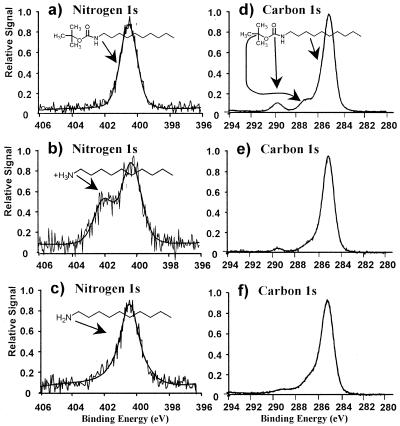
Figure 1
Figure 1
X-ray photoelectron spectra of the t-BOC protected 10-aminodec-1-ene (a). The nitrogen 1s spectrum shows a single peak at 400.5 eV. After treatment in 25% TFA for 1 h (b) two peaks are recorded. The NH3+ and the primary amine have been assigned to the peaks at 401.9 and 400.2 eV, respectively. A surface that has been treated with 25% TFA followed by a 5 min rinse in 10% NH4OH shows only one peak at 400.3 eV (c). This indicates that the NH3+ nitrogens have been completely deprotonated. The carbon 1s spectrum of the t-BOC protected amine shows a strong peak at 285.0 eV assigned to the bulk carbons as well as a peak at 289.7 eV assigned to the carbonyl carbon of the t-BOC group (d). The carbonyl peak is reduced by ~70% after deprotection with TFA (e) and treatment with NH4OH (f). The shoulder at 287.2 eV is attributed to the t-butyl carbon.
Figure 2
Figure 2
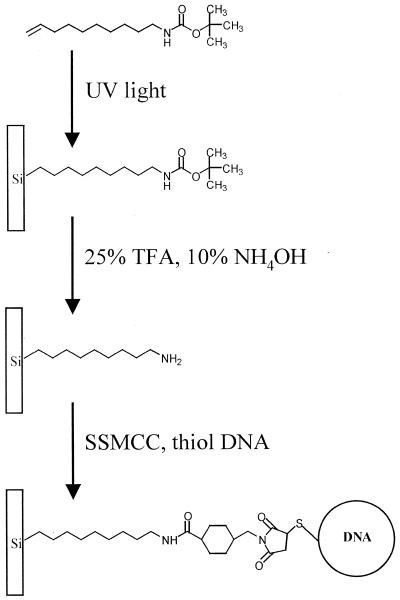
Reaction scheme for immobilization of DNA on amine-modified silicon (001) wafer. A layer of t-BOC protected 10-aminodec-1-ene is bound to the surface by applying a thin layer of the protected amine to the wafer and exposing it to UV light from a low pressure mercury vapor lamp. Deprotection is accomplished by treating the surface with 25% TFA in methylene chloride for 1 h followed by a 5 min rinse in 10% NH4OH. The crosslinker SSMCC is added to the surface which binds to the free amines through an N-hydroxysuccinimidyl ester. Thiol DNA is then bound to the maleimide groups of the SSMCC.
Figure 3
Figure 3
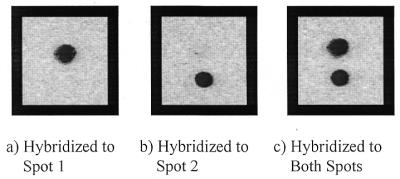
Images of DNA modified silicon (001) obtained using a Molecular Dynamics FluorImager. Two different oligonucleotides are attached to the surface in two spots ~2 mm across. Hybridization with the fluorescent complement of the upper spot shows the expected image (a). Denaturation and hybridization to the lower spot also shows the expected image (b). Denaturation and hybridization with both complements allows both spots to be visualized (c).
Figure 4
Figure 4
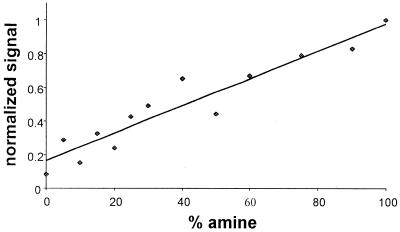
Control of oligonucleotide density using binary mixtures of 10-aminodec-1-ene and dodecene. Mixtures containing different percentages of t-BOC protected 10-aminodec-1-ene and dodecene were attached to the surfaces using UV light. Deprotection and addition of SSMCC and thiol DNA followed by hybridization with the fluorescent complement allowed for quantification of the signal. A linear relationship is observed between the fluorescence signal obtained and the percent of amine attached to the surface (y = 0.0081x + 0.1664).
Figure 5
Figure 5
Control of oligonucleotide density by exposing surfaces to deprotection conditions for differing lengths of time. Surfaces were deprotected, and then modified with SSMCC and thiol DNA. Hybridizing with the fluorescent complement followed by imaging on the FluorImager allowed for quantification of the signal. Exposure to TFA rapidly deprotects the t-BOC modified 10-aminodec-1-ene molecules to yield surface amines.
Figure 6
Figure 6
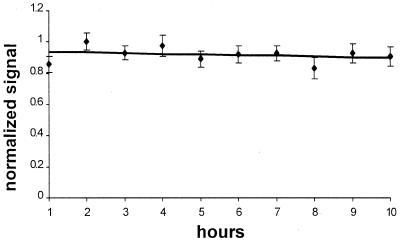
Stability of silicon surfaces covalently modified with fluorescently tagged oligonucleotides. DNA-modified silicon surfaces were prepared using 3′ thiol DNA with fluorescein on the 5′-end. The surfaces were stored overnight in HB then scanned with the FluorImager. Hourly scans recorded the surface fluorescence intensity. The observed fluorescence signal is stable throughout the experiment (y = –0.0041x + 0.9395).
Figure 7
Figure 7
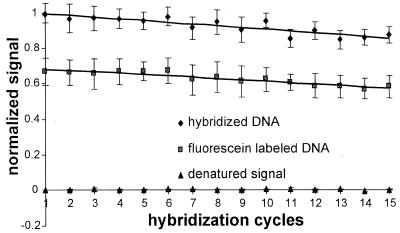
Stability of surfaces during 15 hybridization and denaturation cycles. The measured fluorescence signal from both the hybridized DNA and the fluorescein tagged DNA decreases by ~1% with each hybridization cycle. The surfaces were also imaged after each denaturation step to demonstrate the complete removal of the fluorescent complement. No fluorescence signal from the complement was observed after denaturation (hybridized DNA signal, y = –0.0097x + 1.0059; covalently attached DNA, y = –0.0076x + 0.6897).

References

    1. Rasmussen S.R., Larsen,M.R. and Rasmussen,S.E. (1991) Anal. Biochem., 198, 138–142. - PubMed
    1. Yang M., McGovern,M.E. and Thompson,M. (1997) Anal. Chim. Acta, 346, 259–275.
    1. Yang M., Kong,R.Y.C., Kazmi,M. and Leung,K.C. (1998) Chem. Lett., 3, 257–258.
    1. Service R.F. (1998) Science, 282, 396–399. - PubMed
    1. Kremski J.N., Wooters,J.L., Dougherty,J.P., Meyers,R.E., Collins,M. and Brown,E.L. (1987) Nucleic Acids Res., 15, 2891–2909. - PMC - PubMed