


Exploring performance issues for a clinical database organized using an entity-attribute-value representation
- PMID: 10984467
- PMCID: PMC79043
- DOI: 10.1136/jamia.2000.0070475
Exploring performance issues for a clinical database organized using an entity-attribute-value representation
Abstract
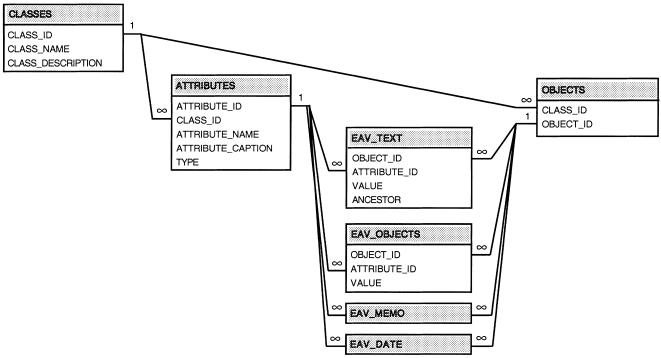
Background: The entity-attribute-value representation with classes and relationships (EAV/CR) provides a flexible and simple database schema to store heterogeneous biomedical data. In certain circumstances, however, the EAV/CR model is known to retrieve data less efficiently than conventionally based database schemas.
Objective: To perform a pilot study that systematically quantifies performance differences for database queries directed at real-world microbiology data modeled with EAV/CR and conventional representations, and to explore the relative merits of different EAV/CR query implementation strategies.
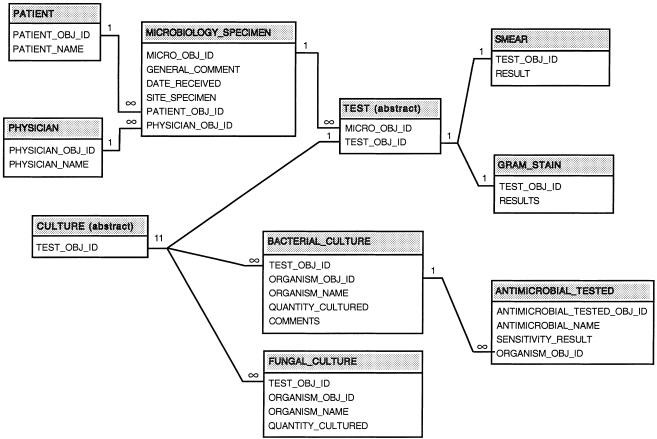
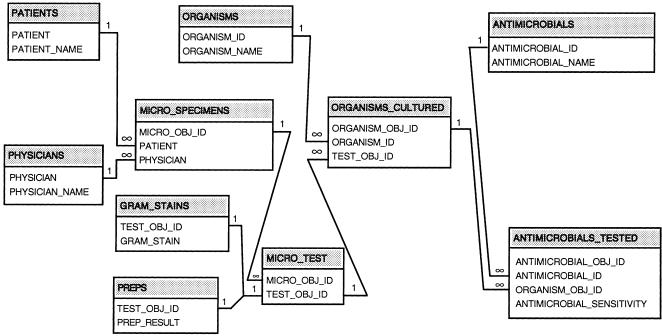
Methods: Clinical microbiology data obtained over a ten-year period were stored using both database models. Query execution times were compared for four clinically oriented attribute-centered and entity-centered queries operating under varying conditions of database size and system memory. The performance characteristics of three different EAV/CR query strategies were also examined.
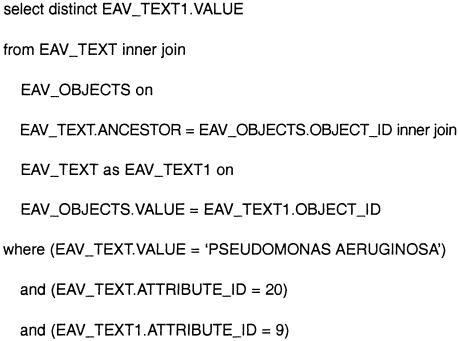
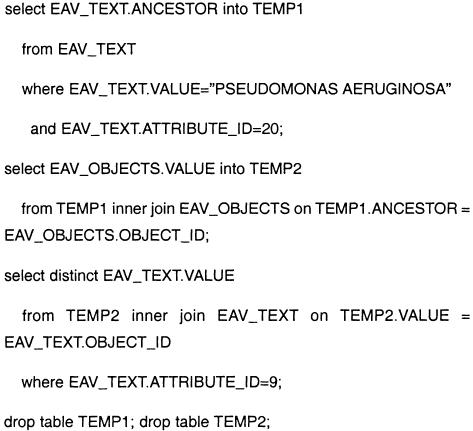
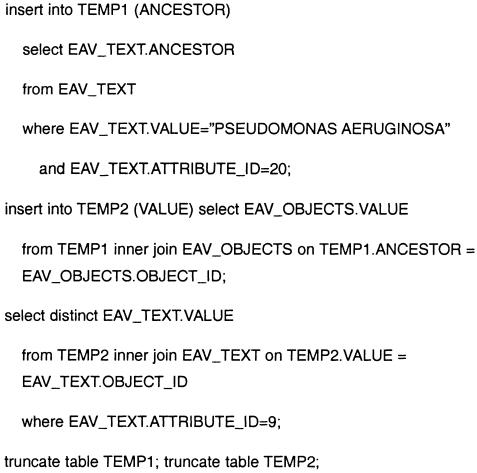
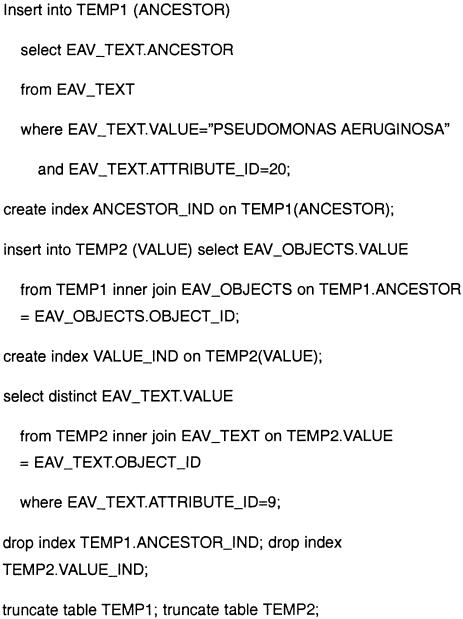
Results: Performance was similar for entity-centered queries in the two database models. Performance in the EAV/CR model was approximately three to five times less efficient than its conventional counterpart for attribute-centered queries. The differences in query efficiency became slightly greater as database size increased, although they were reduced with the addition of system memory. The authors found that EAV/CR queries formulated using multiple, simple SQL statements executed in batch were more efficient than single, large SQL statements.
Conclusion: This paper describes a pilot project to explore issues in and compare query performance for EAV/CR and conventional database representations. Although attribute-centered queries were less efficient in the EAV/CR model, these inefficiencies may be addressable, at least in part, by the use of more powerful hardware or more memory, or both.
Figures
References
-
- Winston PH. Artificial Intelligence. 2nd ed. Reading, Mass: Addison-Wesley, 1984.
-
- Friedman C, Hripcsak G, Johnson S, Cimino J, Clayton P. A generalized relational schema for an integrated clinical patient database. Proc 14th Symp Comput Appl Med Care. 1990: 335-9.
-
- Johnson S, Cimino J, Friedman C, Hripcsak G, Clayton P. Using metadata to integrate medical knowledge in a clinical information system. Proc 14th Symp Comput Appl Med Care. 1990: 340-4.
Publication types
MeSH terms
Grants and funding
LinkOut - more resources
Full Text Sources
Other Literature Sources
